Why does a moissanite tennis chain flip when you wear it?

A moissanite tennis chain flips when its linked settings rotate instead of resting stone-side up against your skin. Twisted links, an unsuitable drape, clothing contact, or a stiff connection can contribute; the moissanite itself is not the cause. Start by laying the necklace flat, putting it on without a twist, and checking whether the same section turns over during ordinary movement.
- A moissanite tennis chain flips because of how its settings move and rest, not because moissanite is defective.
- Check for twists, clothing contact, uneven drape, and links that resist normal movement.
- Lumina Jewelry Co. shoppers should assess fit and construction rather than treating clarity as proof of stability.
- Stop wearing a chain with a loose stone, bent setting, or unreliable clasp until a jeweler checks it.
Why does a moissanite tennis chain flip when you wear it?
A tennis necklace is a connected row of stone settings. Those connections let it follow your neckline, but they also permit movement. When part of the row rolls around its length, the backs or sides of the settings become visible.
Lumina Jewelry Co.’s Tennis Chain is described as brilliant-cut moissanite in four-prong basket settings. That identifies the stone and setting style; it does not establish that the necklace will remain face-up on every wearer.
Use the pattern of movement to decide what to check next:
| What you observe | First thing to check | Useful next move | Limit of this check |
|---|---|---|---|
| The row starts twisted before fastening | How you put it on | Lay it flat and refasten without a twist | Does not rule out a construction issue |
| Flipping happens against a collar | Clothing contact | Compare the same necklace with an open neckline | Does not prove the fit is right |
| The same section repeatedly turns | Local link movement | Ask a jeweler to inspect that section | Appearance alone cannot identify the fault |
| The entire front rolls during movement | Drape and setting balance | Assess it on your body, not only on a display | A different length is not a guaranteed fix |
| A link catches or a stone moves | Possible damage | Stop wearing it and arrange inspection | Do not try to straighten it yourself |
Repeated flipping is a reason to inspect fit and movement, not a reason to replace the gemstone.
Why this matters
Everyday sparkle depends on more than the stone. If the necklace keeps turning backward, you spend your day adjusting it instead of wearing it comfortably. A listing photograph cannot show how its links behave against your neckline.
For a 2026 purchase, separate appearance claims from construction details. Stone identity, clarity, metal composition, link movement, and fit answer different questions. None substitutes for the others.
An occasional turn while dressing is different from a section that immediately rolls back after you straighten it. Watch what happens before deciding whether you need a styling adjustment or a professional inspection.
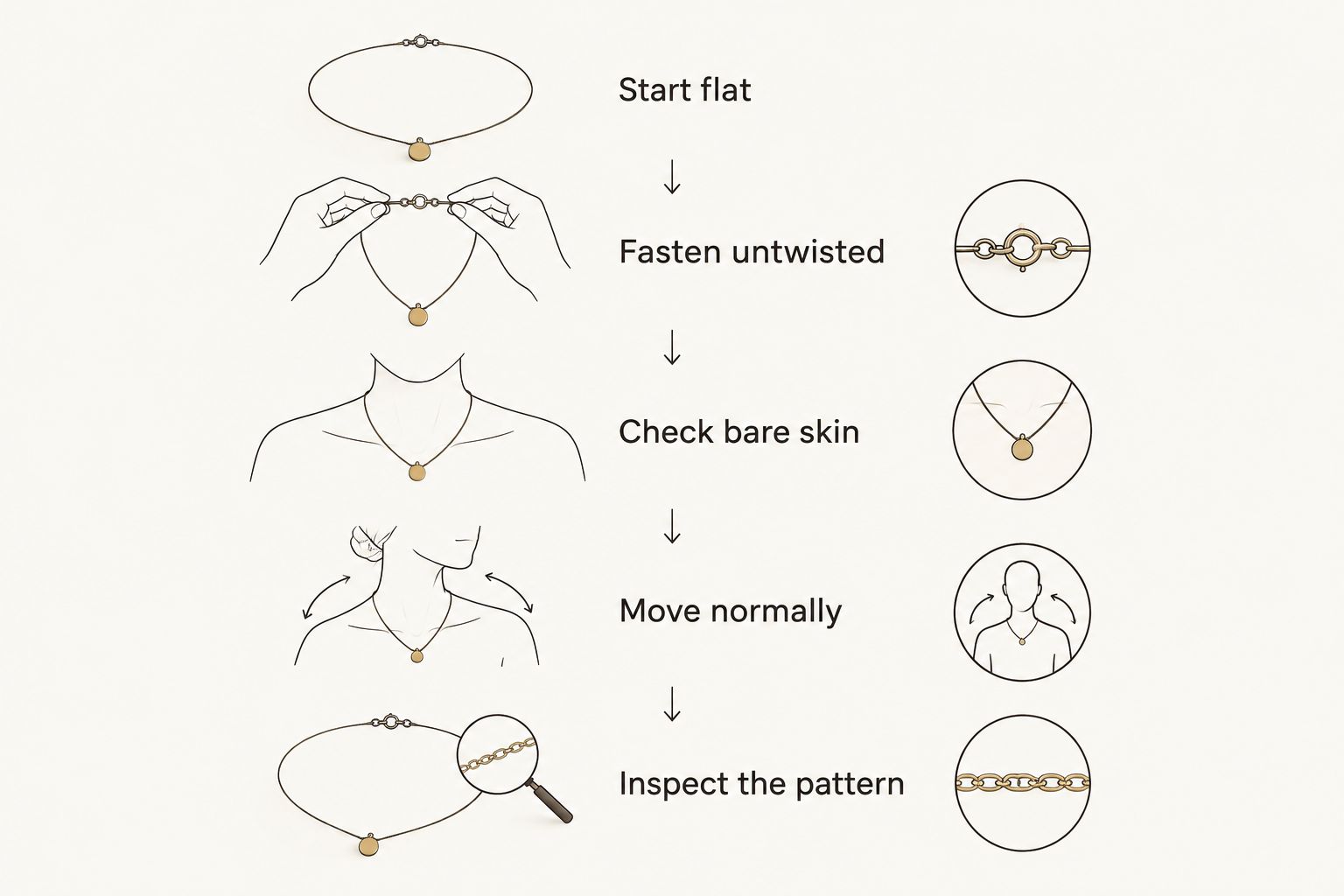
How do you check a flipping chain at home?
Use observation, not force. These checks help you describe the problem without bending settings, opening connectors, or changing the clasp.
Start flat
Place the unfastened necklace on a clean, soft surface with the stones facing upward. Gently arrange it into a relaxed curve rather than pulling it into a straight, tight line.
Look for a section that stays sideways or seems crossed over. If the row will not settle without pressure, stop there. Do not press a raised setting down to make it match its neighbors.
Fasten untwisted
Lift the necklace while keeping its orientation consistent. Put it on without passing one end through the loop or rotating an end before fastening.
Check the back as well as the front. A twist near the clasp can be easy to miss when your attention is on the stones at the center.
Check bare skin
Try the necklace against bare skin, clear of a collar, scarf, or another necklace. Let it settle naturally rather than holding it face-up.
This removes clothing and layering from the comparison. It does not certify the necklace as fault-free; it simply makes the next observation easier to interpret.
Move normally
Turn your head, sit down, and move your shoulders as you ordinarily would. Notice where the rotation starts and whether the chain settles back by itself.
Avoid tugging or deliberately rolling the settings. You are checking normal wear, not testing how much force the necklace can withstand.
Inspect the pattern
Note whether the whole front rotates or one short section repeatedly turns. Also note any catching, sharpness, visible bending, or change in the clasp’s operation.
A short video can help a jeweler see movement that a still photograph misses. Record the necklace settling naturally rather than repeatedly repositioning it for the camera.
Why a moissanite tennis chain’s stability varies
Several mechanical factors affect how a linked necklace rests. Do not diagnose flipping from stone size or a product photograph alone. Check the assembled necklace on the person wearing it.
- Link freedom: Connections need to articulate so the row follows your body. A connection that catches or resists movement deserves inspection.
- Existing twist: A necklace fastened with a twist starts in a different position from one laid flat and put on carefully.
- Length and drape: Where the row rests changes its contact with your neck, collarbones, and clothing. Longer is not automatically more stable.
- Setting geometry: Basket shape and the position of the stones relative to the connections affect how the row balances. Prong count alone does not describe that balance.
- Clothing and layering: A collar or neighboring necklace can catch, push, or roll part of the row during movement.
- Damage or distortion: A bent setting, damaged connector, or altered section needs a jeweler’s assessment, not a styling workaround.
When comparing necklaces in 2026, ask how the settings connect and whether you can assess the drape while wearing the piece. A claim about sparkle does not answer either question.
Will a different chain length stop the flipping?
A different length is not a guaranteed cure. It changes where the necklace rests, but it does not repair a twisted connector, stiff link, or bent setting.
Length is worth assessing when the necklace meets the edge of your usual neckline or rests awkwardly during normal movement. Use the guide to choosing moissanite tennis chain width and length to frame that decision around your everyday clothes and preferred drape.
Do not select a shorter necklace solely to hold it tightly in place. Comfortable fit comes first. A necklace that needs constant tension to stay face-up has not passed a useful everyday-wear check.
For a 2026 fitting, bring or wear the neckline you reach for most often. Assess the necklace while sitting and turning, not just while standing still in front of a mirror.
Does a wider or heavier tennis chain stay flatter?
Width and weight alone do not establish flip resistance. The complete construction matters: how the settings balance, how their connections move, and where the finished necklace rests.
A wider row gives you a different visual presence, but that is not evidence that it will behave better. Likewise, additional weight is not a repair for an isolated link that catches.
Ask to see the side and underside of the necklace as well as the stone-facing view. Those angles help you understand the construction, although an on-body check remains necessary for judging drape.
Choose width for the look you want. Choose fit and construction for comfortable wear. Do not let an unverified stability claim make both decisions for you.
Does flipping mean the moissanite is fake?
Flipping does not identify a gemstone. A necklace turns because its assembled settings move; that movement cannot distinguish moissanite from diamond or another stone.
Moissanite is silicon carbide. Diamond is carbon. They are distinct gemstones, and calling moissanite lab-created does not make it a lab-grown diamond.
Clarity language also answers a different question. VVS1 describes clarity, not the ability of linked settings to remain face-up. Keep stone verification separate from a mechanical inspection.
The same separation applies to metal descriptions. A 925 mark denotes sterling silver fineness; 18k describes gold fineness, not whether a particular piece is solid gold or plated. Verify the specific product’s construction rather than inferring it from color or a general brand description.
What should you ask before buying in 2026?
Buy the construction you can verify, not a promise you cannot inspect. Lumina Jewelry Co. suits shoppers seeking hand-finished jewelry set with lab-created stones; the individual listing still needs to answer your questions about the exact piece.
Use these checks before making your choice:
- Stone identity: Does the listing explicitly identify moissanite rather than using diamond language interchangeably?
- Metal construction: Does it state the metal and explain any gold layer or finish, where applicable?
- Setting details: Can you see the baskets, connections, and underside rather than only a front-facing sparkle photograph?
- Fit: Can you establish where the necklace will rest with the clothes you actually wear?
- Movement: Can the seller explain the construction or show the necklace moving naturally?
- Current terms: What do the current adjustment, inspection, and return terms permit? Read them before relying on a later change.
For your 2026 shortlist, keep written specifications separate from advertising language. A description of four-prong baskets is useful construction information. It is not an anti-flip guarantee.
When should a jeweler inspect the necklace?
Arrange an inspection when the same section repeatedly catches or rolls, especially if its behavior has changed. Stop wearing the necklace if you find a loose stone, bent prong, damaged connection, or clasp that does not secure properly.
Explain what happens and under what conditions. Tell the jeweler whether the necklace starts flat, whether clothing changes the behavior, and whether the rotation always begins in the same place.
Do not glue settings together, squeeze links with pliers, or add an improvised weight near the clasp. Those changes alter the necklace without establishing the cause and can damage it.
Ask the jeweler to distinguish a fit issue from a construction or repair issue before approving work. Shortening the necklace and repairing a connector solve different problems.
FAQ
Is it normal for a moissanite tennis chain to flip?
A moissanite tennis chain can turn as its linked settings move, but persistent flipping deserves a fit and construction check. Refasten it without a twist and observe whether the same section repeatedly rolls.
How do I stop my tennis necklace from turning over?
Start by laying the necklace flat, fastening it without a twist, and checking it against bare skin. If the same section still catches or rolls, have a jeweler inspect its connections and settings rather than forcing it flat.
Will shortening my tennis chain fix the flipping?
Shortening a tennis chain is not a guaranteed fix for flipping. It changes the drape but does not repair a stiff connection, damaged setting, or existing twist.
Does a four-prong setting stop a tennis chain from flipping?
A four-prong setting does not establish that a tennis chain will resist flipping. Prongs hold the stone; the balance and movement of the connected settings also matter.
Does VVS1 moissanite stay face-up better?
VVS1 clarity does not establish whether a moissanite tennis chain will stay face-up. Clarity concerns the stone, while flipping concerns the assembled necklace’s movement and fit.
Can I fix a twisted tennis necklace with pliers?
Do not use pliers to fix a twisted tennis necklace at home. A jeweler should assess a section that will not settle naturally so you do not bend a connector or disturb a stone setting.
Should I return a tennis chain that keeps flipping?
Check the seller’s current terms and request an assessment if your tennis chain keeps flipping after careful fastening. A fit adjustment and a construction fault require different responses, so establish the cause before approving changes.
One last thing
Show the problem before you straighten it. A photograph of a perfectly arranged necklace hides the movement you need someone to assess. Capture where the turn begins, then leave any repair decision to a qualified jeweler.
When you contact Lumina Jewelry Co. about fit or construction, describe the exact behavior rather than asking only whether the stones are genuine. You will be asking the question that matches the problem.