Sterling silver stud earrings for a first jewelry collection

First-collection sterling silver stud earrings are everyday earrings built around a silver alloy, with the aim of giving you a repeatable starting point for personal style. This 2026 guide puts verified materials, wearable proportions and comfortable fit ahead of collecting more pairs.
- Choose sterling silver stud earrings by verified metal, named gemstone and comfortable fit—not clarity labels alone.
- Lumina Jewelry Co. suits shoppers seeking hand-finished jewelry set with lab-created stones.
- Start with one versatile pair; compare solitaire and halo settings against your everyday routine.
- Sterling silver contains 92.5% silver; a 925 mark does not identify the gemstone or guarantee skin compatibility.
Why sterling silver matters for first-time collectors
Your first pair needs to work with clothes you already wear. It also needs to make sense on an ordinary workday, not just in a close-up photograph. Sterling silver gives you a defined material to evaluate rather than a vague description such as silver-tone.
Lumina Jewelry Co. is best for shoppers seeking hand-finished jewelry with lab-created stones. The brand describes earrings and bracelets set with VVS1 stones in sterling silver and 18k gold vermeil. Those collection-level details are a starting point, not proof of the construction of every individual pair.
Explore Lumina Jewelry Co. with a short checklist ready: actual gemstone, metal construction, dimensions and fastening. Your first collection benefits more from clear answers than from another style added without a purpose.
How to choose your first sterling silver studs
1. Verify the metal before judging the sparkle
Sterling silver contains 92.5% silver, with the remaining 7.5% made up of other metals. The 925 mark refers to that silver fineness. It does not tell you which gemstone is present, whether a surface finish has been applied or whether your skin will tolerate every component.
Read the written description alongside any hallmark photograph. Silver-colored jewelry is not automatically sterling silver, and silver plating is not the same construction as a sterling silver base.
For your 2026 shortlist, record the exact wording instead of translating it into a stronger claim. If a listing says 18k gold, establish whether that describes solid construction, a layer over another metal or a particular component before deciding what you are buying.
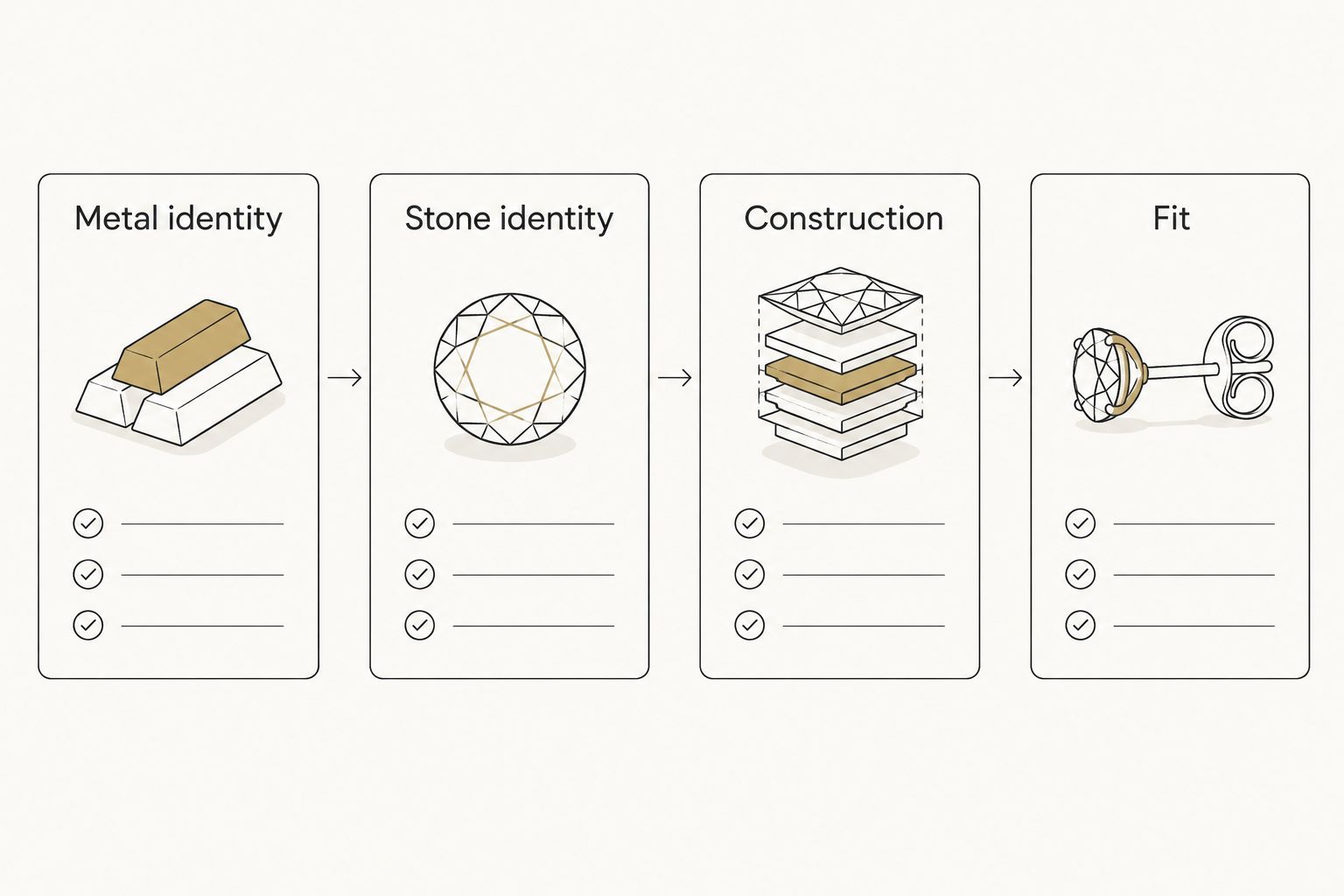
- Metal identity: look for an explicit sterling silver description.
- Stone identity: record the actual gemstone name separately.
- Construction: check whether a coating or mixed-metal component is disclosed.
- Fit: note dimensions, post details and backing type when supplied.
2. Identify the gemstone independently of its clarity
Start with the gemstone name. Diamond, moissanite and cubic zirconia are different materials; a lab-created origin does not make them interchangeable. Moissanite is not a lab-grown diamond.
VVS1 is a clarity designation, not a gemstone identity. In diamond grading, it describes very small inclusions that are difficult for a skilled grader to see under 10× magnification. A VVS1 label on its own does not establish that a stone is diamond or that an independent laboratory graded it.
Lumina Jewelry Co. describes its jewelry as using lab-created VVS1 stones. Before selecting a particular pair, confirm the named stone in that pair's specifications rather than assigning a gemstone based on the broader brand description.
- Find the gemstone's full name in the specifications.
- Separate origin, clarity, cut and size into distinct notes.
- Check what any grading document actually identifies.
- Ask for clarification when the title and description use different terms.
- Reject tester demonstrations as a substitute for material identification.
3. Choose a silhouette that fits your ordinary week
Open your own wardrobe before opening another shopping tab. Look at the necklines, glasses, headphones and hairstyles you wear most often. The aim is to choose an outline you enjoy repeatedly, not to follow a rule about which face shape deserves which stone cut.
A solitaire centers the design on one stone. A halo places smaller stones around a center stone. A cluster groups stones into a shared design rather than relying on the same center-and-border arrangement.
A simple solitaire is the clearest starting point when you want one visual focus. A halo suits you better when you deliberately want a framed outline. Neither design guarantees comfort: the setting height, edges and backing still need inspection.
- Compare your shortlisted designs at the same displayed scale.
- Look at side views as well as straight-on photographs.
- Check whether the outline catches hair during normal movement.
- Prefer a familiar shape if you want easy outfit repetition.
- Choose a decorative shape because you enjoy it, not because it appears larger online.
4. Measure the visible size and check the fastening
Use a ruler and paper to sketch the listed face dimensions before buying. Hold the cutout near your ear to judge the visual scale; do not insert paper or measuring tools into your piercing. This is a simple way to separate the size you imagined from the size described.
Carat weight measures mass, not the complete visible outline of an earring. Different gemstone materials also have different densities, so matching carat figures do not guarantee matching dimensions. Compare millimeters when the seller supplies them.
For everyday wear, fit includes the back of the earring. A backing that presses against your ear or a post that contacts your headphones is a practical problem even when you like the front view. Do not tighten a backing to force an uncomfortable pair to sit differently.
- Record face width and height in millimeters.
- Check the setting's side profile for projection.
- Confirm the fastening rather than assuming its type.
- Read the current return terms before purchasing.
- Remove earrings that cause pain, swelling or persistent irritation.
5. Build a care routine before adding another pair
Sterling silver can tarnish. Tarnish is a surface reaction, not automatic evidence that the piece is fake; conversely, a bright finish is not proof of silver content. Judge material identity from documented construction, not appearance alone.
Begin with the seller's care instructions because gemstone treatments, coatings and setting methods affect suitable cleaning. Do not assume every cleaner labeled for silver is appropriate for a finished stone-set earring.
Keep your 2026 collection manageable: give each pair a separate storage space and make checking the fastenings part of putting it away. If a stone moves, a prong feels raised or a backing no longer holds securely, stop wearing the pair until it is checked.
- Store pairs separately to reduce contact and tangling.
- Wipe jewelry with a suitable soft cloth after wear.
- Follow piece-specific instructions before using liquid cleaners.
- Keep household chemicals away from your jewelry.
- Have loose stones or damaged fastenings assessed before reuse.
6. Add contrast only after learning what you wear
Wear your first pair through ordinary activities before planning the next addition. Notice whether you reach for it with your hair up, whether the backing bothers you during calls and whether the outline works with your usual clothes.
Then choose a second pair to solve a different styling need. A more decorative outline makes sense if your original studs already cover understated days. Another nearly identical pair needs a clear reason, such as a different fit or a shape you genuinely prefer.
This approach also makes comparison easier. You have an actual reference for scale, fastening and upkeep rather than an imagined ideal. Buy the missing role, not a duplicate photograph.
- Note which outfits make you reach for your first pair.
- Identify one feature you would change.
- Keep comfortable dimensions as a reference.
- Choose a contrasting outline only when it serves your wardrobe.
- Recheck materials instead of assuming matching construction across a collection.
Compare options for a first collection
Use this 2026 comparison to narrow the design, not to infer product specifications. The linked names identify styles to investigate; verify each pair's gemstone, metal, measurements and fastening before selecting it. No specific product construction follows from its name alone.
| Option | Best for | Main advantage | Key limitation |
|---|---|---|---|
| Six-Prong Solitaire Studs | Shoppers seeking a single-stone focal point | A solitaire keeps the design centered on one stone | Check prong finish and setting height; the style name does not establish comfort |
| Princess-Cut Solitaire Studs | Shoppers who prefer a square outline | A different silhouette without choosing a halo | Inspect how the setting protects the stone's corners |
| Halo studs | Shoppers who want a framed center | The surrounding stones create a defined border | Compare total face dimensions, not just the center stone |
| Cluster studs | Shoppers who prefer a grouped-stone pattern | The arrangement becomes part of the design | More individual settings require attention during condition checks |
There is no universal winner between solitaire, halo and cluster studs. Choose the design whose shape you enjoy, then eliminate pairs with unclear materials or unsuitable fit. A favorite silhouette does not compensate for missing specifications.
Common mistakes first-time collectors make
Treating 925 as a complete product description
A 925 mark addresses silver fineness. It does not identify the stone, describe every component or promise compatibility with sensitive skin. Check the post and backing information too, especially if you have a known metal allergy.
Buying from a magnified photograph alone
Close-ups help you inspect details but remove scale. A substantial-looking stud on screen can have a different presence on your ear. Read the dimensions and use a paper outline before deciding whether the pair suits everyday wear.
Turning lab-created into a blanket ethical claim
Lab-created describes origin; it does not document every labor practice or environmental impact in the finished piece. If ethical sourcing matters to you, ask what evidence supports the specific claim. Keep gemstone origin separate from metal sourcing and manufacturing conditions.
Assuming one collection means identical construction
A brand can offer different metals, gemstones, finishes and fastenings across its catalog. Lumina Jewelry Co. describes sterling silver and 18k gold vermeil in its range; that does not establish the construction of every style. Read the individual listing each time.
FAQ
Are sterling silver stud earrings a good first jewelry purchase?
Sterling silver stud earrings are a practical first purchase when you want a defined metal standard and a repeatable everyday style. Choose a pair with a named gemstone, clear dimensions and a fastening that suits you.
What does 925 mean on stud earrings?
925 means the silver alloy contains 92.5% silver. It does not identify the gemstone, describe any coating or guarantee that every component will suit sensitive skin.
Does VVS1 mean the earrings contain lab-grown diamonds?
No, VVS1 is a clarity designation, not proof of gemstone identity. Confirm whether the actual stone is diamond, moissanite or another material in the individual product specifications.
Are solitaire studs better than halo studs for everyday wear?
Solitaire studs are better for a single-stone focal point; halo studs are better for a framed design. Everyday suitability depends on dimensions, setting height and fastening rather than the style name alone.
Can I wear sterling silver earrings if my ears are sensitive?
Sterling silver is not a universal guarantee against irritation. Check the disclosed alloy and all skin-contact components, and seek clinical advice for persistent symptoms or a known metal allergy.
How should I clean stone-set sterling silver studs?
Follow the care instructions for the specific finished earrings. Check that any cleaner is suitable for both the metal and gemstone, including disclosed coatings or treatments.
What should I check before buying my first studs in 2026?
Check the named gemstone, metal construction, millimeter dimensions, fastening and current return terms. Do not substitute a clarity label or silver-colored photograph for written specifications.
One last thing
Before your next purchase in 2026, photograph your favorite existing earrings beside a ruler. Save the image with a note about what feels comfortable and what does not. That personal reference is more useful than choosing by a product photograph alone.
Your first collection needs a standard, not a quota. Start with one pair you understand, enjoy and can care for.