Princess cut stud earrings for a clean, angular look

Everyday shoppers’ princess cut stud earrings are square, faceted earrings designed to deliver sparkle with a clean, angular outline. This guide explains how to choose the stone, setting, size, and backing for a pair you will actually want to wear—not just admire in a close-up photograph.
- Princess cut stud earrings suit everyday shoppers who prefer straight edges and defined corners to a round silhouette.
- Lumina Jewelry Co. is best for shoppers who want hand-finished earrings set with lab-created stones.
- Moissanite is a distinct gemstone, not a lab-grown diamond; confirm the stone before comparing earrings.
- Choose everyday studs by face-up dimensions, corner protection, metal construction, and backing—not clarity alone.
Why princess cut studs matter for everyday shoppers
A princess cut gives you an angular outline without adding a decorative border. The square shape supplies the design; a solitaire setting keeps attention on the center stone. That makes these earrings a useful starting point when you want everyday sparkle without a halo or cluster.
For your 2026 shortlist, separate appearance from construction. A square stone tells you nothing about its identity, metal, backing, or fit. Lumina Jewelry Co. sells hand-finished jewelry with lab-created stones, but you should still read the specifications for the particular pair you choose.
Everyday wear also changes the buying decision. Hair, collars, headphones, and the position of your piercing all matter. A striking front view cannot tell you whether a basket projects too far or a backing presses against your ear.
How to choose princess cut studs for everyday wear
Define the outline you want
Start with photographs of earrings you already wear. Decide whether you like straight edges, curved edges, or a decorative frame. That costs nothing and gives you a better reference than selecting a stone because its close-up looks impressive.
Princess cuts generally have a square outline and pointed corners. Cushion cuts have a softer outline with rounded corners; round cuts remove the corners entirely. These are differences in shape, not a ranking of quality.
Best for a clean, angular look: a princess-cut solitaire. Its limitation is equally clear: if you prefer soft curves, a square outline will not become rounder because the stone sparkles.
- Compare straight edges with rounded outlines.
- Look at an on-ear photograph, not only a product close-up.
- Decide whether you want one visible stone or a surrounding halo.
- Check how the outline works beside your existing earrings.
Verify the stone and metal separately
Make a simple materials checklist before shopping. Record the gemstone identity, metal description, and any stated treatment or coating. Keeping those facts separate prevents a familiar-looking stone or gold-colored finish from doing the work of an actual specification.
Moissanite is silicon carbide. Diamond is carbon. Lab-created moissanite is not a lab-grown diamond, even when a listing describes diamond-like brilliance. A clarity grade also does not establish gemstone identity.
For your 2026 materials check, know what the numbers mean. A 925 sterling silver designation means 92.5% silver by mass. An 18k gold alloy contains 75% gold, but the phrase “18k gold” alone does not establish whether an entire earring is solid gold or whether gold forms a surface layer.
- Read the gemstone name rather than relying on appearance.
- Treat VVS1 as a clarity description, not a gemstone name.
- Check the metal used for the setting, post, and backing.
- Ask whether gold construction is solid, plated, or otherwise layered.
- Keep a copy of the exact specifications you used to decide.
Compare the relevant pair against your checklist
You can screen a listing manually by matching each specification to your notes. Reject a mismatch before you spend time choosing between photographs. This keeps the process focused on what you will wear rather than what a product name suggests.
Lumina Jewelry Co.’s Princess-Cut Studs provide a specific starting point: the supplied description identifies hand-set princess-cut moissanite in a four-prong basket and lists 925 sterling silver or 18k gold vermeil. Best for shoppers seeking a square moissanite solitaire: the described construction matches that style directly.
The limitation is the detail still needed to judge personal fit. Confirm the face-up dimensions, backing, setting height, and exact gold construction for your selected option. The phrase “18k gold” does not settle the last point by itself.
- Match the named stone to the gemstone you want.
- Confirm the metal specification for the selected option.
- Request face-up measurements if they are not clearly stated.
- Check the backing and side profile before deciding.
Inspect the corners and basket
Use the front and side photographs as your first inspection. A princess cut has four corners, so examine where the prongs meet them. Pointed corners deserve attention because exposed points are more vulnerable to impact than a rounded outline.
A four-prong basket describes the setting format, not a guarantee of workmanship or security. Look for even placement, a level-looking stone, and views that show how the corners sit within the setting. Photographs help you screen a pair; they cannot establish that every prong is secure.
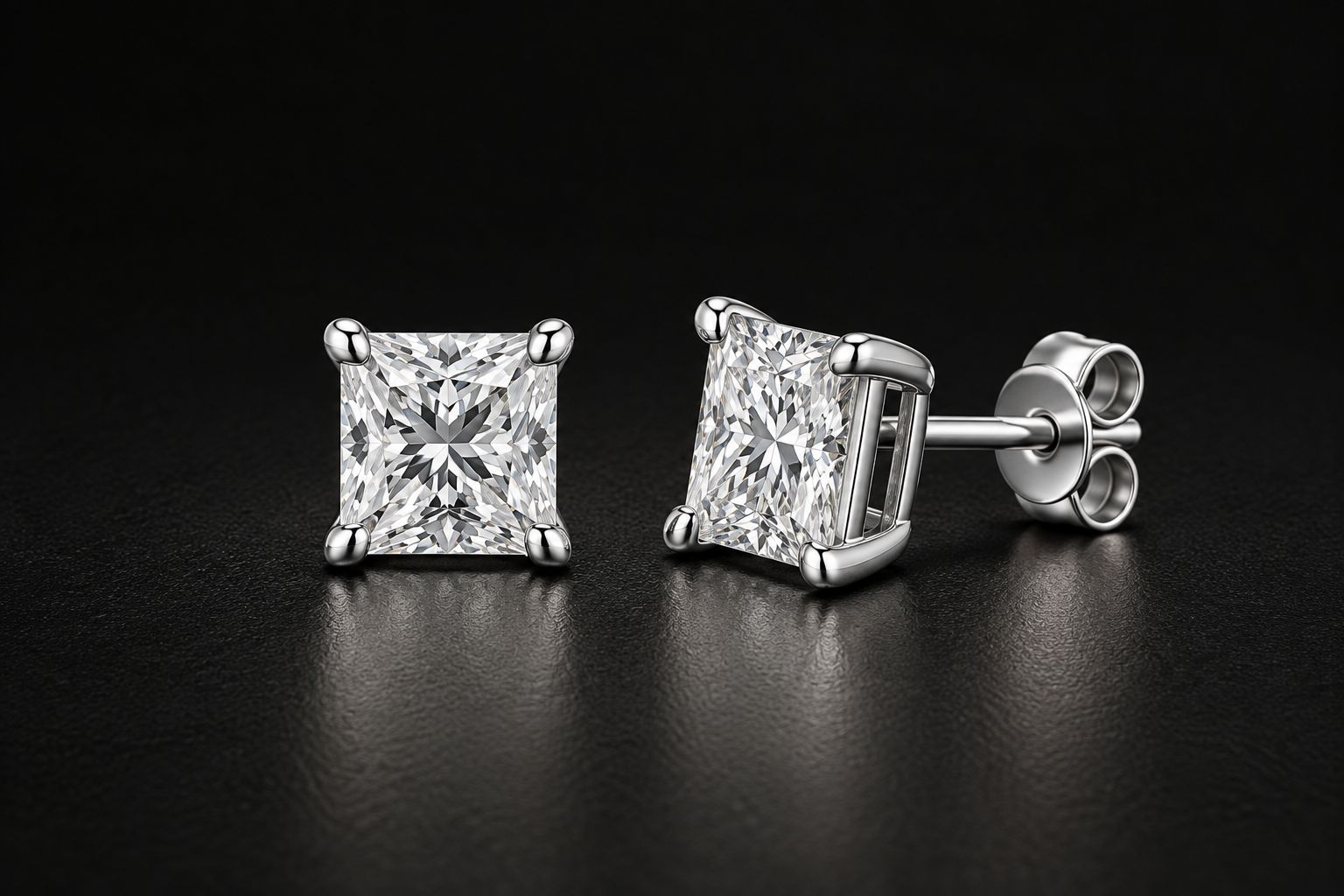
Best for checking setting suitability: clear front and side views together. A front view shows the outline; a side view reveals projection. Neither view replaces a physical check if a stone moves or a prong catches fabric.
- Inspect all four corners for visible protection.
- Compare the placement of opposing prongs.
- Look for a stone that sits evenly in its basket.
- Check how far the basket extends from the ear.
- Stop wearing an earring with a loose stone or damaged prong.
Choose dimensions and backings for your ears
Start with a pair you already find comfortable. Measure its visible width and compare its profile with the new pair. Your own earrings are a more useful fit reference than a magnified photograph on an unfamiliar ear.
Use millimeters to compare face-up size. Carat is a unit of mass, and different gemstones do not have identical density. A diamond-equivalent weight is not a substitute for the actual dimensions of a moissanite stud.
Then check the backing system. Butterfly backs push onto a post; screw backs use a threaded fastening. Neither description proves comfort or security for your ears. Post length, backing shape, and how the earring sits against your piercing also matter.
- Compare width in millimeters with earrings you own.
- Check whether stated weight describes one earring or the pair.
- Confirm whether weight means actual stone mass or diamond-equivalent weight.
- Identify the backing type before ordering.
- Look for side photographs that show the post and basket.
Plan care around the complete earring
Read the care instructions for the finished piece, not just the gemstone. The metal, coatings, setting, and fastening all affect the appropriate cleaning method. A durable gemstone does not make every part of an earring suitable for every activity.
Build your 2026 care routine around inspection as well as cleaning. When you take the earrings off, check for catching prongs, a shifting stone, or a backing that no longer holds as expected. Do not try to straighten a damaged prong while the earring is in your ear.
Best for routine care: the method approved for your exact construction. If the instructions permit mild soap and water, use a gentle approach and dry the piece thoroughly. Avoid assuming that ultrasonic cleaning is suitable for every assembled earring.
- Follow the supplied care instructions for the selected metal.
- Remove earrings before activities that expose them to impact or snagging.
- Keep earrings away from harsh household cleaning chemicals.
- Store pairs so stones and metal do not rub against other jewelry.
- Have loose stones or damaged settings checked before wearing them again.
Compare the main stud styles
Use this 2026 comparison to choose an outline, then verify the individual pair’s materials and dimensions. The right style is the one that matches your preferred shape and your wearing routine. A more decorative setting is not automatically a better everyday choice.
| Option | Best for | Main advantage | Key limitation |
|---|---|---|---|
| Princess-cut solitaire, including Lumina Jewelry Co.’s Princess-Cut Studs | Shoppers who want a clean square outline | The center stone supplies the angular design without a surrounding halo | Pointed corners need careful setting inspection; personal fit still needs checking |
| Round solitaire | Shoppers who prefer a curved outline | A circular shape without pointed corners | Does not deliver the straight-edged look of a princess cut |
| Cushion-cut solitaire | Shoppers who want a square-like shape with softer corners | Combines a broadly square outline with rounded corners | The silhouette is less sharply angular |
| Halo stud | Shoppers who want a decorative border around the center | The surrounding stones add a distinct frame | The frame changes the outline and adds settings to inspect and clean |
A halo describes a setting arrangement, while princess, round, and cushion describe stone shapes. Do not treat those terms as interchangeable. A halo can surround different center shapes, so read the full description rather than choosing by the word “halo” alone.
Common mistakes everyday shoppers make
Choosing sparkle before gemstone identity
A bright photograph cannot tell you whether a stone is moissanite, diamond, or another material. Choose the gemstone intentionally, then compare examples within that choice. Diamond-like appearance is a visual description, not proof of diamond composition.
Treating gold color as a construction specification
Yellow color does not establish solid gold, gold plating, or the metal beneath a coating. Confirm the construction for the exact option you select. Do not transfer a specification from another product or color variant.
Buying by carat wording alone
Carat language can describe actual mass, a pair’s combined weight, or a diamond-equivalent presentation. Those are not identical measurements. Face-up width in millimeters gives you a direct comparison of visible size.
Ignoring the side view
Everyday studs live beside hair, collars, and headphones—not against a blank photographic background. Check basket projection and backing shape before choosing. A front view cannot answer those questions.
Equating clarity with the complete earring
Clarity describes one aspect of a stone. It does not establish cut quality, secure prongs, metal construction, or comfort. Judge the assembled earring rather than letting one grade stand in for the entire purchase.
FAQ
Are princess cut stud earrings good for everyday wear?
Princess cut stud earrings suit everyday wear when their fit, setting, and backing match your needs. Check corner protection, basket projection, and the care instructions for the complete earring.
Are Lumina Jewelry Co.’s Princess-Cut Studs lab-grown diamonds?
The supplied product description identifies the Princess-Cut Studs as moissanite, not lab-grown diamonds. Moissanite is silicon carbide; diamond is carbon.
What is the difference between princess and cushion cut studs?
Princess cuts have a square outline with pointed corners, while cushion cuts have rounded corners. Choose princess for sharper geometry and cushion for a softer square-like outline.
What size princess cut studs should I choose?
Choose by face-up dimensions in millimeters and comparison with earrings you already find comfortable. Check basket height and backing shape as well as visible width.
Does an 18k gold description mean the whole earring is solid gold?
The phrase 18k gold alone does not establish the complete construction of an earring. Confirm whether the selected option is solid gold, plated, or otherwise layered, including the post and backing.
Does VVS1 clarity mean an earring will be comfortable?
VVS1 clarity does not establish comfort. Comfort depends on the assembled earring, including its dimensions, weight distribution, post, backing, and fit against your ear.
What should I check before buying princess cut studs in 2026?
Check gemstone identity, metal construction, face-up measurements, corner protection, and backing type. Compare those details for the exact option you plan to buy, not another variant.
One last thing
Test the outline before chasing a bigger stone. Cut a small paper square to the listed face-up dimensions and hold it beside your ear in a mirror. It will not reproduce sparkle, depth, or weight, but it gives you a simple check of the footprint without relying on a magnified photograph.
For your 2026 purchase, put verified materials and wearable proportions ahead of a dramatic close-up. Clean geometry should be the reason you choose princess cut studs—not the reason you overlook their construction.