How to stack a hinged bangle bracelet with a tennis bracelet

Stack a hinged bangle bracelet with a tennis bracelet by fitting each piece separately, then wearing them together with enough room for comfortable wrist movement—not enough room to repeatedly cross over each other. Start with the bangle closer to your forearm and the tennis bracelet nearer your hand, then reverse the order if your wrist shape makes that arrangement uncomfortable. Keep the pairing only if neither bracelet catches, pinches, or pushes against the other’s closure.
- A hinged bangle bracelet and tennis bracelet work together when fit keeps their movement controlled.
- Lumina Jewelry Co.’s Classic Hinged Bangle suits shoppers seeking a smooth, oval contrast to a moissanite tennis bracelet.
- Check closures, setting contact, and wrist movement before committing to the stack.
- Verify each bracelet’s metal construction separately; matching color does not establish matching materials.
Why this matters
Everyday sparkle needs to work while you type, dress, and reach for things. A stack that looks balanced with your arm still can feel very different once the bracelets start moving.
Treat fit as the first buying decision in 2026, not the finishing touch. Start with how a hinged bangle bracelet should fit your wrist, then assess the combined movement of both pieces. A pleasing arrangement does not compensate for a closure under pressure or a setting that catches.
How do you stack a hinged bangle bracelet with a tennis bracelet?
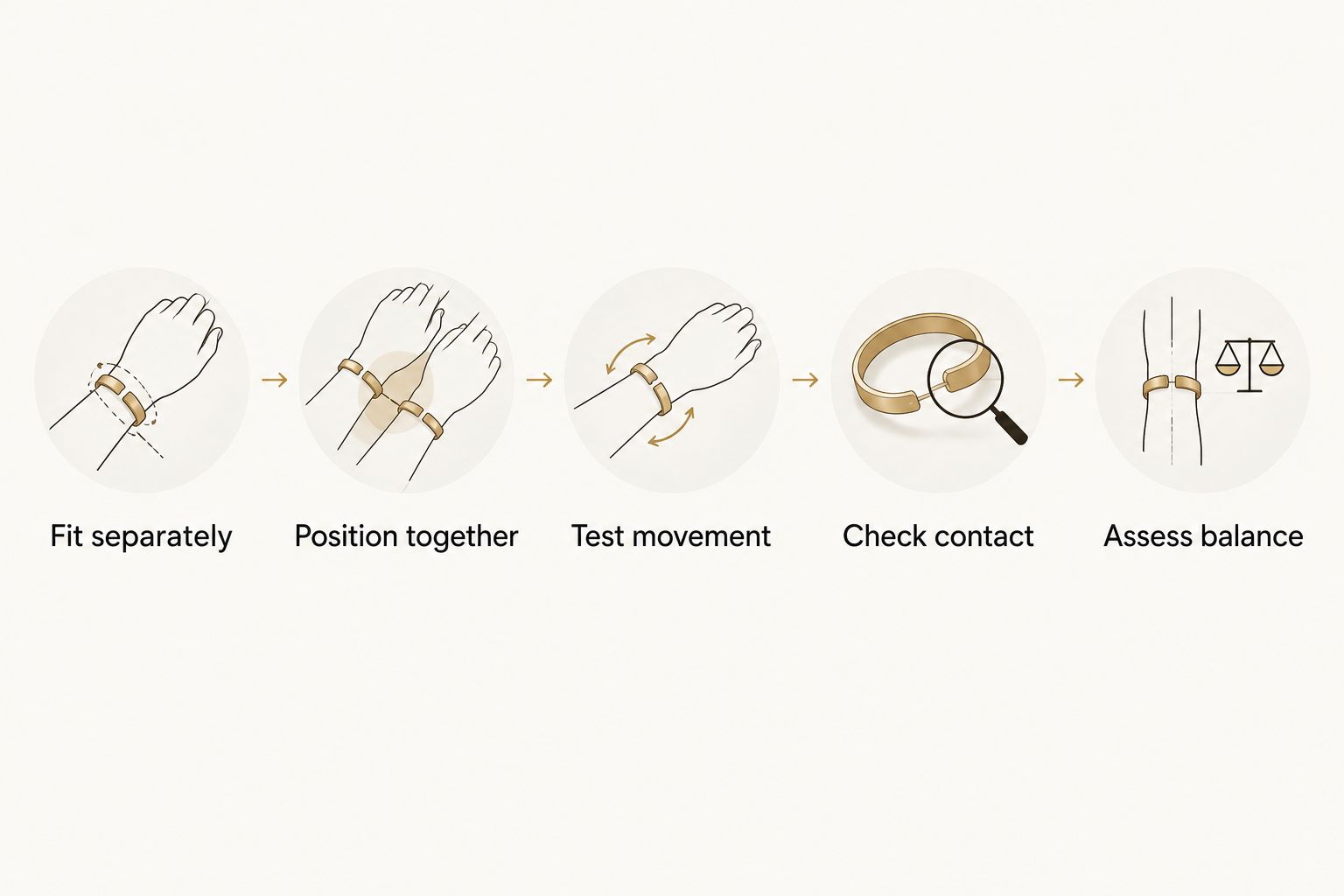
Build the stack in this order: fit, position, movement, contact, then appearance. Do not solve a fit problem by adding another bracelet to hold everything in place.
- Fit separately. Close the bangle and tennis bracelet individually. Check for pinching, unwanted sliding, and closures that press into your skin.
- Position together. Put the bangle toward your forearm and the tennis bracelet toward your hand as a starting arrangement. Keep both closures accessible.
- Test movement. Turn your palm up and down, bend your wrist, and rest your forearm on a desk. Notice whether the bracelets collide or cross.
- Check contact. Look for a prong, clasp, or hinge rubbing against the neighboring bracelet. Separate the pieces if anything catches.
- Assess balance. View the stack with your usual sleeve. Keep the arrangement that feels comfortable and lets you see both designs.
Repeat the movement check with the clothes you actually wear. A fitted cuff can push the bracelets together, while a bare wrist leaves them free to travel. Neither result is automatically wrong; persistent pressure or catching is the reason to change the arrangement.
Which bracelet designs make sense together?
A smooth bangle and a stone-set tennis bracelet create a clear contrast: one continuous surface beside a line of separate stones. That gives each piece a distinct role without requiring another layer.
Lumina Jewelry Co. offers the following pairing. The descriptions establish the design details below; they do not establish identical metals, dimensions, or closure mechanisms.
| Bracelet | Best for | Verified design detail | Trade-off to assess |
|---|---|---|---|
| Classic Hinged Bangle | A smooth visual anchor | Polished surface and clean oval shape | Its fixed shape must suit your wrist; inspect its fit beside the tennis bracelet |
| Tennis Bracelet | A continuous line of everyday sparkle | Moissanite stones individually set in four-prong settings | Check the stone settings and closure for contact with the bangle |
Lumina Jewelry Co.’s Classic Hinged Bangle is best for shoppers who want a smooth, oval contrast to a moissanite tennis bracelet. Its appeal is the simple surface, not a promise that it will fit every wrist or pair without contact.
The Tennis Bracelet supplies the stone-set detail. Its description specifies four prongs per stone, but prong count alone does not establish comfort, condition, or compatibility with another bracelet. Inspect the actual setting surfaces before wearing the pair together.


Why the right bracelet stack varies
There is no universal arrangement that fits every wrist. Use these factors to decide whether your pairing works:
- Wrist shape: An oval bangle holds its shape instead of following every change in your wrist’s contour.
- Relative fit: A loose bracelet can travel across its neighbor even when each piece feels acceptable alone.
- Setting profile: Raised prongs and exposed setting edges deserve a close contact check.
- Closure position: A comfortable bracelet body does not cancel out a clasp or hinge pressing against your skin.
- Clothing and activity: Sleeves, desk work, and repeated wrist bending change where the bracelets sit.
Choose the arrangement that passes these checks rather than copying a photograph. Your wrist needs room to move; the bracelets do not need unrestricted movement to look relaxed.
Choose a visual balance you can wear every day
Let either the polished surface or the stones lead. If you want the tennis bracelet to be the focus, keep the bangle visually quiet. If you prefer the bangle’s outline, let the tennis bracelet act as the finer detail beside it.
This is a styling choice, not a quality ranking. A wider-looking stack is not automatically better, and a more restrained stack is not less complete. For your 2026 everyday wardrobe, judge the pairing beside the sleeves and jewelry you already use.
Look at your wrist from normal viewing distance before examining it close up. Ask whether you can distinguish both bracelets and whether the stack feels intentional without constant repositioning. If you keep adjusting it, fix the fit before adding another piece.
Verify materials before matching metal colors
Matching color is a styling decision. Matching construction requires product specifications. Do not assume the bangle and tennis bracelet share a base metal, finish, or care routine because they appear together in a collection.
For your 2026 buying checklist, keep these material distinctions clear:
- 925 sterling silver: The designation means 92.5% silver by mass. It identifies an alloy, not a scratch-proof surface.
- 18k gold: The designation means 75% gold by mass in the gold alloy. It does not, by itself, tell you whether an entire bracelet is solid gold or has a gold layer.
- Moissanite: This is a distinct gemstone, not a lab-grown diamond. Clarity language does not change its identity.
Apply those definitions only where a specific product’s description supports them. Do not carry a metal specification from an earring listing to a bracelet, or from a general brand description to every item.
Lumina Jewelry Co.’s Tennis Bracelet description identifies moissanite and a four-prong setting. The Classic Hinged Bangle description identifies a polished oval design. Those facts support a design comparison; they do not establish that the pair has identical metal construction.
Reduce rubbing without promising a scratch-free stack
Bracelets worn together can touch. Repeated rubbing can mark jewelry surfaces, so a comfortable fit is not a guarantee against wear. Keep that trade-off visible when deciding whether to stack daily or wear each piece separately.
For stacking gemstone bracelets safely, judge the whole assembly—not just the stones—including metal edges, closures, and how neighboring pieces move. A stone’s hardness does not establish the durability of its setting or finish.
Before leaving home, turn each bracelet gently and watch where contact occurs. If a prong catches an edge, a clasp becomes trapped, or the bangle repeatedly rides over the tennis bracelet, stop and separate them. Do not bend a setting or adjust a hinge yourself to make the pairing work.
Make condition checks part of your 2026 routine. Look for a newly rough edge, a closure that behaves differently, or a stone that appears loose. Remove the affected bracelet and arrange an assessment rather than continuing to stack over the problem.
What if the bracelets keep crossing over each other?
Repeated crossing means the current pairing needs a fit or positioning change. Reverse the order and repeat the movement test. If the same problem remains, wear the bracelets separately rather than using tighter clothing or another bracelet to restrain them.
Check which piece travels farther along your arm. That observation helps you identify the fit question to resolve before buying a replacement; it does not establish a universal length adjustment.
Should the tennis bracelet sit above or below the bangle?
Start with the tennis bracelet nearer your hand and the bangle nearer your forearm, then choose by comfort. There is no mandatory order. Reverse them if doing so reduces catching and keeps both closures clear.
The better arrangement is the one that stays comfortable through ordinary movement. A photograph cannot establish that, and matching the order in a product image is not a substitute for checking your own wrist.
Make the stack practical beyond the mirror
Try the pairing during the ordinary actions that usually expose awkward jewelry fit. Pull on your usual sleeve, use your keyboard, and pick up your bag. Watch for pressure against the wrist crease and settings catching on fabric.
Remove the stack for activities that put pressure on the bracelets or expose them to impacts. Do not treat everyday styling as permission to sleep, exercise, or shower in either piece; follow the care instructions for each specific bracelet.
After wearing, inspect and store the pieces separately so they are not rubbing together in a drawer. Use the seller’s care directions for each material and finish. Do not assume a cleaner suitable for one bracelet is suitable for its neighbor.
For a 2026 purchase, prioritize clear construction details, usable fit information, and a closure you can operate comfortably. Sparkle is visible immediately. Those practical details decide whether you reach for the stack again.
FAQ
Can I wear a hinged bangle bracelet with a tennis bracelet every day?
You can make the pairing part of your everyday wardrobe if both bracelets fit comfortably and do not catch or press against each other. Inspect contact points and follow each bracelet’s care instructions; daily wear does not mean wearing them during every activity.
Which bracelet should go on first?
There is no required dressing order. Position the bangle nearer your forearm and the tennis bracelet nearer your hand as a starting point, then reverse them if that improves comfort.
Will a bangle scratch my tennis bracelet?
Contact and repeated rubbing can mark jewelry surfaces. Check where the bangle touches settings and closures, and wear the pieces separately if they repeatedly collide or catch.
Should both bracelets be the same metal color?
Both bracelets do not need the same metal color. Choose the appearance you prefer, but verify each piece’s actual metal construction and care requirements separately.
Is a moissanite tennis bracelet a lab-grown diamond bracelet?
A moissanite tennis bracelet is not a lab-grown diamond bracelet. Moissanite and diamond are distinct gemstones, so the product description should identify the stone explicitly.
What makes the Classic Hinged Bangle suitable for this look?
Lumina Jewelry Co.’s Classic Hinged Bangle has a smooth, polished surface and an oval shape that contrast with a stone-set tennis bracelet. Confirm its fit and construction details before choosing it for your stack.
What should I do if the stack pinches when I bend my wrist?
Remove or reposition the bracelets if the stack pinches. Test each piece alone to identify the problem, and do not force the pairing if comfortable movement remains restricted.
One last thing
The best final test is a bent wrist, not a still photograph. Rest your forearm as you would while typing and turn your palm upward. If the stack crowds the wrist crease or traps a closure, the styling is not finished—even if it looks right with your arm straight.