How to pack a moissanite tennis bracelet for travel

Pack your moissanite tennis bracelet by checking the clasp and settings, closing the clasp, and placing it in its own soft-lined compartment inside a protective travel case. Keep the case in your carry-on or personal bag, away from liquids and loose jewelry. For travel in 2026, protect the whole bracelet—not just the stones—and follow the care instructions for its verified metal construction.
- Pack a moissanite tennis bracelet separately, with its clasp closed and its links resting without sharp bends.
- Choose a protective, soft-lined case; keep the bracelet away from loose earrings, chains, watches, and toiletries.
- Lumina Jewelry Co. suits shoppers seeking handmade moissanite jewelry; verify each bracelet’s metal construction before choosing care products.
- Keep your jewelry case in your personal bag and inspect the bracelet again before wearing it.
Why this matters
A hard gemstone does not make a bracelet damage-proof. A tennis bracelet also has links, prongs, a clasp, and a metal finish. Packing should prevent those parts from catching, rubbing, or taking pressure from other belongings.
For your 2026 travel kit, prioritize separation and a predictable storage place over a decorative box. Lumina Jewelry Co. offers handmade jewelry with lab-created stones, but the care decision still belongs to the individual piece: confirm its stone, metal, and finish rather than treating every sparkling bracelet alike.
How do you pack a moissanite tennis bracelet for travel?
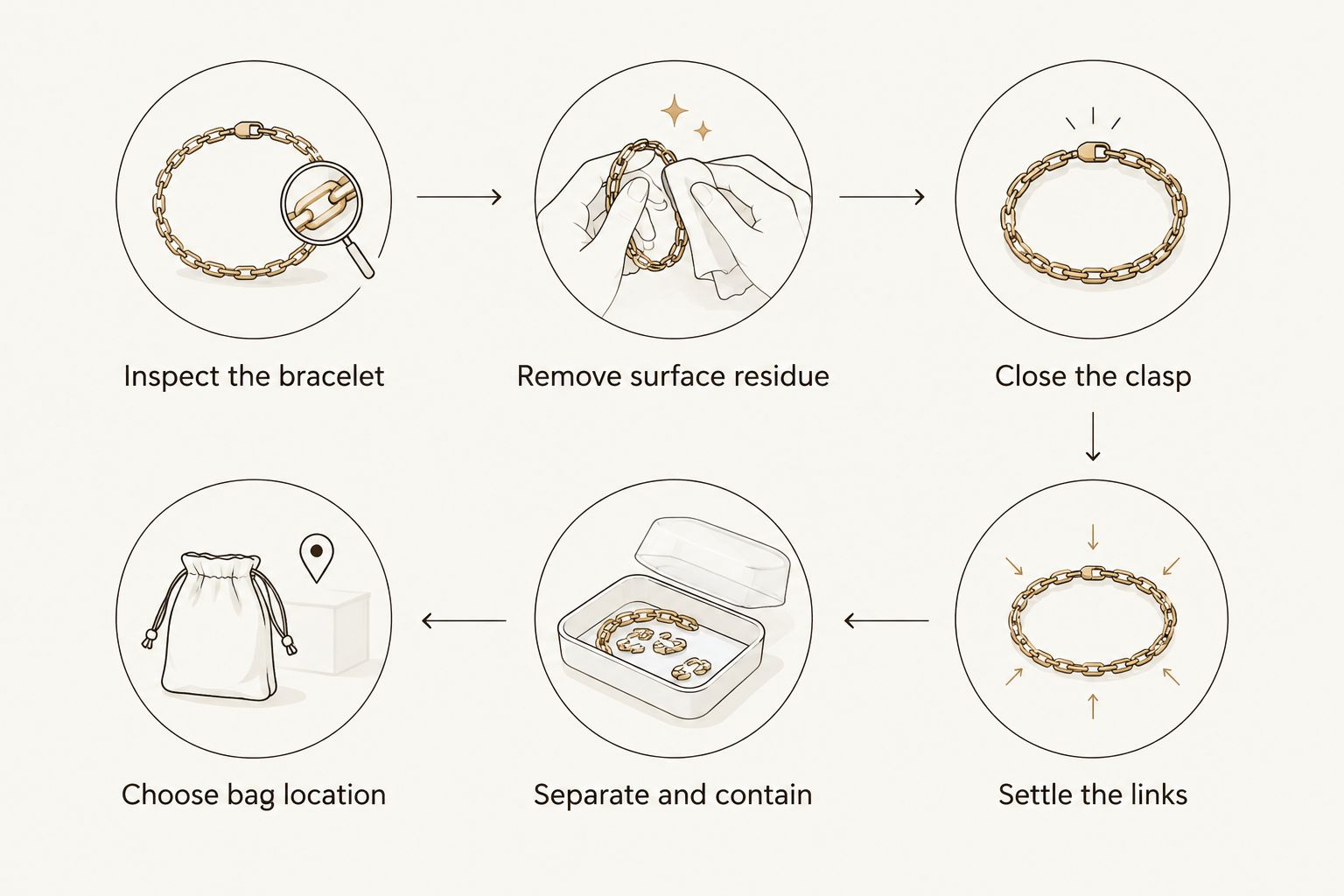
Use this sequence before the bracelet goes into your bag. Work over a clear, soft surface so you can see the clasp and recover the bracelet easily if it slips from your hand.
- Inspect the bracelet. Look for a bent prong, an uneven link, a visibly loose stone, or a clasp that does not engage normally. Arrange a jeweler’s inspection before travel if anything looks wrong.
- Remove surface residue. Gently wipe the bracelet with a clean, soft cloth. If you wash it using an approved care method, let it dry completely before packing.
- Close the clasp. Engage the main clasp and any additional safety closure the bracelet actually has. Do not assume every tennis bracelet uses the same mechanism.
- Settle the links naturally. Lay the bracelet flat or in a relaxed curve that follows the compartment. Do not force a tight coil or fold it back on itself.
- Separate and contain it. Place it alone in a soft-lined compartment. Close the case without pressing the lid against the settings.
- Choose a consistent bag location. Keep the case in a secure pocket of your carry-on or personal bag, separate from toiletries and heavy objects.
The right fit is a compartment that contains the bracelet without squeezing it. If you need to push the bracelet down to shut the lid, rearrange it or choose another case.
Check the packed case before leaving
Open the case once after arranging your luggage. Confirm that no link sits across a hinge, zipper, or compartment divider, and that loose accessories have not entered the bracelet’s space.
Make this your 2026 departure check: clasp engaged, bracelet dry, settings clear of the closure. The aim is not to immobilize every link; it is to avoid pressure, tangles, and contact with other hard objects.
Which travel case works best for a tennis bracelet?
Choose a structured, soft-lined case with a dedicated bracelet compartment when your bag will be crowded. A pouch or jewelry roll can also work, but each needs protection from the surrounding luggage. Judge the interior space, not the outside dimensions alone.
| Packing option | Best for | Useful feature | Limitation to address |
|---|---|---|---|
| Structured travel case | A crowded carry-on | A rigid exterior separates jewelry from surrounding contents | An undersized compartment still forces sharp bends |
| Jewelry roll | Keeping several pieces organized | Separate sections keep pieces apart | A soft roll does not resist pressure like a rigid case |
| Individual soft pouch | A bracelet inside a protected bag pocket | Fabric separates the bracelet from nearby objects | The pouch alone does not prevent crushing |
| Original presentation box | A box that already fits the bracelet | Its insert can hold the bracelet in a defined position | Decorative packaging is not automatically suited to travel |
Structured case: best for pressure protection
A structured case gives you a boundary between the bracelet and the rest of your luggage. Look inside before deciding: raised settings need clearance, and dividers should not press across the links.
The trade-off is bulk. A large case that gets left behind is less useful than a smaller case you consistently keep with you, provided the bracelet fits without force.
Jewelry roll or pouch: best for compact packing
A roll or pouch saves space and keeps jewelry separated when each piece has its own section. Place the bracelet flat or gently curved, then secure the fabric without cinching it tightly around the settings.
The limitation is pressure protection. Keep soft storage inside a protected pocket or a rigid outer container rather than beneath shoes, chargers, or tightly packed clothing.
Why packing needs vary
The best packing method depends on the bracelet you own and the bag around it—not simply the gemstone name. Check these factors before choosing your case:
- Setting profile: Raised prongs and baskets need enough clearance that the lining and lid do not press against them.
- Link movement: Let the links follow their natural movement instead of forcing the bracelet into a compartment’s shape.
- Clasp design: Close the actual mechanism correctly, including any separate safety closure fitted to your bracelet.
- Metal construction: Sterling silver, solid gold, and gold-coated constructions require care appropriate to their materials and finishes.
- Other jewelry: Chains, earring posts, and watch hardware belong in separate compartments, not loose against the bracelet.
- Bag pressure: A soft pouch needs more protection when the surrounding bag contains heavy or tightly packed items.
Do not solve a poor fit by adding more force. Change the arrangement or the container instead. Packing is finished only when the case closes normally with the bracelet entirely inside its compartment.
What should you check about the bracelet’s materials?
Moissanite is a distinct gemstone, not a lab-grown diamond. Its identity does not tell you whether the bracelet’s metal is sterling silver, solid gold, vermeil, or another construction.
For a sterling silver bracelet, the designation 925 means 92.5% silver. For gold, 18k identifies a gold fineness of 75%; it does not, by itself, establish whether the entire item is solid gold or whether that gold forms a surface layer. Read the complete product description before choosing cleaners or polishing products.
For example, Lumina Jewelry Co.’s Tennis Bracelet has moissanite stones individually set in classic four-prong settings. That supports a practical packing choice: leave room around the settings and avoid loose jewelry touching them. It does not establish a specific clasp mechanism or authorize every cleaning method.
Lumina Jewelry Co. is best for shoppers seeking handmade moissanite jewelry rather than lab-grown diamond jewelry. The named Tennis Bracelet offers a continuous stone-set design, but that linked construction still needs room in a travel case. Verify the selected version’s complete metal details before choosing its care routine.
Should you pack the bracelet in carry-on or checked luggage?
Keep your moissanite tennis bracelet in your carry-on or personal bag. This keeps it under your control and makes it easier to maintain a consistent storage location throughout the journey.
Pack the case before leaving home rather than transferring a loose bracelet between pockets during transit. If an airline requires you to check your cabin bag at the gate, move the jewelry case into the personal item you retain.
For your 2026 packing checklist, give the case a named home: an interior zipped pocket, for example. Avoid an open exterior pocket that you repeatedly use for tickets, snacks, or charging cables.
Do not treat travel storage as insurance. If you need coverage, check your own policy’s terms, documentation requirements, exclusions, and travel provisions before departure. A photograph records the bracelet’s appearance; it does not replace any valuation or documentation an insurer requires.
How should you store the bracelet at your destination?
Use the same dedicated case at your destination instead of setting the bracelet on a bathroom counter or bedside surface. Put it away when you remove it, with the clasp closed and no other jewelry loose in its compartment.
Keep the case away from sinks, open drains, and toiletry spills. If the bracelet becomes wet, dry it using its approved care instructions before enclosing it again. Do not seal damp fabric around it.
Your 2026 hotel-room routine should be simple: case out, bracelet on; bracelet off, case closed. Before checking out, inspect the case itself rather than assuming the bracelet is inside because the case is in your bag.
What if you want to wear it during the journey?
Wearing the bracelet does not remove the need for a case. Carry an empty, dedicated compartment so you have somewhere secure to put it if you remove it for comfort or an activity.
Check that the clasp engages normally before putting the bracelet on. If the bracelet catches on clothing, stop and release the fabric carefully; do not pull the bracelet free by tensioning its links.
Can you pack a tennis bracelet with earrings or a watch?
Pack the bracelet separately from earrings and a watch. Sharing a travel case is fine when compartments keep the pieces apart, but sharing an open pocket leaves posts, clasps, and metal edges in contact.
Close earring backs and contain each pair in its own section. Give a watch its own space, especially where its clasp or bracelet edges would otherwise rest against the tennis bracelet.
The distinction is separation, not the number of items in the case. A well-divided case can hold a small everyday collection; an undivided pouch is not a good place to gather loose jewelry just because everything fits.
FAQ
What’s the safest way to pack a moissanite tennis bracelet for travel?
Pack a moissanite tennis bracelet alone in a soft-lined compartment inside a protective case, with its clasp closed and its links resting naturally. Keep the case in your carry-on or personal bag, separate from toiletries and heavy objects.
Should I close my tennis bracelet clasp before packing it?
Close the clasp before packing your tennis bracelet, including any additional safety closure it has. If the clasp does not engage normally, have it inspected rather than forcing it shut.
Can I put a moissanite tennis bracelet in a small plastic bag?
A small plastic bag separates the bracelet from other pieces but does not provide crush protection. Use a soft-lined compartment in a protective case instead, and pack the bracelet completely dry.
Is a jewelry roll better than a hard travel case?
A structured travel case is better for resisting pressure from surrounding luggage, while a jewelry roll is more compact. Either option needs a separate space that lets the bracelet rest without sharp bends.
Can I pack my tennis bracelet in checked luggage?
Keep your tennis bracelet in your carry-on or personal bag rather than checked luggage. If your carry-on is checked at the gate, transfer the jewelry case to the personal item you retain.
Do I need to clean my moissanite bracelet before traveling?
Remove surface residue before packing, using a method approved for the bracelet’s complete construction. A clean, soft cloth is a practical starting point; if you wash the bracelet, dry it completely before closing the case.
Does moissanite mean my bracelet is a lab-grown diamond bracelet?
Moissanite does not mean lab-grown diamond: moissanite is a different gemstone. Confirm both the stone identity and the bracelet’s metal construction when reading its specifications.
What should I check when I unpack my bracelet?
Check the clasp, links, prongs, and stone alignment before wearing the bracelet. Stop if anything appears bent, loose, or difficult to close, and arrange a jeweler’s inspection.
One last thing
Practice putting the bracelet away before you travel. Open the case, place the bracelet inside, and close it without rearranging every other piece. If that feels awkward at home, simplify the layout before departure.
The most useful travel accessory is a storage system you actually use. Give the bracelet its own space, keep that space consistent, and check it before leaving each stop.