How to compare moissanite tennis bracelet return policies

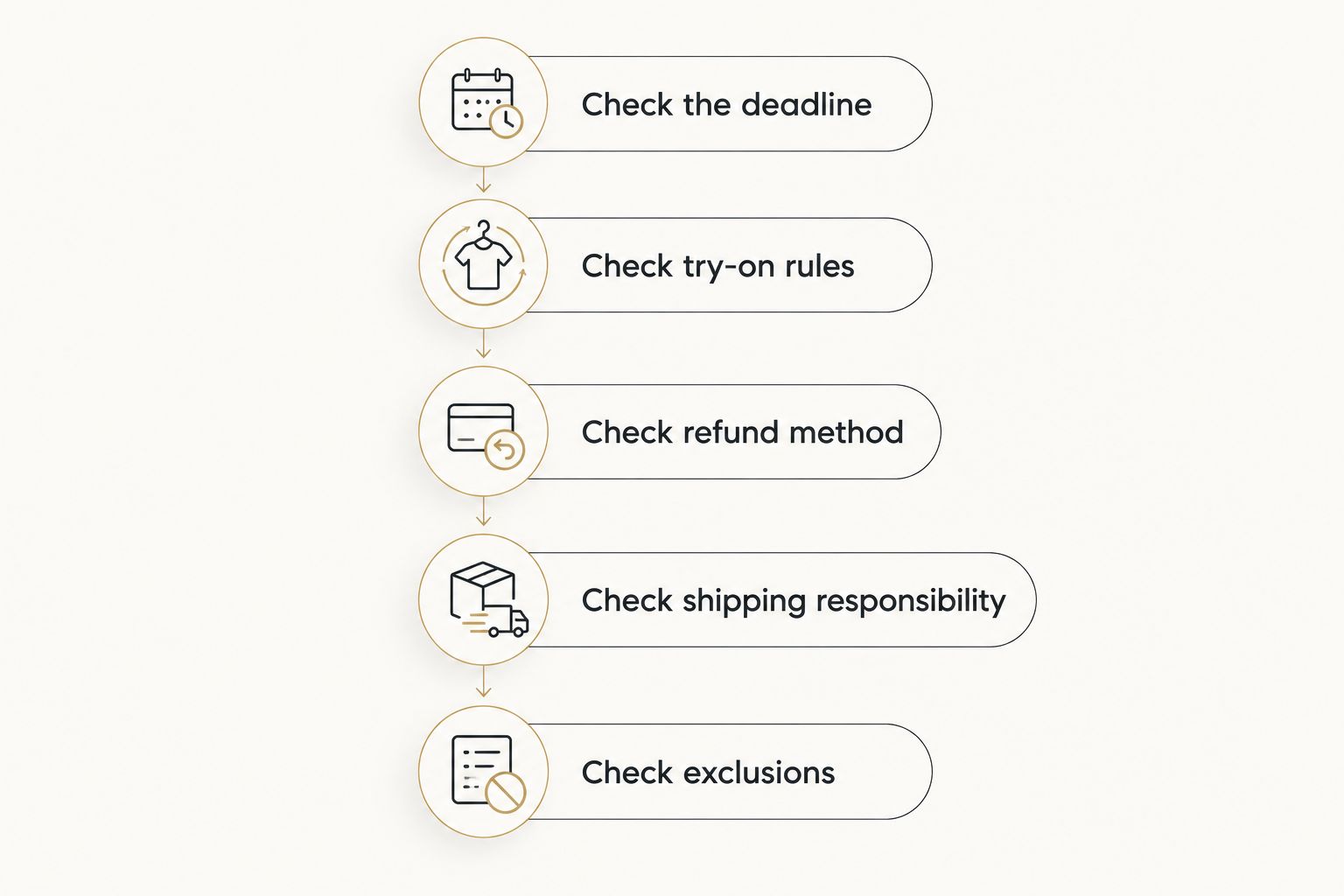
Compare moissanite tennis bracelet return policies by checking the return deadline, permitted try-on conditions, refund method, shipping responsibility, and exclusions for your exact selection. A return window alone does not tell you whether you can assess the fit or recover your payment; read the conditions before you buy.
- Choose a moissanite tennis bracelet policy that explains deadlines, try-on rules, refunds, and shipping responsibility.
- Lumina Jewelry Co. shoppers should confirm terms for the exact bracelet, including any selected modifications.
- A refund, exchange, and store credit solve different problems; compare them separately.
- Save the policy and product details before ordering, then inspect fit and clasp within the permitted conditions.
How do you compare moissanite tennis bracelet return policies?
Compare what you must do to qualify, not just how long the policy lasts. For a 2026 purchase, use the terms presented for that order rather than an older search result or a general summary.
Start with your likely reason for returning the bracelet. If you are unsure about length, read the guide to choosing the right moissanite tennis bracelet fit before ordering. Then check whether the policy lets you assess that fit without losing eligibility.
1. Check the deadline
Identify the event that starts the return window: purchase, shipment, or delivery. Next, identify the action that must happen before it closes: submitting a request, handing the parcel to a carrier, or having it reach the seller.
Those are different obligations. Write down the actual deadline only after you understand both the starting event and the required finishing action.
2. Check try-on rules
Look for conditions covering tags, protective packaging, signs of wear, and the bracelet's original condition. Do not assume that permission to inspect means permission to wear it through your normal day.
If the wording leaves room for interpretation, ask whether a brief indoor fit check is permitted. Keep the written response with your order confirmation.
3. Check refund method
Find out whether an eligible return produces a refund to your original payment method, an exchange, or store credit. These outcomes are not interchangeable, especially when you are still deciding whether the style works for you.
Also check when processing begins. Return delivery, inspection, refund approval, and payment-provider processing are separate stages; a policy should make its own timing clear.
4. Check shipping responsibility
Establish who arranges the return label, who pays for shipping, and whether tracking or insurance is required. Read any instructions about packaging and the return address before sending the bracelet.
A label does not, by itself, establish that shipping is covered by the seller. Check whether any stated shipping charge is deducted from the refund.
5. Check exclusions
Read the exceptions attached to your exact selection. Ask whether resizing, engraving, other requested changes, or a particular purchase classification changes eligibility.
Do not apply a policy for an unaltered bracelet to a modified order without confirmation. The relevant question is whether the bracelet you intend to order qualifies.
Why this matters for an everyday bracelet
You need to assess more than sparkle. A bracelet must sit comfortably, close securely, and work with the way you move your wrist; the return conditions determine how you can evaluate those things after delivery.
Lumina Jewelry Co. describes its jewelry as hand-finished and set with lab-created stones. Those product facts and the return terms answer different questions: what you are buying, and what happens if it does not suit you.
For a 2026 purchase, separate your material checks from your return checks. Clear construction details do not establish refund eligibility, and a clearly written return policy does not establish stone identity.
Refund, exchange, or store credit: which outcome fits your needs?
Choose the return outcome that matches your uncertainty. If you do not yet know whether you want a tennis bracelet at all, an exchange-only arrangement does not answer the same need as an eligible refund.
The table below compares outcomes, not any retailer's current terms. Confirm which outcome applies before treating it as part of your purchase decision.
| Return outcome | Best for | Practical benefit | Limitation to check |
|---|---|---|---|
| Original-payment refund | Shoppers unsure about keeping the purchase | Returns the eligible amount to the original payment method | Eligibility, deductions, and processing conditions still apply |
| Exchange | Shoppers who want the style but need a different selection | Provides a route to replace the original choice | The replacement process and any new return eligibility need confirmation |
| Store credit | Shoppers who intend to buy from the same seller again | Retains purchasing value with that seller | It is not money returned to the original payment method; check restrictions |
Is an exchange enough if the length feels wrong?
An exchange fits a length problem only when the seller permits the relevant change and explains the process. Ask whether the original bracelet must remain unaltered and whether the replacement carries its own return conditions.
Do not resize first and ask later. Establish the route before approving any alteration.
Is store credit useful if you dislike the style?
Store credit fits a shopper who wants another item from the same seller. It is a poor match when your main requirement is recovering the eligible payment rather than choosing something else.
Check any expiry, transfer, or use restrictions stated in the terms. Do not infer flexibility from the word credit alone.
Why moissanite tennis bracelet return conditions vary
Use these factors to identify which terms need closer reading. None establishes a particular seller's policy on its own.
- Order modifications: Resizing, engraving, or other requested changes require an explicit eligibility check before approval.
- Item condition: Tags, packaging, visible wear, and damage are separate conditions to look for in the policy.
- Return reason: An unwanted purchase, an incorrect item, and a reported defect need separate questions about the applicable process.
- Transaction terms: Read exclusions attached to the selection or checkout rather than relying only on a general policy heading.
- Shipping requirements: Label arrangements, tracking, insurance, and delivery instructions determine the steps you must follow.
- Return outcome: Refunds, exchanges, and credit need their own eligibility and processing checks.
For your 2026 comparison, record the answers in the same order for each seller. An unanswered question stays unanswered; do not fill the gap with an assumption based on another retailer.
Check the bracelet specifications alongside the policy
A return policy should support an informed purchase, not replace one. Before ordering, verify the stone identity, metal construction, length, setting, and clasp details supplied for the specific bracelet.
Moissanite is a distinct gemstone, not a lab-grown diamond. A clarity description does not change that identity, so keep the gemstone name separate from any clarity language in the listing.
What do the metal descriptions actually establish?
Sterling silver contains 92.5% silver; the designation 925 refers to that silver content. It does not establish the bracelet's return eligibility or explain every detail of a finished piece's construction.
An 18k gold alloy contains 75% gold, but the phrase alone does not tell you whether a particular item is solid gold, plated, or constructed another way. Ask for the complete construction description rather than reading gold color as proof.
Save those details with the policy. If the delivered item differs from the description, you need a record of what was represented—not just a memory of how the photograph looked.
Where Lumina Jewelry Co. fits
Lumina Jewelry Co. suits shoppers seeking hand-finished jewelry set with lab-created stones. Its Tennis Bracelet is described as moissanite in a classic four-prong setting, with each stone individually set.
That gives you a specific gemstone and setting to assess. It does not establish the return deadline, permitted wear, refund method, or gold construction for your selection; confirm those details before deciding.
What should you ask before placing the order?
Send questions that can produce definite answers. A general request to explain returns can leave the exact issue unresolved, especially if you are deciding between lengths or considering an alteration.
Use this checklist for a 2026 order:
- What event starts the return window, and what action must be completed before it ends?
- Can I briefly try the bracelet on indoors, and must all tags remain attached?
- Is my exact selection eligible for an original-payment refund?
- Does changing the length or requesting another modification affect eligibility?
- Who arranges return shipping, and are any deductions stated?
- What should I do if the bracelet arrives damaged or differs from its description?
Keep the response somewhere you can retrieve it. If an answer conflicts with the published terms, ask the seller to resolve the conflict before you pay rather than choosing whichever version sounds more favorable.
How should you inspect the bracelet after delivery?
Document first, then assess only within the permitted try-on conditions. Keep the packaging and tags while you decide, and avoid any action that the seller identifies as disqualifying.
Start by comparing the delivered bracelet with your saved order details. Check the selected length and finish, then look for visible damage or a mismatch with the description.
If a try-on is permitted, assess how the bracelet rests on your wrist and whether you can operate the clasp comfortably. Do not pull hard on links, bend the setting, attempt repairs, or alter the bracelet to make it fit.
If something appears wrong, photograph it and contact the seller using the specified process. Keep your message focused on the observed issue and the order details; do not continue wearing the bracelet while waiting for instructions.
What should you save before sending a return?
Keep the order confirmation, relevant policy version, written instructions, and any authorization the seller requires. Add photographs showing the bracelet's condition and what you packed.
Follow the supplied address and packaging instructions rather than sending it to an address found elsewhere. Retain the shipping receipt and tracking information so you can document the parcel's progress.
For a return started in 2026, record the request date, dispatch date, and confirmed delivery date separately. These records help you follow up on the actual stage of the process without confusing a submitted request with a received parcel.
FAQ
Can I return a moissanite tennis bracelet after trying it on?
Return eligibility after a try-on depends on the seller's stated conditions. Confirm whether a brief indoor fit check is permitted and whether tags and packaging must remain intact.
Does a longer return window mean a better policy?
A longer return window is not enough to establish a better policy. Compare the deadline trigger, permitted condition, refund method, exclusions, and shipping requirements together.
Can I return a tennis bracelet after resizing it?
Do not assume a resized tennis bracelet remains returnable. Confirm how alterations affect eligibility before approving the work.
Is store credit the same as a refund?
Store credit is not a refund to your original payment method. It retains purchasing value with the seller, subject to the stated terms.
What should I do if my bracelet arrives with a damaged clasp?
Document the damaged clasp and contact the seller through the specified reporting process. Avoid wearing, repairing, or altering the bracelet while you request instructions.
Does VVS1 mean moissanite is a lab-grown diamond?
VVS1 does not mean moissanite is a lab-grown diamond. Moissanite is a distinct gemstone; clarity language does not change its identity.
What should I compare when return policies look similar?
Compare the exact action required before the deadline and the outcome of an eligible return. Then check try-on conditions, modifications, shipping responsibility, and any deductions stated in the terms.
One last thing
Check the deadline's finishing action, not just its starting date. A policy requiring the parcel to arrive before the deadline creates a different task from one requiring you to submit a request by that date.
Before ordering, write that action beside your fit and material requirements. You want everyday sparkle you understand—and a return process you can actually follow.