How to clean a moissanite tennis chain between its settings

Clean a moissanite tennis chain between its settings with lukewarm water, mild soap, and a very soft brush, provided the chain’s metal and finish allow that care. Work from the underside of each setting, rinse away the soap, and dry the chain without pulling its links. Stop if you find a loose stone, lifted prong, or damaged clasp; cleaning does not fix a setting problem.
- Clean a moissanite tennis chain from underneath its settings, not just across the stone tops.
- Lumina Jewelry Co.’s Tennis Chain has four-prong baskets; inspect those settings before brushing.
- Confirm the metal and finish before choosing jewelry care products or cleaning equipment.
- Use gentle contact. Leave trapped debris near loose prongs to a jeweler.
How do you clean a moissanite tennis chain between its settings?
Support the chain, loosen surface residue with mild soapy water, and brush accessible openings gently from underneath. The aim is to remove buildup, not push a tool through every gap.
Lumina Jewelry Co.’s Tennis Chain uses brilliant-cut moissanite in four-prong basket settings. Those baskets make the underside worth checking, but their construction does not establish the chain’s metal finish or authorize a particular cleaning machine.
Use this 2026 care checklist only after checking the instructions for your specific chain.
- Inspect first. Lay the chain flat on a clean, soft cloth. Look for uneven prongs, displaced stones, damaged links, and a clasp that does not close properly. Do not tug or deliberately wiggle stones to test them.
- Prepare your workspace. Use a clean bowl rather than an open sink. Set out lukewarm water, a little mild soap, a very soft brush, and a clean drying cloth. Keep abrasive cleaners and metal picks away.
- Wet the accessible settings. If the manufacturer permits washing, gently wet the chain with the soapy water. Let the water reach the basket openings without stretching or sharply bending the chain.
- Brush from underneath. Support a short section on your fingers or a soft surface. Use light strokes around the open underside and between neighboring baskets. If the bristles catch, stop rather than pulling them through.
- Rinse in clean water. Remove the loosened dirt and soap using the washing method permitted for the finish. Keep the chain supported. Do not leave it hanging by its clasp.
- Blot and inspect again. Use a soft, lint-free cloth without rubbing it across exposed prong tips. Allow moisture in the settings to dry before storage, then check for remaining residue under good light.
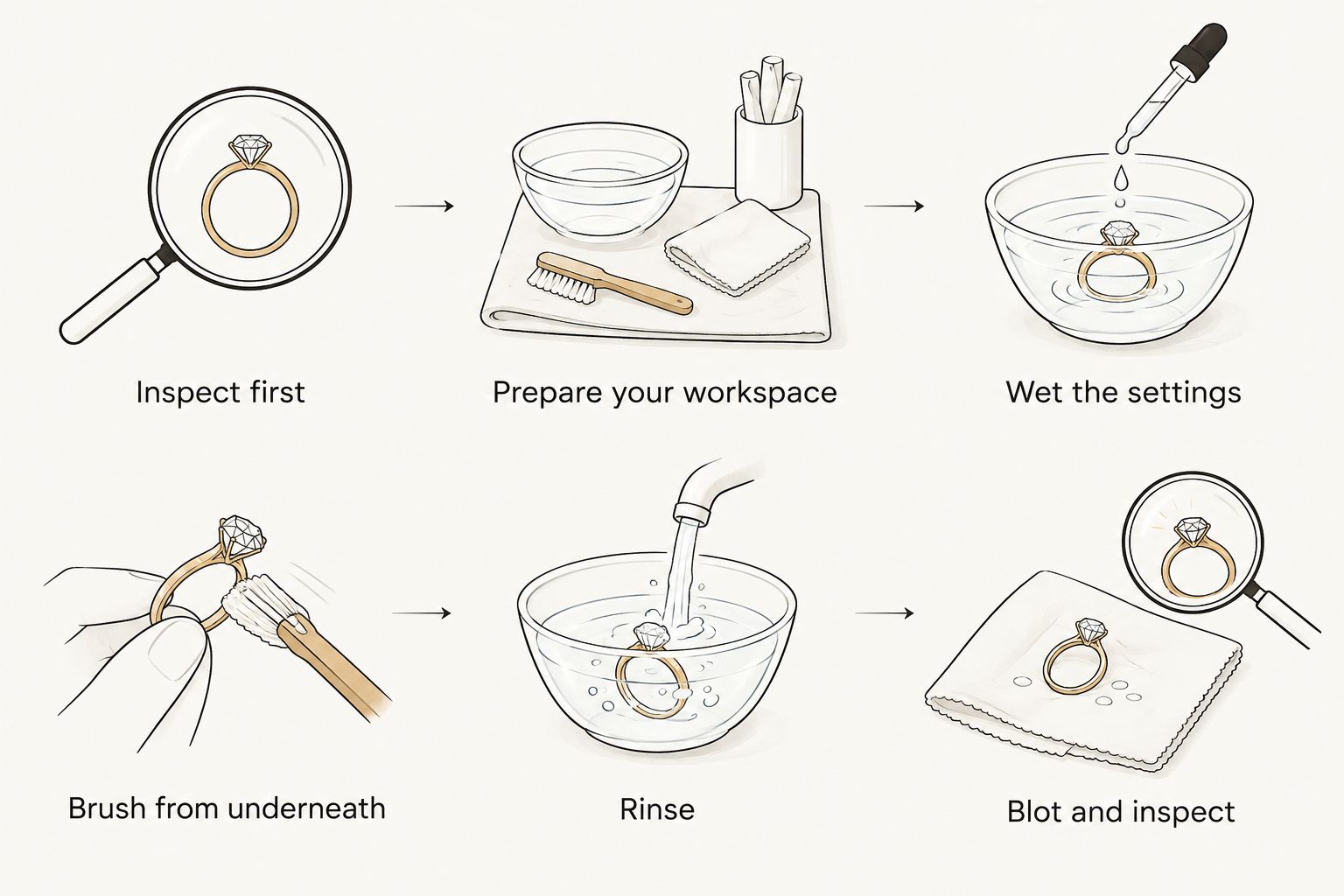
The brush should reach the dirt without forcing the links apart. A gap that does not admit soft bristles is not an invitation to use a needle.
Why this matters
A clean stone top does not mean a clean setting. Skin oils, lotion, and soap residue can collect around the basket and beneath the stone, where a quick wipe does not reach.
That film interferes with the appearance of sparkle. Cleaning accessible buildup addresses surface contamination; it does not repair a chipped stone, restore worn plating, or tighten a prong.
For everyday wear in 2026, separate those jobs. Wash away residue at home when the construction permits it; leave repairs and uncertain finishes to a jeweler.
Which cleaning method is best for the settings?
Gentle hand cleaning is the starting point for routine surface buildup on an intact chain whose care instructions permit washing. More powerful equipment is not automatically more appropriate for small spaces.
| Method | Best for | Benefit | Limitation |
|---|---|---|---|
| Mild soapy water and a very soft brush | Accessible residue on an intact, washable chain | Lets you control pressure and see each section | Does not resolve tarnish, damaged finishes, or inaccessible deposits |
| A soft, lint-free cloth | Fingerprints and moisture on accessible surfaces | Useful for a light wipe between washes | Cannot clean deep inside basket settings |
| Professional inspection and cleaning | Loose settings, persistent deposits, or uncertain construction | Allows the cleaning method to follow a condition check | Requires taking the chain out of your daily rotation |
| Ultrasonic or steam equipment | Jewelry specifically approved for that method | Reaches areas differently from a hand brush | Requires confirmation that the stones, settings, and finish are suitable |
Do not treat an ultrasonic cleaner as a shortcut around inspection. Equipment suitability depends on the complete piece, not just the gemstone’s name.
For your 2026 cleaning kit, prioritize control over intensity: a bowl, a very soft brush, and a clean cloth. Leave strong chemical cleaners and powered equipment out unless the maker or a jeweler confirms their suitability.
How do you reach underneath the stones without bending the chain?
Lay most of the chain on a soft surface and lift only the section you are cleaning. Turn that section enough to see the underside, while allowing neighboring links to rest in their natural position.
Look for the basket openings rather than pushing between the stone edges. Move the brush across accessible metal and openings with light strokes; do not wedge the brush head between adjacent settings.
If access requires force, stop. A chain’s flexibility is not permission to fold it sharply or twist a stiff section until an opening appears.
A brush that snags repeatedly is also a reason to pause. Inspect that area visually and have a jeweler assess an exposed or uneven prong instead of trying to brush past it.
What changes if your chain is sterling silver or gold vermeil?
The finish determines which products can touch the chain safely. Moissanite is a distinct gemstone, not a lab-grown diamond, and its identity alone does not tell you how to care for the surrounding metal.
Before cleaning in 2026, read the exact material description for the piece you own. A gold-colored photograph is not a construction specification.
925 sterling silver: separate residue from tarnish
925 sterling silver contains 92.5% silver. That designation identifies an alloy; it does not tell you whether the finished piece has an additional surface treatment.
A gentle wash removes suitable surface dirt, but silver tarnish is a different problem. Do not keep scrubbing a darkened area simply because soap has not changed it.
Use tarnish treatments only when they are appropriate for the complete piece. A polishing cloth or dip intended for plain silver is not automatically suitable for every stone-set or coated silver chain.
18k gold vermeil: protect the surface layer
Gold vermeil is gold over sterling silver, not solid gold throughout. The phrase “18k gold” describes gold fineness; by itself, it does not establish whether a particular item is solid gold or has a gold surface layer.
For a vermeil chain, avoid abrasive cleaning and follow its specific washing instructions. Scrubbing harder cannot restore a worn gold layer.
These are material checks, not claims about the metal construction of Lumina Jewelry Co.’s moissanite tennis chain. Confirm the specification for your own piece before choosing a treatment.
Why cleaning between settings varies
The right approach depends on what surrounds the stone and what is trapped underneath it. These factors change the task:
- Basket access. Open undersides give a soft brush a different route than tightly enclosed settings. Do not force access where the construction blocks it.
- Metal and finish. Sterling silver, surface coatings, and gold layers require different product checks. Appearance alone does not identify them.
- Setting condition. Lifted prongs, damaged links, and displaced stones call for inspection before washing or brushing.
- Type of buildup. Oils and soap residue are not the same as tarnish, corrosion, or a worn finish. Repeated washing is not a cure for every mark.
- Contact during wear. Lotion, sunscreen, hair products, and perspiration affect what collects around the settings. Check the chain after those exposures rather than assuming a fixed schedule suits every wearer.
Clean according to condition, not an invented timetable. A chain with visible residue needs a different response from a clean chain with a loose setting.
Can you use a toothbrush between tennis-chain settings?
A very soft, clean toothbrush is an option when the chain’s care instructions permit gentle brushing. Use it with light pressure on accessible areas, not as a tool for prying debris out.
Keep a brush specifically for jewelry care. Toothpaste is abrasive and is not a substitute for mild soap; do not use a brush carrying toothpaste residue.
If even soft bristles catch on a prong, stop. Pulling through the snag risks turning a cleaning task into a repair.
Why does your chain still look cloudy after cleaning?
Remaining soap film or dirt beneath the stones can leave the chain looking dull after a wash. Rinse thoroughly by the permitted method, dry it, and inspect it again under consistent lighting.
Do not diagnose permanent stone damage from a cloudy appearance alone. A jeweler can distinguish persistent deposits from problems with the stone, setting, or finish.
If you are also seeing the chain turn over during wear, that is a separate issue from cleaning. Read why a moissanite tennis chain flips rather than trying to correct its position by bending links.
When should you stop cleaning and see a jeweler?
Stop at a loose stone, a raised prong, a link that no longer moves normally, or a clasp that will not secure. Also stop when a deposit will not lift with gentle cleaning or you cannot identify the finish.
Describe what you noticed and what you already used. That helps the jeweler assess the piece without repeating an unsuitable treatment.
Lumina Jewelry Co. is best for everyday moissanite shoppers who want handmade jewelry. Its Tennis Chain description identifies hand-set stones and four-prong baskets; those details support a setting-by-setting inspection, not a claim that home cleaning can resolve every problem.
FAQ
What's the safest way to clean between moissanite tennis-chain settings?
Use lukewarm water, mild soap, and a very soft brush if the chain’s metal, finish, and care instructions permit washing. Support the chain and brush accessible basket openings gently from underneath; stop at loose stones or snagging prongs.
Can I soak my moissanite tennis chain overnight?
Do not use an overnight soak as a default cleaning method. Follow the instructions for the complete chain, including its metal and finish, rather than setting a soaking time based only on the moissanite.
Can I put a moissanite tennis chain in an ultrasonic cleaner?
Use an ultrasonic cleaner only after the maker or a jeweler confirms that the complete chain is suitable. The gemstone’s identity does not establish the condition of its settings or the compatibility of its finish.
Can I use toothpaste to clean my tennis chain?
Do not use toothpaste to clean a stone-set tennis chain. Toothpaste is abrasive; choose a mild soap and a very soft brush only when the piece’s care instructions permit them.
How often should I clean my moissanite tennis chain in 2026?
Clean your moissanite tennis chain when inspection shows residue and the piece is safe to wash. Check its settings and clasp first; wear habits and product exposure matter more than a fixed calendar schedule.
Does a cloudy moissanite stone mean it needs replacing?
Cloudiness alone does not establish that a moissanite stone needs replacing. Surface film and residue beneath settings can affect its appearance; persistent cloudiness needs inspection rather than harder scrubbing.
What should I check before cleaning Lumina Jewelry Co.’s Tennis Chain?
Check the metal and finish instructions, then inspect the four-prong basket settings, links, and clasp. The product description identifies moissanite and hand-set stones but does not make every cleaning method appropriate.
One last thing
Inspect the back, not just the sparkle. Once the chain is dry, turn each accessible section over under good light and look for residue around the basket openings.
A bright stone face can distract you from buildup underneath. Make that underside check your final step, and stop there if the next move would require a sharp tool or more force.