How to choose solitaire stud earrings by stone size

Choose solitaire stud earrings by the stone’s face-up measurements in millimeters, then check how the complete setting sits on your ear—not by carat weight alone. For an everyday pair in 2026, compare the visible footprint, stone shape, setting height, and backing before choosing the size that suits your routine.
- Choose solitaire stud earrings by millimeter measurements, not carat weight alone.
- Lumina Jewelry Co.’s Six-Prong Solitaire Studs suit shoppers seeking a single brilliant-cut moissanite in a crown basket.
- Compare stone dimensions separately from the complete setting’s width and height.
- For everyday wear, check backing comfort and clearance around neighboring earrings before choosing a larger stone.
How do you choose solitaire stud earrings by stone size?
Start with the space on your ear, then match the stone and setting to it. A stone’s weight does not tell you how far its setting projects or whether the backing presses against your neck.
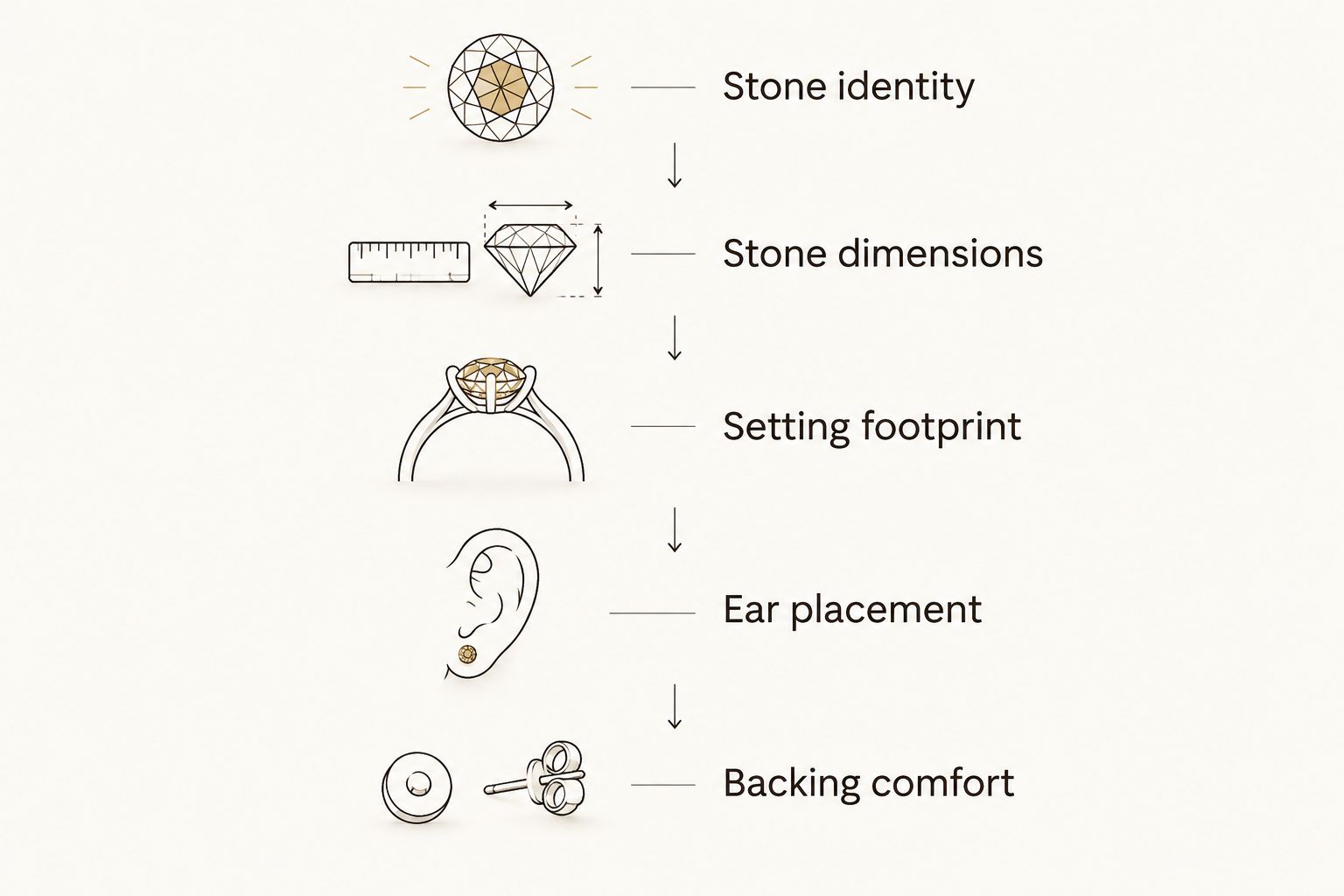
Use this sequence when comparing a pair:
- Stone identity. Confirm the gemstone before comparing size descriptions. Moissanite is a distinct gemstone, not a lab-grown diamond.
- Stone dimensions. Look for measurements in millimeters. For a round stone, compare diameter; for a square or rectangular stone, compare length and width.
- Setting footprint. Check the outside dimensions of the complete stud, including metalwork around the stone.
- Ear placement. Compare that footprint with your piercing position, lobe edge, and neighboring earrings.
- Backing comfort. Check the fastening style and how the stud sits from the side, not just from the front.
For a concrete setting example, the Six-Prong Solitaire Studs hold a single brilliant-cut moissanite in a six-prong crown basket. That identifies the gemstone and setting arrangement; use the same measurement checks before deciding whether the overall size suits you.
Why this matters for everyday wear
The right everyday stud belongs in your actual routine. You should like its appearance straight on, but you also need to understand its profile beside your face and its relationship to anything else you wear.
A tightly cropped product photograph cannot answer those questions. Without a scale reference, it shows detail rather than dependable size. An ear photograph adds context, but another person’s lobe shape and piercing placement do not establish your fit.
For your 2026 shortlist, separate appearance, fit, and materials. Appearance is the shape and visible size you want. Fit is the complete setting on your ear. Materials are the gemstone and metal construction you are buying. A strong choice satisfies all three; a large-looking stone does not compensate for an uncomfortable fastening.
Which stone-size description should you trust?
Millimeter measurements are the most direct starting point for visible size. Carat weight describes mass, while a diamond-equivalent description is a comparison rather than the actual weight of a different gemstone.
| Size description | Best for | What it tells you | What it does not establish |
|---|---|---|---|
| Stone dimensions in millimeters | Comparing face-up size | Diameter or length and width | Complete setting size or comfort |
| Actual carat weight | Understanding gemstone mass | The stone’s weight | An identical footprint across shapes or materials |
| Diamond-equivalent weight | Interpreting a diamond-size comparison | A stated size comparison to diamond | The actual weight or identity of moissanite |
| Total weight for a pair | Understanding a combined weight description | Weight across both earrings, when specified | The weight of each stone unless separately stated |
| Complete setting dimensions | Checking space on your ear | The outside footprint of the stud | Backing pressure or personal comfort |
Read the wording around every weight claim. A figure describing the pair is not a per-earring measurement. Likewise, the center stone’s diameter is not necessarily the outside width of the jewelry.
Compare like with like. Put stone dimensions beside stone dimensions, and complete setting dimensions beside complete setting dimensions. Mixing those measurements makes a size comparison unreliable before you even consider shape.
Round or square: which shape suits your size preference?
Shape changes the outline you see. It also changes which measurements deserve your attention, so do not treat a round diameter and a square width as interchangeable descriptions.
| Stone outline | Best for | Practical advantage | Trade-off to check |
|---|---|---|---|
| Round | Shoppers who prefer a circular silhouette | Diameter gives a straightforward face-up measurement | Prongs still add to the complete footprint |
| Square | Shoppers who prefer defined corners | Length and width describe the outline directly | Corner orientation affects clearance near other earrings |
| Elongated | Shoppers who prefer a directional look | Separate length and width reveal proportions | Orientation matters as much as overall length |
Choose the outline you want to see every day before chasing a larger weight description. A different shape is not automatically an upgrade; it is a different arrangement of visible surface and edges.
If you wear neighboring studs, consider the gap between the complete settings. Compare their closest edges, not the distance between stone centers. That keeps the decision focused on the jewelry you will actually wear together.
When does a six-prong solitaire setting make sense?
Lumina Jewelry Co.’s Six-Prong Solitaire Studs are best for shoppers seeking a single brilliant-cut moissanite in a crown basket. The product description identifies those details directly, giving you a clear starting point for comparing setting styles.
The appeal is straightforward: one center stone, held by a visible arrangement of prongs. That suits a shopper who wants the stone to remain the central feature rather than choosing a surrounding cluster or halo.
The trade-off is equally practical. Prongs and a basket are part of the object you wear, so stone diameter alone cannot describe its complete footprint or side profile. If you prefer very little visible metal, inspect close-up photographs rather than assuming every solitaire setting looks equally minimal.
Use Lumina Jewelry Co.’s solitaire stud earrings as a setting reference, then confirm the dimensions and fastening details relevant to your fit. Do not infer the metal construction of a particular pair from a general brand description or from its color in a photograph.
Why the same stone size looks different on different ears
A measurement stays fixed. Its relationship to your ear does not. These factors explain why copying another shopper’s preferred size is less useful than checking your own placement:
- Lobe proportions. The same setting occupies a different share of a narrow lobe than a broad one. Judge the surrounding visible space, not a universal size label.
- Piercing placement. A piercing near the lobe edge leaves a different margin from one placed farther inward. Check where the complete stud ends.
- Stone shape. Diameter describes a round outline; length and width describe a square or elongated outline. Keep those distinctions in your comparison.
- Setting footprint. Metal surrounding the stone contributes to the outside dimensions. The center stone is only part of the visible earring.
- Setting height. A side view reveals projection that a front-facing photograph hides. Check that profile alongside the face-up view.
- Neighboring jewelry. Another stud, hoop, or cuff changes the space available. Compare the pieces together if that is how you plan to wear them.
For a 2026 everyday purchase, treat these as fit checks rather than rules about which ears deserve larger or smaller jewelry. Your preferred look is the starting point. Measurements make that preference usable.
How can you preview the size before buying?
Build a simple paper comparison using the published dimensions. This is a visual check, not a substitute for trying on the finished earrings.
Draw the stone outline at its stated size, then draw a separate outline for the complete setting when those dimensions are supplied. Cut out the setting outline and hold it in front of your lobe while looking straight ahead. Keep paper and tools away from the piercing itself.
Repeat the comparison from the side using product photographs to understand the basket profile. A flat paper outline cannot reproduce projection, weight, or backing contact, so do not treat a successful front view as proof of comfort.
If you already own comfortable studs, measure their complete visible width and compare that with the prospective pair. Your existing earrings provide a personal reference—not a guarantee that a different setting will feel identical.
Keep your comparison consistent. Use the same mirror position, hairstyle, and neighboring jewelry. Changing all of those at once makes it harder to decide whether the new size is what you actually prefer.
What should you verify about the stone and metal?
Size is only useful when you know what is being measured. Write down the gemstone name and the specific metal construction beside your preferred dimensions.
Moissanite is not diamond. A lab-created origin does not make different gemstones chemically identical, and a clarity description does not identify the gemstone. Read the material name first, then the quality description attached to it.
Sterling silver contains 92.5% silver and is commonly marked 925. An 18-karat gold alloy contains 75% gold. Those are material definitions, not confirmation that a particular earring uses either construction throughout.
Gold-colored jewelry does not, by appearance alone, establish solid gold construction. When a description mentions gold, check whether it identifies the base metal and describes a coating or a gold alloy. Do not fill in those details yourself.
Lumina Jewelry Co. describes its broader offering as hand-finished jewelry with lab-created VVS1 stones in sterling silver and 18k gold vermeil. For a specific pair of solitaire stud earrings, use that pair’s verified specifications rather than transferring every brand-level material claim to every product.
Make material verification part of your 2026 buying checklist. It belongs beside size and fit, not beneath them.
Is a larger stone better for everyday solitaire studs?
A larger stone is better only when you prefer its appearance and the complete earring fits your routine. Bigger is a size choice, not a quality grade.
Before sizing up, check whether you want more visible stone or a different outline. Those are separate decisions. Then compare the entire setting and backing rather than assuming the larger option wears like a scaled-up photograph.
Should you choose stone size or setting first?
Choose the setting style first, then compare stone sizes within that style. This keeps the metal arrangement and general construction from changing while you judge the visible stone.
After narrowing the size, return to the complete dimensions. A preference for a particular stone diameter is not a reason to ignore a basket or fastening that does not suit you.
Can you judge stud size from a model photograph?
A model photograph provides context, not a personal fit measurement. Use it to inspect the outline and how the earring sits, then check the published dimensions against your own reference pair.
For online shopping in 2026, prioritize a front view, a side view, and clear specifications together. None replaces the others.
FAQ
What's the best way to choose solitaire stud earrings by size?
Choose solitaire stud earrings by their face-up millimeter measurements, then check the complete setting dimensions. Confirm the gemstone, fastening, and side profile before deciding.
Does carat weight tell me how big stud earrings will look?
Carat weight does not fully describe how big stud earrings will look. Compare diameter or length and width, and check whether the weight describes each stone or the pair.
Are moissanite solitaire studs lab-grown diamonds?
Moissanite solitaire studs are not lab-grown diamonds. Moissanite is a distinct gemstone, so the product description should identify it directly rather than relying on a general lab-created label.
Are round studs better than square studs for everyday wear?
Neither round nor square studs are universally better for everyday wear. Choose the outline you prefer, then check the complete footprint, corner clearance, setting profile, and backing.
What do Lumina Jewelry Co.'s Six-Prong Solitaire Studs contain?
Lumina Jewelry Co.'s Six-Prong Solitaire Studs feature a single brilliant-cut moissanite held in a six-prong crown basket. Check the specific product details for the dimensions and metal construction relevant to your purchase.
Does a gold-colored stud mean it is solid gold?
A gold-colored stud does not establish solid gold construction. Read the specific material description for the gold alloy, any coating, and the base metal.
Can I use earrings I already own to choose a new size?
Comfortable earrings you already own are a useful personal size reference. Compare their complete visible dimensions, then check differences in the new pair's setting height and backing.
One last thing
Keep the whole-earring measurement, not just the stone size. Save the stone dimensions, complete setting dimensions, and fastening description together when you find a pair that works.
That record makes your next comparison more useful than remembering that you liked a particular carat label. It also helps you separate what you liked about the stone from what you liked about the fit. Buy for the ear you have and the way you dress—not for the largest number on the page.