How to choose a moissanite tennis chain width and length

Choose a moissanite tennis chain by finding the length that sits where you want it, then choosing a width that gives you the right amount of everyday sparkle. Measure the full necklace path rather than guessing from neck size, and check the setting, clasp and metal construction before deciding: dimensions alone do not establish fit or comfort.
- Choose moissanite tennis chain length for placement and width for visual presence; check both together before buying.
- Lumina Jewelry Co.’s Tennis Chain uses brilliant-cut moissanite in four-prong basket settings; verify dimensions before choosing your fit.
- Moissanite is a distinct gemstone, not a lab-grown diamond. Confirm the stone and metal separately.
- Measure against your everyday neckline, then check how the chain sits when you move.
How do you choose a moissanite tennis chain width and length?
Choose placement first, visual presence second, and construction before checkout. Length determines where the necklace falls. Width determines how broad the row looks, but the setting also contributes to its visible size.
Use this comparison to identify your starting point. These are relative fit choices, not claims about specific dimensions offered by a seller.
| Fit choice | Best for | Main advantage | Main limitation |
|---|---|---|---|
| Narrower width | A quieter everyday look | Less visual emphasis around the neck | Does not create the same broad line as a wider design |
| Wider width | Making the necklace the focal point | More visible coverage across the neckline | Needs closer attention to setting profile and comfort |
| Shorter length | Keeping sparkle near the neck | Keeps the necklace higher on the body | Requires careful clearance when you turn or look down |
| Longer length | Placing sparkle lower on the chest | Changes where the necklace meets clothing | Can put the row directly against a neckline or seam |
Why this matters
A necklace has to work with your clothes and your movement, not just a product photograph. Lumina Jewelry Co.’s Tennis Chain has a continuous row of brilliant-cut moissanite stones in four-prong basket settings, with each stone hand-set.
That description establishes the stone and setting style. Your 2026 buying checklist still needs the selected chain’s dimensions, metal construction and clasp details before you can judge its fit.
Measure length where you actually want the chain to sit
Your neck circumference is a starting measurement, not an automatic necklace length. A chain that rests below the neck follows a different path from a tape wrapped tightly around it.
Use a flexible measuring tape and your usual clothing. If you use a cord to establish placement, keep it loose and remove it before measuring it flat.
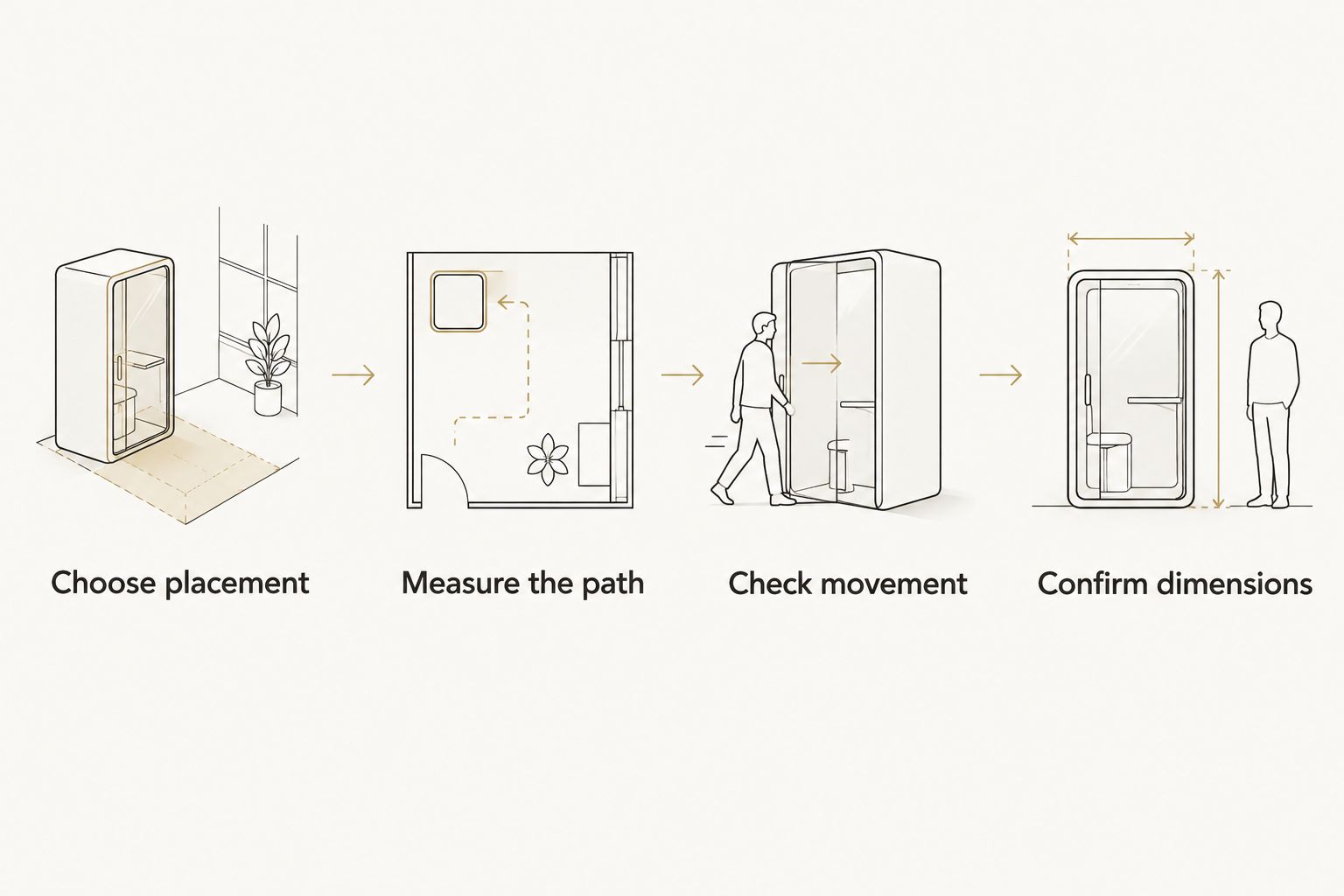
- Choose placement. Stand naturally and identify where you want the lowest part of the necklace to fall. Check the position with the neckline you wear most often.
- Measure the path. Drape the tape around the back of your neck and down to that position. Do not pull it tight to make the measurement look neater.
- Check movement. Turn your head, look down and sit normally. The intended position should not require you to hold a special posture.
- Confirm dimensions. Compare your measurement with the seller’s stated finished length. Ask whether that measurement includes the clasp and whether the necklace adjusts.
A cord helps you locate the necklace; it does not reproduce a set chain’s structure. Use it to choose placement, then assess the actual necklace’s drape and movement separately.
Use a necklace you already wear as a reference
Lay a comfortable necklace flat and measure it end to end, including its fastening. Note where it falls when worn and whether you like that position with open collars, crewnecks or other everyday necklines.
Copy the placement, not an assumption about fit. A fine chain and a continuous row of stone settings do not have identical construction. Matching their stated lengths does not establish that they will feel the same.
Choose width by the look you want every day
Start with the role you want the necklace to play. A narrower row suits a supporting accent; a wider row suits a focal point. Neither choice is automatically more wearable.
Compare width measurements using the same unit. 1 inch equals 25.4 millimeters, so convert measurements before comparing listings that use different systems. Do not compare a width in millimeters with a necklace length in inches as though they describe the same dimension.
Ask what the listed width measures:
- Stone diameter: The size across the stone, not necessarily the whole setting.
- Overall width: The outside measurement of the assembled row.
- Setting profile: How far the setting projects outward from its underside.
These details answer different questions. Overall width helps you judge visible coverage; setting profile helps you understand the shape you will wear against your body.
For a 2026 purchase, save the selected measurements alongside the exact option you are considering. A screenshot of an unselected product page is not a substitute for knowing which dimensions belong to your choice.
Narrower width: best for a supporting accent
Choose a narrower profile if you want the necklace to complement your outfit rather than dominate it. The advantage is a quieter visual line; the trade-off is less coverage when you want a statement.
Check close-up photographs as well as worn views. A distant photograph does not show you how the settings meet or how much metal surrounds each stone.
Wider width: best for a focal point
Choose a wider profile if the necklace is the main piece you want people to notice. The advantage is a broader line of sparkle; the trade-off is that the setting’s underside and profile deserve more attention before purchase.
Do not assume that wider means better made. Width describes size, not the quality of stone setting, link articulation or fastening.
Check length and width together
A width that appeals to you in isolation still needs to work at your chosen position. Judge the necklace as a complete shape around your neck and across your clothing.
Try your intended placement with the clothes you actually wear. A necklace that lands on a collar edge needs a different decision from one that sits clearly above or below it.
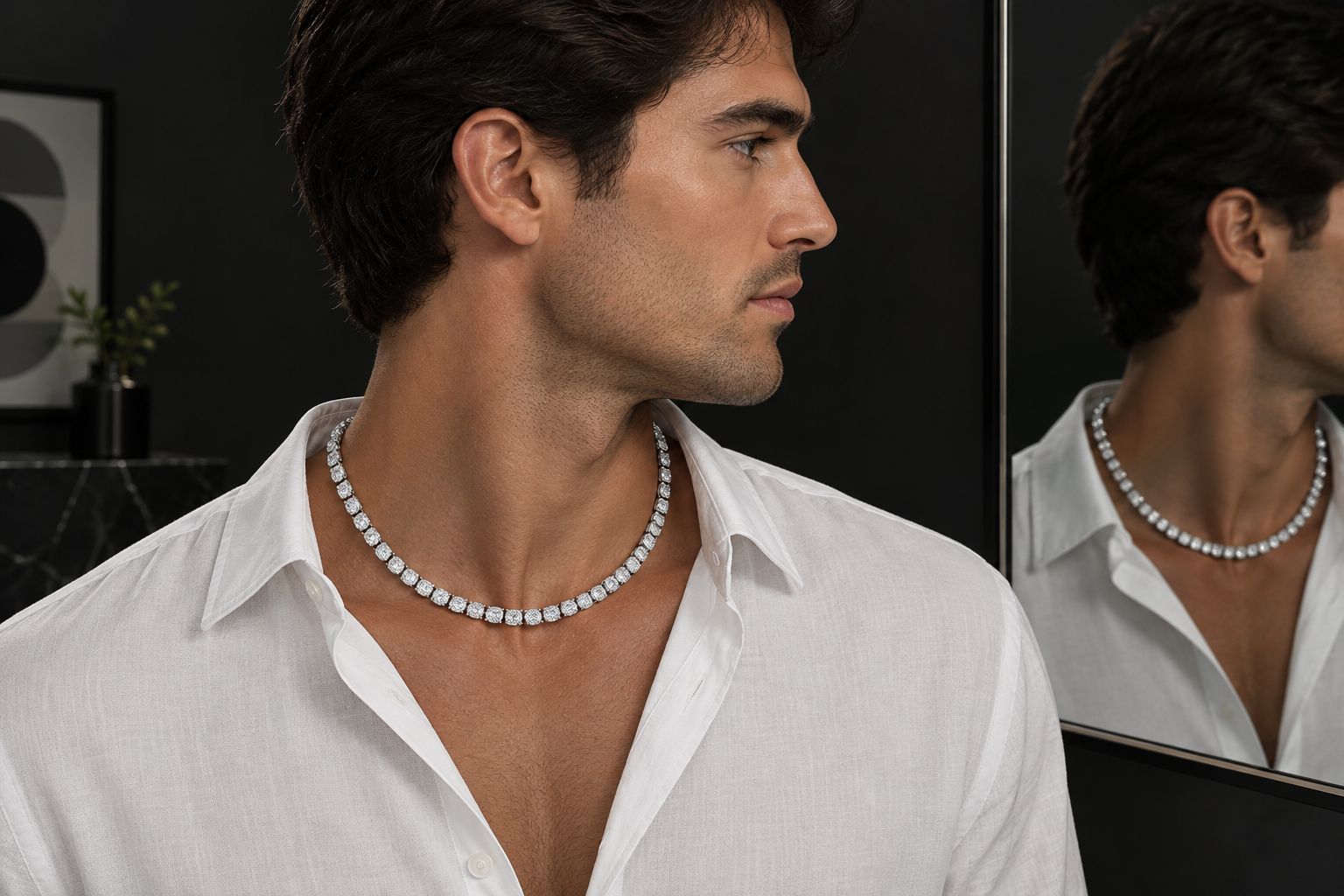
Resolve neckline contact before changing width. If the necklace lands exactly where your shirt folds, first reconsider its placement. A different width does not necessarily solve a length problem.
If you layer necklaces, check them together rather than separately. Keep the rows visually distinct if that is your goal, and watch for clasps or settings catching during ordinary movement. Do not assume that a pairing works because it looks separated while you stand still.
Why moissanite tennis chain fit varies
There is no universal best width or length because fit depends on more than the label attached to a necklace. Use these factors to explain what you see when comparing options.
- Placement: A higher position follows a different path from a lower position across the chest.
- Overall width: The outside of the settings determines the row’s visible breadth, not just the stone measurement.
- Setting profile: Basket shape and height change the form of the necklace against your body.
- Neckline: A collar, seam or fabric edge can occupy the same position as the chain.
- Articulation: The connections between settings determine how the assembled necklace bends.
- Clasp construction: The fastening is part of the finished necklace and needs its own fit and handling check.
Use this list when asking questions about a product. A clear answer about finished length is more useful than a general description such as comfortable or everyday-ready.
Verify the stone and metal before judging value
Moissanite is not a lab-grown diamond. Moissanite is silicon carbide; diamond is carbon. A chain described as moissanite should be assessed as moissanite, regardless of diamond comparisons in its sales copy.
Clarity language also does not answer your sizing questions. A VVS1 description does not establish necklace width, finished length, setting height or clasp construction.
For metal, separate composition from appearance:
- 925 sterling silver denotes silver with a fineness of 92.5%. Confirm that the specification applies to the selected chain.
- 18k gold denotes a gold alloy containing 75% gold. The phrase alone does not establish whether an entire piece is solid gold or whether gold is part of a surface layer.
- Gold color describes appearance. It does not identify the underlying metal or construction.
For your 2026 materials check, ask for the base metal and any surface treatment in plain language. Do not transfer specifications from another item in the same store to the chain you are considering.
What does the Tennis Chain establish about the design?
Lumina Jewelry Co.’s Tennis Chain is best for shoppers seeking a continuous row of brilliant-cut moissanite in four-prong basket settings. Its stated construction also identifies individually hand-set stones.
The design’s appeal is the uninterrupted row rather than a central pendant or alternating motif. Its limitation as a buying decision is straightforward: the setting description alone does not tell you the selected necklace’s width, length, metal or clasp.
Treat those details as separate checks. Choose the design because you want that row of sparkle, then confirm the specifications needed for your body and routine.
Should you choose chain length or width first?
Choose length first when your priority is where the necklace sits. Establish the path around your neck, then compare widths at that intended position.
If visual impact is your priority, identify the width you like before finalizing length. In either case, confirm the combination rather than treating either dimension as a complete fit recommendation.
Does a wider moissanite tennis chain mean better quality?
A wider moissanite tennis chain means a broader stated dimension, not better quality. Evaluate the actual stone identity, setting construction, metal specification and fastening separately.
For a 2026 shortlist, reject comparisons that use width as proof of workmanship. A dimension cannot establish how carefully a necklace was assembled.
Can you choose a chain from a worn photograph alone?
A worn photograph helps you judge styling, but it cannot establish your finished fit. The wearer’s proportions, posture and clothing differ from yours, and the image needs an identified chain size to serve as a useful reference.
Use photographs to narrow your preference. Use measurements and product-specific construction details to make the decision.
FAQ
What is the best moissanite tennis chain width for everyday wear?
The best everyday width is the one that gives you your preferred visual presence at a comfortable placement. Compare the full setting width and profile, not only the stone diameter.
How do I measure myself for a moissanite tennis chain?
Drape a flexible measuring tape along the path where you want the necklace to sit. Check that position while turning your head and sitting, then compare it with the seller’s finished necklace measurement.
Should a tennis chain sit above or below my collar?
Choose a position that works with your usual neckline without landing on an unwanted fold or seam. Check it in your everyday clothing rather than choosing from an isolated product photograph.
Is moissanite the same thing as a lab-grown diamond?
No. Moissanite is silicon carbide, while diamond is carbon. A moissanite tennis chain should be identified and assessed as moissanite.
Does 18k gold mean the entire chain is solid gold?
No. The phrase 18k gold identifies gold fineness but does not by itself establish the construction of the entire necklace. Confirm whether the piece is solid gold or has a gold surface layer over another metal.
What is the difference between stone size and chain width?
Stone size measures the gemstone, while overall chain width measures across the assembled row. Settings can contribute to the outside measurement, so ask which dimension the listing provides.
What should I check about a tennis chain clasp?
Check how the clasp operates, whether its measurement is included in the finished length and whether you can fasten it comfortably. Confirm any additional closure features from the specific product description.
One last thing
A perfect measurement taken in the wrong place is still the wrong fit. Before your 2026 checkout, put on your most-worn shirt and repeat the placement check while seated.
For a Lumina Jewelry Co. moissanite tennis chain, keep your chosen placement and the verified product dimensions together. Buy for the way you dress and move, not for a size label that sounds right.