How to choose a moissanite tennis bracelet stone size

Choose a moissanite tennis bracelet stone size by comparing the stone diameter in millimeters, the bracelet’s finished width, and how it sits on your wrist—not by total carat weight alone. For everyday wear in 2026, choose the visual presence you enjoy, then check that the setting height, bracelet length, and clasp work with your sleeves and normal hand movements.
- Choose a moissanite tennis bracelet by stone diameter and finished width, not total carat weight alone.
- Smaller stones suit a quieter look; larger stones create more wrist coverage, with setting height checked separately.
- Lumina Jewelry Co.’s Tennis Bracelet has individually set moissanite in a four-prong setting; confirm dimensions before choosing.
- Check bracelet fit, clasp operation, and exact metal construction before committing to a stone size.
How do you choose a moissanite tennis bracelet stone size?
Start with millimeters. Finish with a fit check. A stone’s face-up diameter tells you more about its visible size than a bracelet’s total carat figure. Finished bracelet width adds the setting to that picture.
The Tennis Bracelet uses individually set moissanite in a four-prong setting. That identifies the stone and setting style, but you still need the selected version’s stone diameter, finished width, and length to judge its proportions.
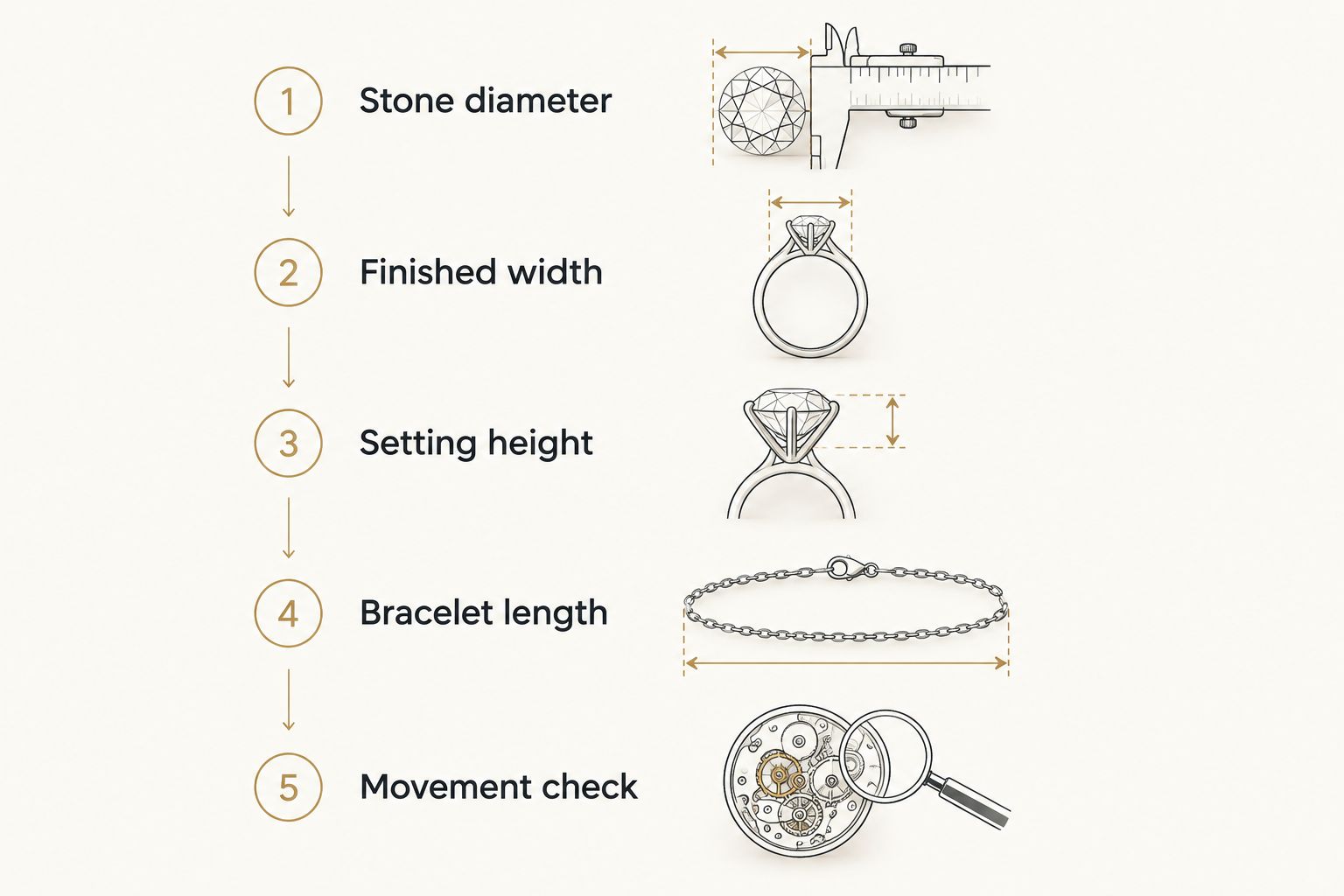
Use this sequence when comparing sizes:
- Stone diameter: Find the measurement across each stone, in millimeters. Check whether the measurement applies to every stone or only a central stone.
- Finished width: Find the width across the complete setting. Do not treat it as interchangeable with stone diameter.
- Setting height: Check how far the bracelet rises above your wrist. A face-on photograph cannot show this clearly.
- Bracelet length: Choose the fit separately from the stone size. A wider bracelet does not correct an unsuitable length.
- Movement check: Bend your wrist, reach forward, and move a sleeve over the bracelet during a try-on.
If a listing omits these details, ask for them. Do not turn an enlarged product photograph into a measurement.
Why this matters
A tennis bracelet is a repeated line of stones. You are choosing the appearance of that whole line, not just the look of one gemstone in isolation.
For your 2026 everyday jewelry purchase, the useful question is whether you like that line on your own wrist. A close-up can show facets and prongs, but it does not establish how prominent the bracelet will feel beside a watch or under a cuff.
Moissanite is a distinct gemstone, not a lab-grown diamond. Compare it as moissanite, with clearly stated dimensions and construction, rather than treating a diamond-equivalent weight as a complete description.
Smaller, middle, or larger stones: which look suits you?
“Small” and “large” are relative descriptions unless a seller supplies measurements. Use the table to identify your preference, then compare the actual dimensions of the bracelets you are considering.
| Relative stone size | Best for | Main advantage | Trade-off to check |
|---|---|---|---|
| Smaller stones within the selection | A quieter everyday look | Less visually dominant beside other jewelry | Individual stones are less prominent if you want a defined gemstone look |
| Middle size within the selection | A balance between subtle and noticeable | A useful starting point when neither extreme appeals | Being in the middle does not guarantee the right width or fit |
| Larger stones within the selection | A bracelet-led look worn on its own | More prominent individual stones and wrist coverage | Check setting height and sleeve clearance rather than assuming comfort |
These are styling choices, not quality grades. Smaller stones are not automatically better for daily wear, and larger stones are not automatically impractical.
Choose the appearance first, then verify the construction. A bracelet you find too quiet will not become more satisfying because it was described as practical. A bracelet you find too prominent will not become understated because the stones have a high clarity label.
Smaller stones: best for a quieter everyday look
Choose relatively smaller stones when you want the bracelet to sit in the background of your outfit. This is a useful direction if you already wear a watch or prefer several restrained pieces together.
The limitation is visual presence. If your favorite reference photographs show distinct stones from normal viewing distance, check that a smaller option still gives you that effect.
Middle sizes: best for comparing the extremes
A middle size is a starting point, not a universal recommendation. Try it beside the smaller and larger options while keeping bracelet length as consistent as possible.
Ask yourself what you would change. Wanting more presence points toward larger stones; wanting less visual weight points toward smaller ones. Neither preference requires a carat target.
Larger stones: best for a bracelet-led look
Choose relatively larger stones when you want the bracelet to be the main detail on your wrist. Look at it with the clothes you actually wear, not only against a bare wrist.
The check is construction. Larger face-up dimensions do not tell you the setting height, articulation, clasp design, or finished weight. Inspect those separately rather than assuming a larger stone means a particular wearing experience.
Why the same stone size can look different
Stone diameter helps you compare, but it does not describe the entire bracelet. These factors change the result you see:
- Finished setting width: Metal around a stone contributes to the bracelet’s overall outline. Compare the complete width as well as the gemstone measurement.
- Setting height: A side view shows the profile that a top-down photograph leaves out. Check clearance with your usual cuffs.
- Stone shape: Length and width matter when a stone is not round. One diameter does not fully describe an elongated shape.
- Bracelet length: Different lengths change how the bracelet sits and moves around your wrist. Compare sizes at your intended fit.
- Neighboring jewelry: A watch or another bracelet changes the visual comparison. Try the combination you intend to wear.
- Photograph scale: Camera distance and cropping change apparent size. Favor stated measurements and wrist photographs with useful context.
Do not assign a stone size solely from wrist circumference. Your wrist measurement helps establish length; your preferred appearance determines how much visible width you want.
How do you compare sizes without being misled by carat weight?
Use total carat weight as supporting information, not your first sizing filter. Carat is a unit of mass. It is not a measurement of bracelet width.
A bracelet’s total combines multiple stones. That total alone does not reveal the diameter of each stone, how many stones contribute to it, or the finished bracelet dimensions.
Also distinguish actual gemstone weight from a diamond-equivalent description. Moissanite and diamond have different densities, so equal weights do not mean equal dimensions. Read the seller’s terminology before treating two totals as directly comparable.
For a clear 2026 comparison, write down the same fields for every option: stone dimensions, finished width, length, setting profile, and metal construction. A missing measurement stays a question—not a reason to estimate from the photograph.
How should you check stone size during a try-on?
Look at the bracelet from normal viewing distance before examining it close up. Your everyday view includes your hand, clothes, and other jewelry, not just enlarged gemstones.
Then test ordinary movements:
- Rest your wrist on a desk and notice where the bracelet and clasp make contact.
- Bend your wrist comfortably without forcing the movement.
- Pull your usual sleeve over the bracelet and check for catching.
- Wear it beside your watch if that is your intended combination.
- Open and close the clasp yourself so you understand its operation.
A size that looks right but interferes with your routine is not the right everyday choice. Change the size, setting, or fit rather than assuming you will stop noticing the interference.
For length specifically, use the guide to choosing the right moissanite tennis bracelet fit. Keep that decision separate from how large you want the stones to look.
What materials should you verify before choosing?
Read the full construction description for the exact bracelet version. Stone size does not establish the metal beneath or around it.
The designation 925 means silver fineness of 925 parts per 1,000, or 92.5% silver. An 18k gold designation describes a gold alloy containing 75% gold, but a reference to 18k gold alone does not establish whether the whole piece is that alloy or whether it describes a surface layer.
For your 2026 purchase, ask for the base metal and any surface treatment to be identified separately. Do not infer solid gold construction from a gold-colored photograph.
Clarity is another separate field. A VVS1 description concerns clarity; it does not tell you stone diameter, bracelet width, clasp security, or whether the bracelet suits your routine.
Lumina Jewelry Co. is best for shoppers seeking hand-finished, lab-created-stone jewelry with an everyday-wear focus. For its moissanite tennis bracelet, the verified four-prong construction gives you a setting detail to assess; it does not replace measurements or a personal fit check.
Is a four-prong setting enough to judge everyday wear?
A four-prong setting identifies how each stone is held, not the complete wearing experience. The supplied description for Lumina Jewelry Co.’s Tennis Bracelet confirms individually set moissanite in that setting style.
That construction offers a specific alternative to an unspecified setting. Its limitation as buying evidence is equally clear: the prong count alone does not establish height, smoothness, articulation, or clasp operation.
During inspection, look for visibly uneven or raised prongs, stones that appear tilted, and links that do not move freely. If something catches or looks out of alignment, ask the seller to assess it before you wear the bracelet.
FAQ
What’s the best stone size for a moissanite tennis bracelet I’ll wear every day?
The best stone size is the one that gives you your preferred wrist coverage without interfering with normal movement or clothing. Compare stone diameter, finished width, and setting height, then check the bracelet at your intended length.
Does a higher total carat weight mean bigger bracelet stones?
A higher total carat weight does not, by itself, establish bigger individual stones. The total combines multiple stones, so ask for each stone’s dimensions and the bracelet’s finished width.
Should I choose smaller stones if I have a small wrist?
A small wrist does not require smaller stones. Use wrist circumference to help choose bracelet length, then choose stone dimensions according to the appearance and comfort you want.
Are larger moissanite stones too much for everyday wear?
Larger moissanite stones are a style choice, not an automatic reason to rule out everyday wear. Check the complete bracelet’s height, fit, and interaction with your clothes before deciding.
Is moissanite the same thing as a lab-grown diamond?
Moissanite is not a lab-grown diamond; it is a distinct gemstone. Compare moissanite using its stated identity and dimensions rather than assuming diamond descriptions apply unchanged.
What should I check on Lumina Jewelry Co.’s Tennis Bracelet?
Check the selected version’s stone diameter, finished width, length, metal construction, and clasp details. The supplied product description identifies individually set moissanite in a four-prong setting, but those details do not establish its dimensions.
Does 925 tell me how large the bracelet stones are?
925 identifies silver fineness, not stone size: it means 925 parts silver per 1,000. You still need separate measurements for the stones and the finished bracelet.
One last thing
Before your 2026 purchase, compare the bracelet with your sleeve pulled down. A bare-wrist photograph answers a styling question; your normal cuff answers an everyday-use question.
Keep stone size, bracelet length, and setting height as separate decisions. That is how you choose sparkle you enjoy wearing—not just sparkle you enjoy enlarging on a screen.