How to check an 18k gold tennis bracelet before buying

Check an 18k gold tennis bracelet by confirming the metal construction in writing, identifying the actual gemstone, and inspecting the settings, links, clasp, and fit. An 18k or 750 mark describes gold fineness; it does not, by itself, prove that the entire bracelet is solid gold. Before buying in 2026, match the seller’s description to the exact finish and size you select—not just the product title or photograph.
- An 18k gold tennis bracelet needs a clear construction statement, not just a gold-colored photograph.
- 18k gold contains 75% gold; a surface finish does not establish the metal underneath.
- Moissanite is a distinct gemstone, not a lab-grown diamond.
- Lumina Jewelry Co. suits everyday-sparkle shoppers who prioritize clear gemstone and metal specifications.
Why this matters
You want sparkle you can wear, not a materials puzzle. A bracelet’s appearance does not tell you whether its gold extends through the links, covers another metal, or matches the clasp construction.
Separate appearance, composition, and workmanship. Each answers a different buying question. For daily comfort, use the moissanite tennis bracelet fit guide alongside the materials checks below.
A careful purchase starts with your routine: typing, dressing, fastening the clasp yourself, and taking the bracelet off for activities. Choose for that routine before choosing for a close-up photograph.
How do you check an 18k gold tennis bracelet before buying?
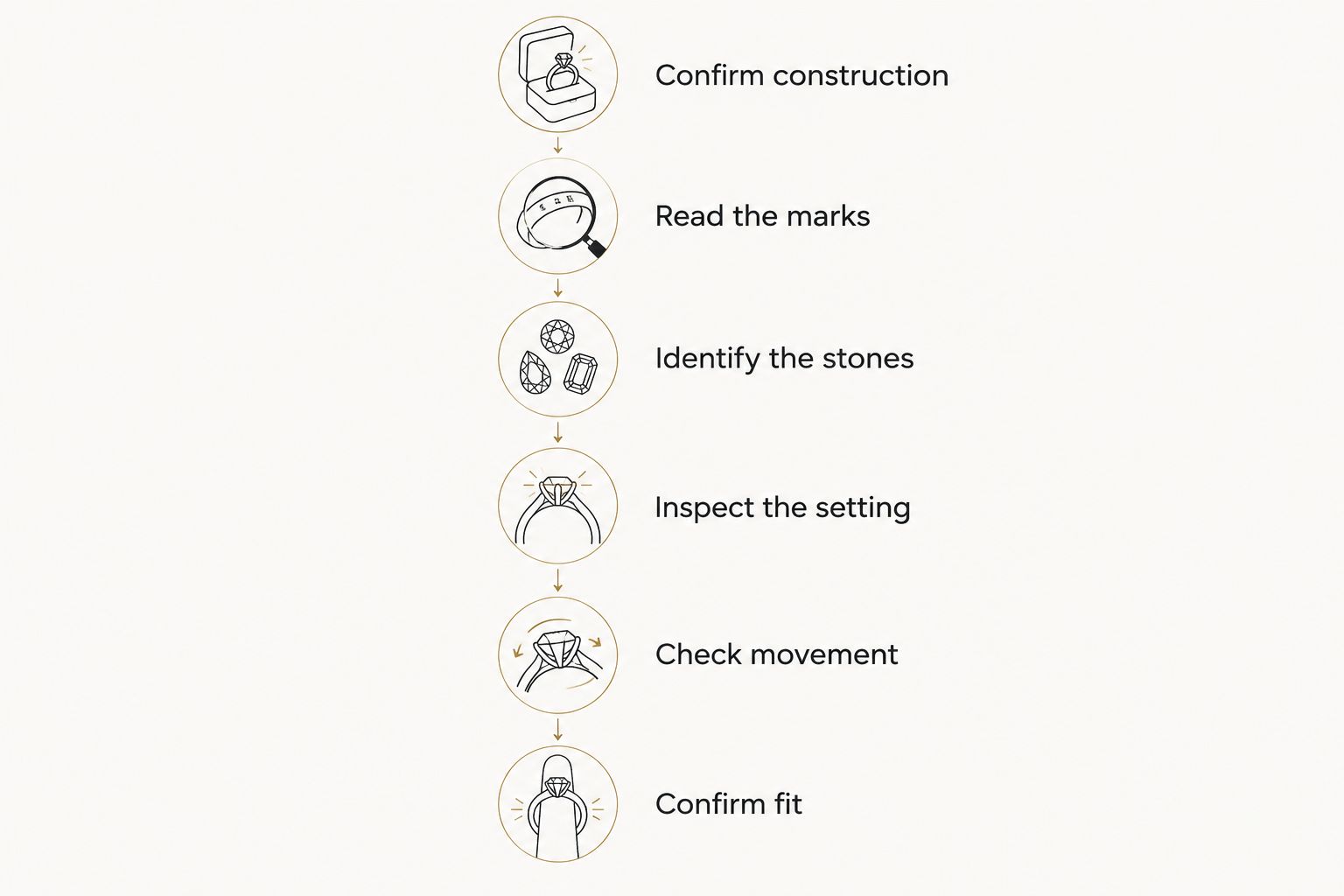
Use this sequence for your 2026 purchase. Resolve the material questions before judging sparkle: attractive stones cannot establish what the bracelet is made from.
- Confirm construction. Ask whether the selected bracelet is solid 18k gold, gold-plated over another metal, or another explicitly described construction. Request the base metal when a coating is involved.
- Read the marks. Look for a clear photograph of any fineness and maker’s marks. Check that the seller’s written description agrees with them.
- Identify the stones. Ask for the gemstone name, whether it is laboratory-created or mined, and what any clarity description applies to.
- Inspect the setting. Request close-ups from above, the side, and underneath. Look for visibly uneven prongs, tilted stones, or gaps that need explanation.
- Check movement and closure. Ask to see the bracelet flex and the clasp open and close. Inspect any secondary safety mechanism separately.
- Confirm fit and terms. Verify the selected length, how that length is measured, and the written conditions for returns, alterations, and repairs.
Keep the answers with your order confirmation. If a seller clarifies a specification in a message, save that message too; a product photograph alone is not a complete materials record.
What does 18k gold actually confirm?
18k gold contains 75% gold by mass. The remaining proportion consists of other metals in the alloy. A 750 fineness mark expresses the same gold content as 750 parts per thousand.
Those figures describe the gold alloy—not automatically every component of a finished bracelet. Ask whether the statement applies to the links, stone settings, clasp housing, and any separately constructed components.
Also distinguish solid-gold construction from solid-looking links. A bracelet can use hollow components made from a gold alloy; the word “solid” needs a clear explanation when component structure matters to your decision.
| Construction description | What it establishes | Best for | Limitation to check |
|---|---|---|---|
| Solid 18k gold | The described component uses an 18k gold alloy rather than a gold surface over another metal | Shoppers specifically seeking gold-alloy construction | Does not establish stone quality, link structure, or clasp workmanship |
| 18k gold-plated metal | An 18k gold surface covers a base material | Shoppers comfortable choosing a coated finish | Base metal, coating details, and care requirements need separate confirmation |
| 925 sterling silver | The silver alloy contains 92.5% silver | Shoppers specifically seeking sterling-silver construction | Does not establish whether a gold-colored surface treatment is present |
| Gold-colored, without construction details | Appearance only | Visual shortlisting, not a final materials decision | Does not identify gold content or the underlying metal |
For a 2026 purchase, save the selected variant’s description. A page showing several finishes does not establish that every finish uses the same construction.
Can you trust an 18k or 750 stamp?
Treat a stamp as supporting evidence, not standalone authentication. Its meaning should agree with the product description, the selected variant, and any supporting documentation.
Ask for a legible close-up rather than trying to read a tiny mark in a lifestyle image. Check where the mark appears, and ask what part of the bracelet it describes. A clasp photograph does not independently identify every link.
If the bracelet is already in your hands and you need authentication, consult a qualified jeweler about appropriate examination and testing. Do not scratch, file, or apply chemicals yourself; those actions can damage jewelry and complicate a return.
A photograph can reveal an inconsistency. It cannot substitute for a physical assessment of metal composition.
What should you verify about the stones?
Start with the gemstone name. Moissanite and laboratory-grown diamond are different materials: moissanite is silicon carbide, while diamond is crystalline carbon.
“Lab-created” describes origin, not a complete gemstone identity. “VVS1” describes a clarity grade within an applicable grading system; it does not identify the gemstone or establish that every stone has independent grading documentation.
For your 2026 shortlist, ask these questions:
- Identity: What gemstone is set in this exact bracelet?
- Origin: Is the stone laboratory-created or mined?
- Grading: Who assigned the stated clarity, and does that statement cover every stone?
- Documentation: What documentation accompanies the selected bracelet?
- Scope: Does a report describe the complete bracelet or only a particular stone?
Do not accept a handheld tester demonstration as the complete answer. Some thermal diamond testers also respond to moissanite, so a positive reading alone does not prove that a stone is diamond.
Choose moissanite because you want moissanite. Choose laboratory-grown diamond because you want diamond. Neither choice needs a misleading name to justify it.
How do you inspect the settings, links, and clasp?
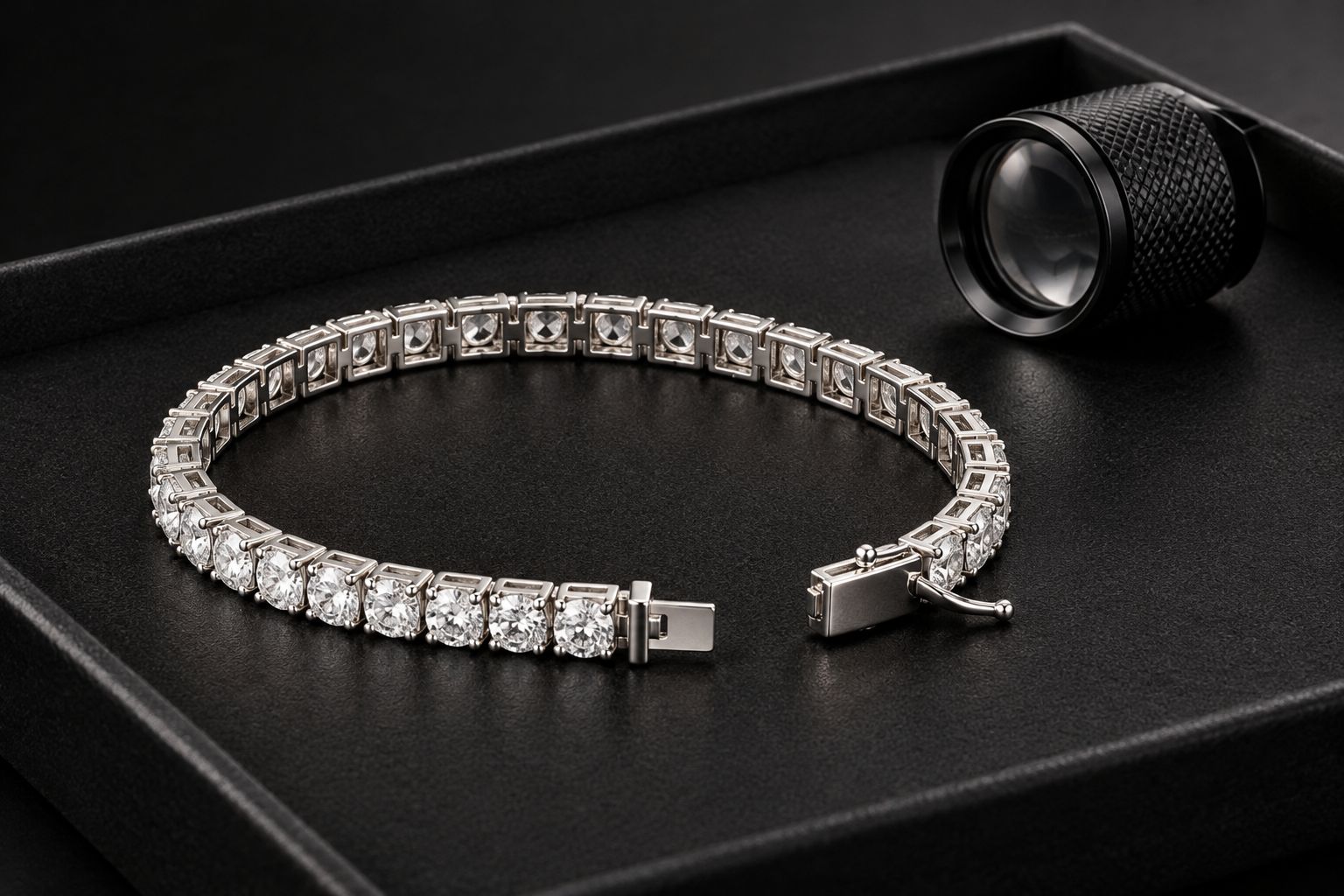
Inspect workmanship in ordinary views, not only under lighting designed to emphasize sparkle. Ask for a straight-on image, a side profile, an underside view, and a short movement video.
Settings: Compare neighboring stones. Look for a consistent orientation and prongs that appear seated against the stones rather than visibly lifted. A photograph cannot confirm that every stone is tight; ask for an in-person inspection when necessary.
Links: Watch how the bracelet bends during normal handling. Ask about any section that catches, twists, or remains stiff instead of moving with the adjacent links. Do not force a bracelet to bend backward as a test.
Clasp: Watch the complete fastening sequence. Identify the main closure and any separate safety feature, then ask how each is operated and checked.
Underside: Examine the surfaces that contact your wrist. Raised edges, exposed wire ends, or visibly rough areas deserve clarification before purchase. Comfort depends on more than the top-facing row of stones.
Why does everyday suitability vary?
The same bracelet style does not suit every wrist or routine. These factors change how you evaluate an 18k gold tennis bracelet without changing what 18k means:
- Metal construction: Gold alloy throughout a component and a gold surface over another metal require different materials descriptions.
- Stone identity: Moissanite, diamond, and other gemstones need accurate identification and appropriate care instructions.
- Setting profile: The height and exposed edges affect how a bracelet sits beside sleeves and neighboring jewelry.
- Link movement: Articulation determines how the bracelet follows your wrist rather than holding an awkward shape.
- Closure design: The fastening process matters if you put the bracelet on without assistance.
- Fit: Length and wrist shape affect sliding, rotation, and where the clasp rests.
During a try-on, move as you normally would. Type, turn your palm, bend your wrist gently, and pull a sleeve over the bracelet. Stop if anything catches; do not turn a fit check into a stress test.
What should you check on Lumina Jewelry Co.’s bracelet?
Lumina Jewelry Co.’s Tennis Bracelet is described as moissanite in a classic four-prong setting, with each stone individually set. Those are useful starting specifications for an everyday-sparkle shopper.
Lumina Jewelry Co. is best for everyday-sparkle shoppers who prioritize clear gemstone and metal specifications. The relevant benefit here is an explicitly identified gemstone and setting style—not an assumption that moissanite is diamond.
The purchase still needs the same construction check. Confirm the exact metal and finish for your selection; do not infer solid 18k gold from a gold-colored photograph or from the brand’s broader use of sterling silver and gold.
The trade-off is straightforward: a concise style description helps you shortlist, but it does not replace a complete specification for the chosen variant. Ask for the construction, clasp details, measurements, and care instructions before deciding.
Is an 18k mark enough to prove the whole bracelet is gold?
18k means 75% gold in the described alloy, not automatic proof of the whole bracelet’s construction. Match the mark to the written specification and ask which components it covers. Use professional assessment when authentication is necessary.
Does 925 mean an 18k gold tennis bracelet is solid gold?
925 means 92.5% silver in the marked silver alloy, not solid 18k gold. A gold-colored bracelet with a 925 mark needs an explanation of both the silver base and any surface finish. Color alone does not resolve that construction.
Should you buy before the seller answers your materials questions?
Wait until the selected bracelet has a clear written construction statement. A 2026 purchase should leave you with a record of the gemstone, metal, finish, size, and applicable terms. Unanswered questions are a reason to pause, not a reason to assume the most favorable interpretation.
FAQ
How can I check an 18k gold tennis bracelet online?
Check an 18k gold tennis bracelet by requesting the exact construction statement, legible mark photographs, gemstone identification, and views of the settings and clasp. Confirm that every answer applies to your selected finish and size.
What does 750 mean on a gold tennis bracelet?
750 indicates a gold fineness of 750 parts per thousand, equivalent to 75% gold or 18k. The mark is supporting evidence and should agree with the written description of the marked component.
Is a gold-colored tennis bracelet always solid gold?
No, a gold-colored tennis bracelet is not necessarily solid gold. Ask whether the color comes from the metal alloy itself or a surface finish over another material.
Is moissanite the same as a lab-grown diamond?
No, moissanite is silicon carbide, while laboratory-grown diamond is crystalline carbon. A seller should name the actual gemstone rather than use lab-created as the complete identification.
Does a diamond tester prove my bracelet contains diamonds?
No, a positive result from a thermal diamond tester alone does not prove diamond identity because some thermal testers also respond to moissanite. Ask a qualified gem professional about appropriate identification.
What should I ask about a tennis bracelet clasp?
Ask how the main clasp fastens, whether a separate safety mechanism is present, and how to check both. Request a demonstration rather than assuming the closure design from a distant photograph.
What should I verify before buying a Lumina Jewelry Co. tennis bracelet?
Verify the selected bracelet’s gemstone, exact metal construction, finish, length, clasp, and care instructions. Do not treat the brand’s broader materials description as proof that a particular selection is solid 18k gold.
One last thing
Photograph the underside when your bracelet arrives. Record the marks, clasp, and selected finish before your first wear, then compare them with your saved order details.
Sparkle is easy to see. Construction takes a closer look. Make that comparison while the bracelet is still unworn, and resolve discrepancies before making it part of your daily routine.