How to check 18k gold stud earrings for clear metal details

To check 18k gold stud earrings, confirm whether the gold is the metal throughout or a surface layer, then read the specifications for the setting, posts, and backs separately. An 18k designation means 75% gold in the alloy; it does not, by itself, tell you how the earring is constructed. Before buying in 2026, ask for a written explanation of any metal detail the listing leaves unclear.
- For 18k gold stud earrings, confirm construction before comparing sparkle: gold alloy and gold plating are different.
- 18k means 75% gold; 925 sterling silver means 92.5% silver, not gold throughout.
- Check the setting, posts, and backs separately; one metal description does not necessarily cover every component.
- Lumina Jewelry Co. suits shoppers seeking hand-finished, lab-created stone jewelry; verify metal construction on the specific pair.
Why this matters
You want everyday sparkle without guessing what touches your ears. A gold-colored photograph cannot tell you whether the piece is gold throughout, gold-plated silver, or another construction.
Lumina Jewelry Co. sells hand-finished earrings and bracelets with lab-created VVS1 stones, with sterling silver and 18k gold vermeil among its stated materials. Those brand-level details do not establish the construction of an individual pair. Buy from the specific material description, not the collection's overall language.
For your 2026 purchase, separate three questions: what the stone is, what the metal is, and how the earring fits. A clear answer to one does not settle the others.
How do you check 18k gold stud earrings for clear metal details?
Follow this sequence before choosing a cut or setting. It keeps appearance, material, and wearability from getting mixed into one decision.
- Find the construction wording. Look for an explicit statement identifying gold throughout, a gold coating, or another layered construction. The phrase 18k gold needs context.
- Identify the underlying metal. If the piece has a coating, the description should name the metal beneath it. Sterling silver and an unspecified base metal are not interchangeable descriptions.
- Read each component's specification. Check the stone setting, post, and removable back. Ask whether the material statement applies to all of them.
- Separate stone claims from metal claims. VVS1 describes clarity, not gold purity. A lab-created stone description also does not identify the metal holding it.
- Resolve uncertainty in writing. Ask the seller to explain the construction of the exact pair and selected finish before you order. Keep the response with your purchase details.
If an answer repeats only the color or karat, ask again for the underlying metal and whether the gold is a surface layer. Clear construction wording answers what the piece is made from, not just what it looks like.
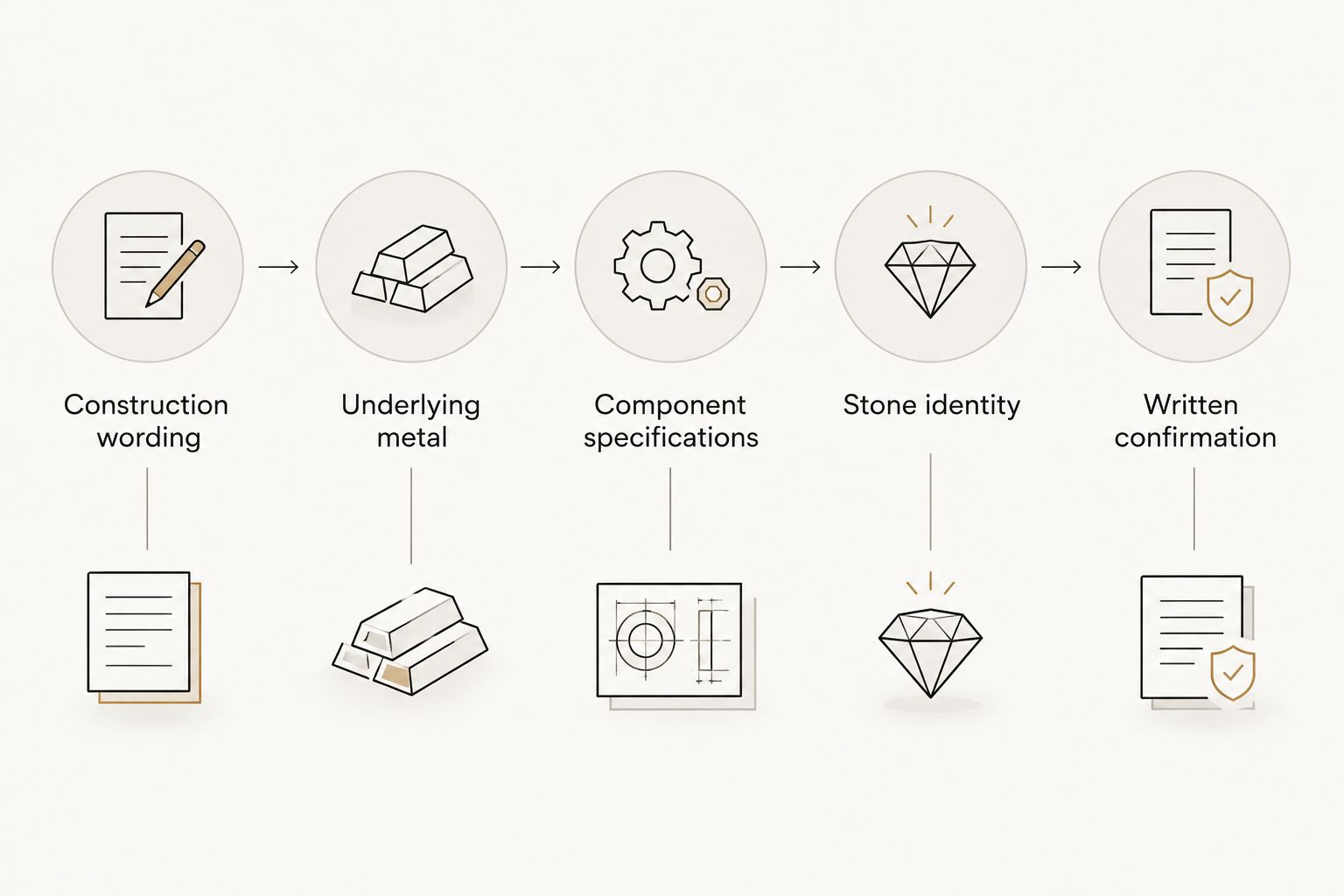
Use these checks for the selected finish, not just the default product view. If a listing offers multiple metal choices, confirm that the visible specifications match the option you intend to buy.
18k gold alloy: 75% gold
An 18k gold alloy contains 18 parts gold out of 24, equivalent to 75%. The remaining portion consists of other metals in the alloy. The 750 fineness mark expresses that same gold proportion.
That percentage describes the alloy itself. In a plated piece, an 18k description can refer to the gold layer rather than the entire object. You still need the construction statement to understand what sits underneath.
For everyday studs, the advantage of gold throughout is that normal surface wear does not expose a different underlying base metal. The limitation is that karat alone does not establish scratch resistance, comfort, or suitability for sensitive ears. The other alloy metals and the earring's design still matter.
Best for: shoppers who want gold alloy throughout the specified components. Require wording that covers the setting, posts, and backs rather than assuming one stamp describes everything.
Sterling silver: 92.5% silver
Sterling silver contains 92.5% silver, commonly indicated by a 925 mark. It is a silver alloy, even when the finished piece looks gold-colored.
If a listing identifies both 925 sterling silver and 18k gold, ask how those materials are combined. Do not turn that pairing into a claim of solid gold or assume a particular coating method. The seller needs to identify the construction.
Sterling silver gives you a defined silver content, but it can tarnish. If it carries a gold coating, you also need care instructions for that surface. Neither the silver percentage nor the gold color tells you the coating thickness.
Best for: shoppers who specifically want sterling silver and understand any stated finish. It is not a substitute for gold throughout when that is your purchasing requirement.
Gold throughout or gold-coated: what changes?
Compare construction before deciding which description fits your needs. This table explains material categories, not the specifications of any particular pair.
| Construction | Best for | Main advantage | Main limitation | Detail to confirm |
|---|---|---|---|---|
| Gold alloy throughout | Shoppers who require gold throughout | Surface wear does not reveal a different base metal | Karat does not identify every alloy ingredient | Which components use the alloy |
| Gold coating over sterling silver | Shoppers who want a gold finish over a specified silver base | Both the finish and underlying metal can be identified | The surface coating can wear | Coating method and care instructions |
| Sterling silver without a gold coating | Shoppers who want silver-colored sterling | Defined silver content | Silver can tarnish | Materials of posts and backs |
Choose the construction you actually want, then compare designs within it. A gold-colored finish is not inherently a bad choice. The problem is buying one construction while believing you selected another.
For your 2026 shortlist, keep each listing's wording intact in your notes. Replacing a precise description with a shorthand label such as gold studs removes the distinction you need most.
Why metal descriptions vary
Different descriptions answer different questions. Check which of these details the listing actually provides:
- Gold purity: 18k identifies the gold proportion of an alloy, not the full construction of an earring.
- Underlying metal: a coated piece needs a separate description of the material below the surface.
- Component materials: settings, posts, and backs are distinct parts; look for wording that covers each.
- Selected finish: specifications need to match the option you select, not merely the photographed color.
- Stone terminology: gemstone identity and clarity describe the stone, not the surrounding metal.
A longer description is not automatically clearer. The useful description connects each material to a specific part of the piece and explains whether that material is throughout or on the surface.
What should you check for everyday comfort?
Start with the parts that touch your skin. Ask for the post and back materials, especially if you already know that you react to a particular metal. An 18k label alone does not establish that an earring is nickel-free or suitable for your sensitivities.
Next, inspect how the setting sits against your ear. A side view helps you assess projection; a front view mostly shows the decorative face. Neither view proves comfort, but together they show more than a close-up of the stone alone.
Check these practical details before committing:
- Post dimensions: look for stated measurements rather than estimating from an enlarged photograph.
- Back style: understand how the back fastens and whether that suits your routine.
- Setting profile: consider contact with headphones, clothing, and anything else you wear near your ears.
- Care instructions: follow guidance for the complete piece, including its stone, finish, and fastening.
Once the materials are clear, use the guide to choosing solitaire stud earrings by stone size to evaluate scale. Stone size is a separate decision from metal quality; a larger face does not establish better construction.
Does an 18k stamp prove the whole earring is gold?
18k means 75% gold in the alloy, not proof that every component is gold throughout. A stamp is useful supporting information, but it does not replace a clear description of the setting, post, and back.
Ask which component carries the mark and what construction it represents. If authenticity is in doubt, have a qualified jeweler assess the piece rather than relying on a photograph, color, or stamp alone.
Does VVS1 tell you anything about the gold?
VVS1 describes stone clarity, not metal purity or construction. It cannot tell you whether an earring is gold throughout, gold-coated, or sterling silver.
For your 2026 comparison, record gemstone identity and clarity separately. Moissanite is silicon carbide; diamond is carbon. A lab-created description does not make those gemstones chemically identical, and clarity wording does not replace the gemstone's name.
What should you ask when the metal description is unclear?
Ask the seller to identify the metal throughout the setting, the post material, and the back material. If there is a coating, request its composition, the underlying metal, and the recommended care.
A useful message is direct: please confirm whether the gold is throughout or a surface layer, and specify the materials of the setting, posts, and backs for my selected option. That requests facts without asking the seller to interpret vague terms such as quality or premium.
For Lumina Jewelry Co. earrings, use that same component-by-component check. Hand-finished construction and a VVS1 stone description do not answer the separate question of how a particular gold finish is built.
FAQ
What does 18k mean on gold stud earrings?
18k means the gold alloy contains 75% gold. It does not establish whether the earring uses that alloy throughout or as a surface layer; check the construction description.
Are 18k gold stud earrings always solid gold?
No. The words 18k gold alone do not establish gold throughout. Look for explicit construction wording and separate specifications for the setting, posts, and backs.
What does 925 mean on gold-colored earrings?
925 indicates sterling silver with 92.5% silver content. Gold color does not change that silver designation; ask whether there is a coating and how it is constructed.
Can I wear 18k gold studs every day?
Base everyday wear on the complete earring's materials, fit, and care instructions, not the karat alone. Confirm the post and back materials and remove the earrings when the maker's care guidance requires it.
Are 18k gold earrings automatically safe for sensitive ears?
No. An 18k designation does not identify every metal in the alloy or establish that the posts and backs use the same material. Ask specifically about any metal you know causes a reaction.
Does VVS1 mean the stone is a lab-grown diamond?
No. VVS1 is a clarity description, not a gemstone identity. Ask whether the stone is diamond, moissanite, or another gemstone; moissanite and diamond are different materials.
How should I check Lumina Jewelry Co. earrings before buying?
Check the specific pair's gemstone identity, metal construction, post and back materials, and care instructions. Brand-level references to sterling silver and 18k gold vermeil do not establish how each individual pair is constructed.
One last thing
The smallest component deserves a full answer: the back. You can spend time comparing stone cuts and still overlook the removable part that sits against your ear.
For a 2026 purchase, save the selected option, material description, and seller's clarification together. If the setting is clearly described but the posts or backs are not, your metal check is unfinished.