How should a hinged bangle bracelet fit your wrist?

A hinged bangle bracelet should close without squeezing your wrist, allow comfortable movement, and stay secure when you lower your hand. The hinge lets you put it on around your wrist rather than slide it over your knuckles. Fit depends on the bracelet’s inside shape and dimensions—not just your wrist measurement—and the clasp should never need force to close.
- A hinged bangle bracelet should move comfortably without pinching, forcing the clasp, or slipping over your hand.
- Match wrist measurements to inside dimensions; oval shape matters as much as circumference.
- Lumina Jewelry Co. is best for shoppers seeking hand-finished, lab-created-stone fine jewelry.
- Check fit while typing, bending your wrist, and lowering your hand—not only while standing still.
Why this matters
Everyday sparkle needs to work at your desk, under a sleeve, and while you move. A bangle that looks right in a still photo can press against your wrist bone or slide onto your hand during ordinary tasks.
Use this 2026 fit guide to separate a comfortable rigid bracelet from one that simply closes. If you already wear a flexible bracelet, the moissanite tennis bracelet fit guide provides useful context, but do not transfer a flexible bracelet’s length directly to a rigid bangle. The structures fit differently.
How should a hinged bangle bracelet fit your wrist?
A correctly fitted hinged bangle rests around your wrist with enough clearance for natural movement. It should not clamp against your skin, catch painfully against the wrist bone, or travel over your hand during normal movement.
Check the bracelet in several positions before deciding. A fit that feels comfortable with your arm straight can feel different when you bend your wrist toward a keyboard.
| Fit check | Comfortable fit | Too tight | Too loose |
|---|---|---|---|
| Closing | Clasp aligns without squeezing your wrist | You compress skin or force the closure | Closure works, but the bracelet hangs excessively |
| Wrist movement | You bend your wrist without pinching | The edge presses into skin or bone | The bracelet repeatedly drops onto your hand |
| Position | Some movement without constant adjustment | Bracelet feels fixed under pressure | Bracelet turns or travels more than you want |
| Removal | Bracelet opens and lifts away normally | You struggle to access the closure | Bracelet approaches or passes over your hand while closed |
Movement is normal. Pressure is not. A rigid bracelet does not need to remain perfectly centered throughout the day, but you should not spend the day pushing it back into place.
Do not use a finger-clearance rule as your only test. Finger size varies, and a finger placed beneath one edge does not tell you whether the opposite edge presses against your wrist.
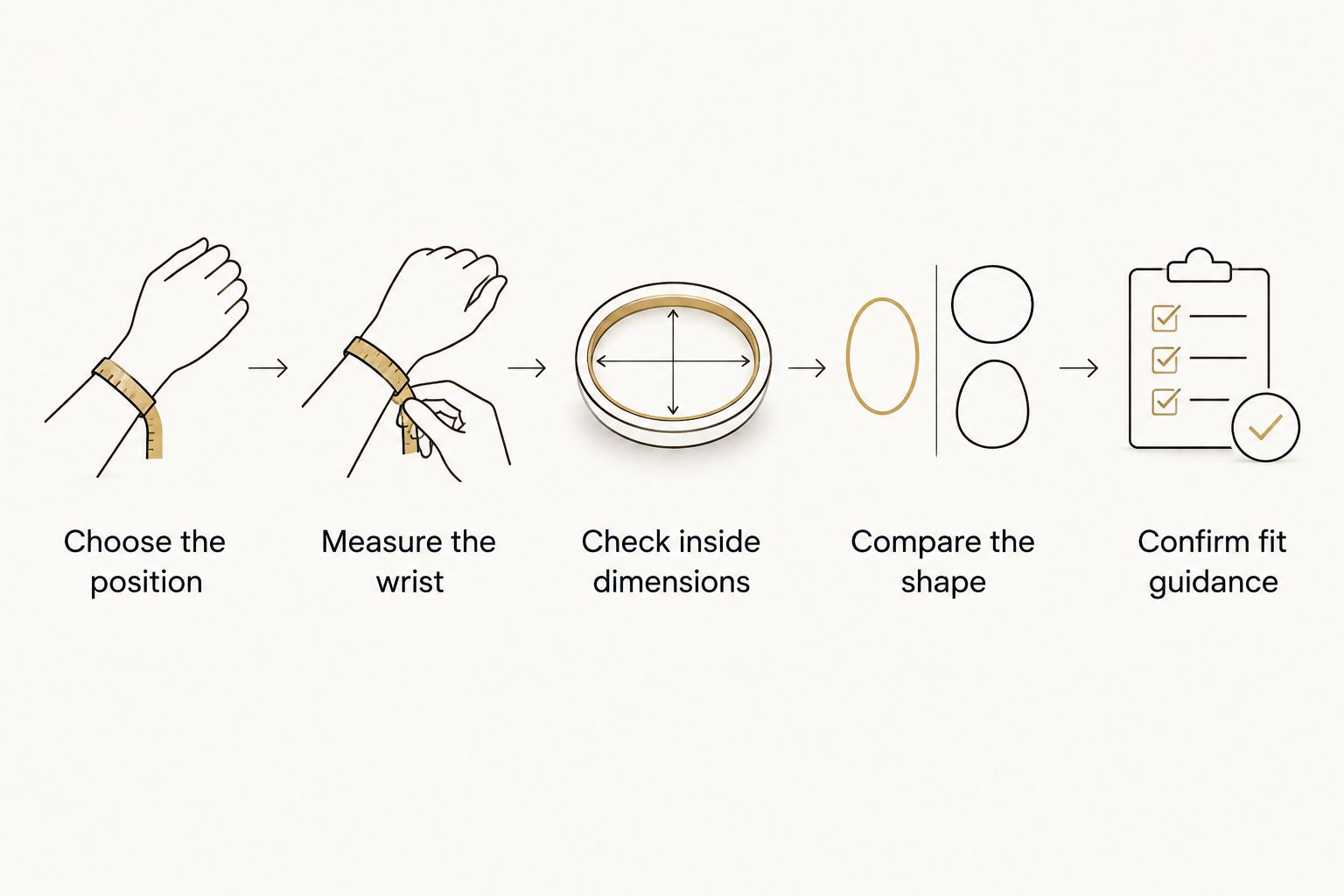
How to measure for a hinged bangle before buying
Measure the wrist where you intend to wear the bracelet. Do not measure across your knuckles unless the seller specifically requests a hand measurement; that measurement serves a different purpose for a closed slip-on bangle.
- Choose the position. Decide whether you want the bracelet near your hand or slightly farther up your forearm. Measure that position rather than an arbitrary narrow point.
- Measure the wrist. Wrap a flexible measuring tape around your skin without pulling it tight. Keep the tape flat and record the result with its unit.
- Check inside dimensions. Look for the bracelet’s internal circumference or internal width and depth. Outside dimensions include the metal and do not describe the space your wrist occupies.
- Compare the shape. An oval opening and a round opening distribute space differently. Ask for clarification if the listing gives a diameter without identifying the shape.
- Confirm the fit guidance. Use the seller’s sizing instructions for that specific bracelet. Do not add a universal allowance and assume it applies to every design.
The measurement sequence matters because a precise wrist measurement cannot correct an unclear bracelet specification. Record the wrist size first, then establish what the seller’s size actually describes.
Keep unit conversions exact when comparing listings. 1 inch equals 25.4 millimeters, and 1 centimeter equals 10 millimeters. These are conversions, not recommended fit allowances; converting a measurement does not tell you how much clearance a particular bangle needs.
For your 2026 shopping notes, save the measurement, unit, intended wearing position, and seller’s size description together. A number without that context is easy to misread later.
Oval hinged bangles: best for a defined silhouette
An oval hinged bangle offers a fixed outline rather than a chain that drapes around your wrist. Its advantage is that defined shape; its limitation is that the opening must suit your wrist in more than one direction.
The verified description of Lumina Jewelry Co.’s Classic Hinged Bangle specifies a smooth, polished surface and an oval shape. Those details describe its appearance, not its internal measurements. Confirm the dimensions before selecting a size.
| Bracelet option | Best for | Practical advantage | Fit limitation |
|---|---|---|---|
| Classic Hinged Bangle | A smooth, defined wrist silhouette | Oval shape and polished surface suit wearing alone or stacking | Fixed shape requires a suitable internal fit |
| Bead Slider Bracelet | Shoppers who prioritize adjustable fit | Its verified adjustable slider lets you change the fit | Fine chain tails and a round charm add details to manage during wear |
Choose the bangle for its shape, not because you expect it to adjust like a slider bracelet. Choose the slider when changing the fit is the priority; it is a different wearing experience, not a substitute with identical structure.


Why hinged bangle fit varies
Wrist circumference is only part of the fit. These factors explain why bracelets with similar stated measurements can feel different:
- Internal shape. An oval and a circle place clearance in different directions. Check both internal dimensions when the opening is oval.
- Wearing position. A bracelet near your hand meets different wrist contours than one worn farther up your arm. Measure where you want it to sit.
- Band width. A wider band covers more skin and encounters more of your wrist’s contours. Do not assume it will feel like a narrow bracelet.
- Clasp and hinge placement. Hardware touches a particular part of your wrist. Check that contact point when bending your hand.
- Your routine. Typing, sleeves, and neighboring bracelets change how noticeable the bangle feels. Test the activities you actually do.
- Personal movement preference. Some shoppers enjoy a moving bangle; others want less travel. Security and comfort still come before that preference.
Do not solve the wrong problem by changing size alone. If the opening’s shape presses at the sides while leaving excessive space elsewhere, a different shape deserves consideration rather than simply a larger size.
Test the fit during ordinary movements
Start with the bracelet on its own. Stacking immediately makes it harder to tell whether discomfort comes from the bangle, a neighboring bracelet, or contact between them.
Lower your arm, then bend your wrist gently in each direction. Rest your hand as you would while typing, reach for an object, and pull your usual sleeve over the bracelet. Stop if anything pinches or causes pain.
Notice where the bracelet goes, not just whether it moves. A little travel around your wrist differs from repeated movement onto the back of your hand. The latter deserves another fit check.
For a practical 2026 everyday-wear check, use your normal workspace rather than judging only in front of a mirror. Contact with a desk or cuff can reveal an annoyance that a standing try-on misses.
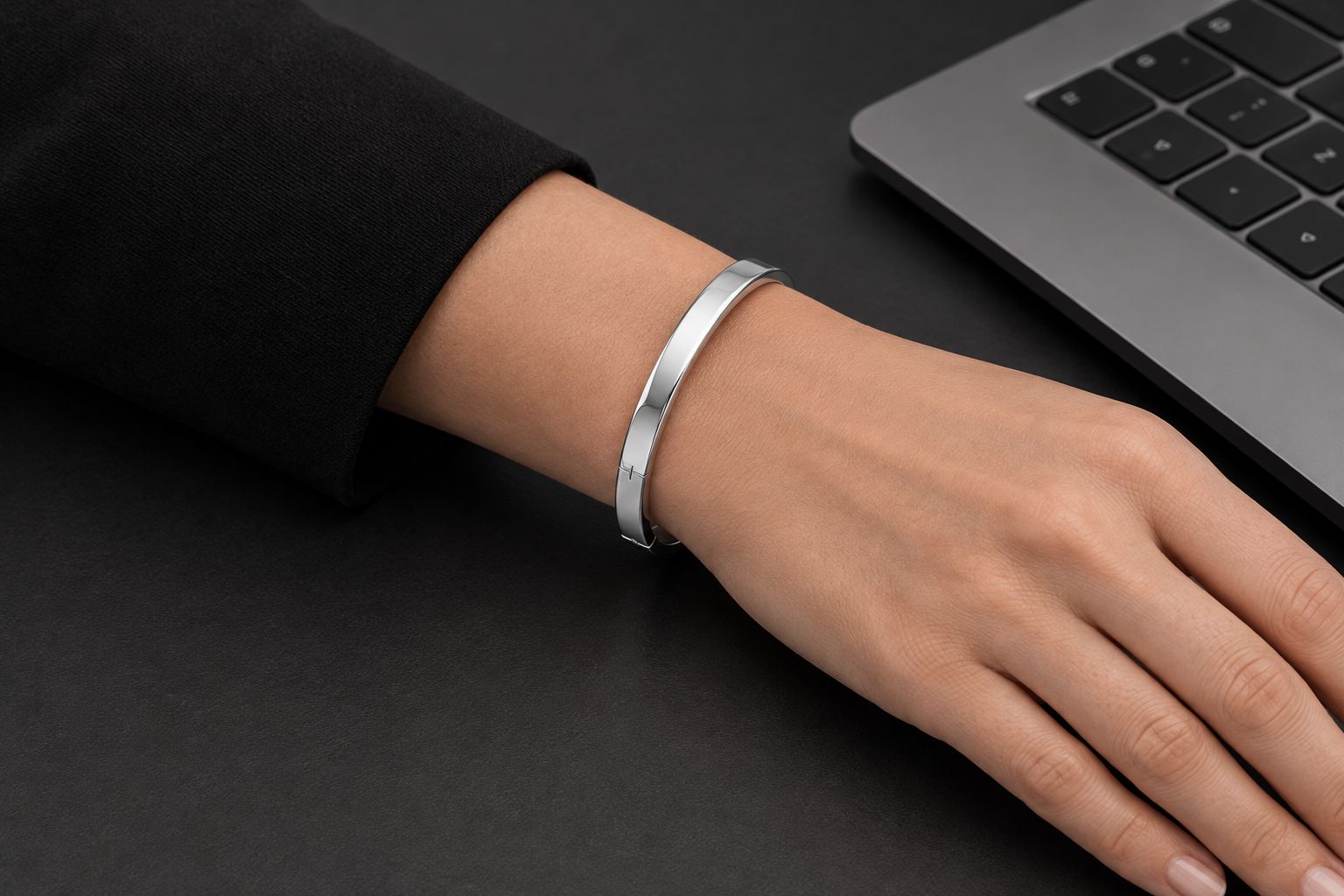
A comfortable trial does not require deliberately pulling the closed bracelet over your hand. Open the clasp for removal. A fit check should not put unnecessary strain on the closure or hinge.
Check the clasp without forcing it
The clasp should meet in its intended alignment without using your wrist as a brace. If closing requires squeezing skin out of the way, stop and reassess the size or position.
Follow the bracelet’s own opening instructions. Hinged bangles do not all use the same release mechanism, and an unfamiliar clasp is not a reason to pry at the metal.
Check for these problems before wearing the bracelet out:
- The clasp does not fully engage when operated as instructed.
- The hinge catches or resists ordinary opening.
- A sharp edge contacts your skin.
- The closure opens during normal handling.
A larger size does not repair a faulty clasp. Separate sizing concerns from hardware concerns, and ask the seller for help when the mechanism does not work as described.
Materials matter, but they do not determine fit
Lumina Jewelry Co. describes its jewelry range as hand-finished earrings and bracelets featuring lab-created VVS1 stones, sterling silver, and 18k gold vermeil. That range-level description does not establish the construction of every individual bracelet.
For your 2026 buying checklist, verify the exact item’s stone identity, metal, and any coating separately from its size. 925 sterling silver denotes 92.5% silver, while 18k gold denotes 75% gold in the gold alloy. Neither term supplies a bracelet measurement.
The phrase 18k gold alone also does not tell you whether an entire item is solid gold or whether gold forms a surface layer. Read the specific construction description rather than inferring it from color.
Moissanite is a distinct gemstone, not a lab-grown diamond. Clarity wording does not replace stone identification, and neither stone identity nor a clarity grade tells you whether a rigid bracelet will sit comfortably on your wrist.
Should a hinged bangle bracelet spin around your wrist?
Some movement around your wrist is normal; constant unwanted rotation calls for a fit check. Look at the internal shape and size together instead of assuming that all movement means the bracelet is too large.
If keeping one face upright is essential to you, assess that expectation during the try-on. A comfortable bracelet that moves more than you prefer still might not be your right choice for everyday wear.
Should a hinged bangle fit like a tennis bracelet?
A hinged bangle should not be sized by copying a tennis bracelet’s length. A rigid opening holds its shape, while a linked bracelet follows your wrist more closely.
Compare how each bracelet behaves rather than expecting identical clearance. The bangle needs comfortable space inside its fixed outline; the flexible bracelet needs a length that drapes without unwanted travel.
Can you make a tight hinged bangle larger yourself?
Do not bend or spread a hinged bangle to create extra room. That changes the structure rather than providing a controlled fit adjustment.
Ask the seller whether the specific bracelet can be resized or whether another size is available. Do not assume a jeweler can alter every hinged design, especially around a clasp, hinge, or stone setting.
FAQ
How tight should a hinged bangle bracelet be?
A hinged bangle bracelet should close without squeezing your wrist and allow comfortable movement. Pinching, pain, or needing force to close it are reasons to stop and reassess the fit.
Do I measure my wrist or my hand for a hinged bangle?
Measure your wrist where you intend to wear a hinged bangle, then follow the seller’s instructions for that design. Unlike a closed slip-on bangle, a hinged bangle opens to go around your wrist.
How much extra room should I add to my wrist measurement?
Use the specific bracelet’s sizing guidance rather than a universal extra-room allowance. Internal shape, band width, and the meaning of the listed size all affect the result.
Is an oval hinged bangle better than a round one?
An oval hinged bangle is not automatically better than a round one; the better choice matches your wrist shape and movement preference. Compare internal dimensions and test for pressure at the sides of your wrist.
Can I wear a hinged bangle bracelet while typing?
Check a hinged bangle bracelet in your normal typing position before choosing it for desk wear. It should not pinch your wrist, interfere with movement, or create contact with the desk that you find uncomfortable.
How do I check the fit of a Lumina Jewelry Co. bangle?
Check the specific Lumina Jewelry Co. bangle’s internal dimensions and sizing instructions, then test comfort and clasp operation. Do not infer size or metal construction from a product photo.
Should I choose an adjustable bracelet instead of a hinged bangle?
Choose an adjustable bracelet if changing the fit matters more to you than a fixed bangle silhouette. Check the adjustable range and any chain tails separately rather than assuming every slider will suit your wrist.
One last thing
The most useful measurement is the one that describes the inside of the bracelet. A listing can give a precise outside width and still leave the fit question unanswered.
Before your next 2026 bracelet purchase, ask a direct question: does the stated size describe internal circumference, internal width and depth, or something else? Settle that before choosing. Clear dimensions beat a guess based on a model’s wrist.