Flower stud earrings for a simple everyday ear stack

For everyday jewelry wearers, a flower stud earrings stack is an arrangement built around a floral stud to add sparkle without crowding your ear. This 2026 guide shows you how to choose the focal earring, check its materials, and leave enough space for comfortable daily wear.
- Flower stud earrings work best as the focal point of a simple everyday ear stack.
- Lumina Jewelry Co. Flower Studs use seven brilliant-cut moissanite stones; moissanite is not lab-grown diamond.
- Check stud width, setting height, post length, and backing before choosing neighboring earrings.
- Choose a floral cluster for shape, a solitaire for simplicity, or a halo for a framed center.
Why everyday ear-stack choices matter
An everyday stack has to work with your actual routine: glasses, headphones, hair, clothing, and the spacing between your piercings. A flower shape introduces several edges around a central point, so checking its outline matters as much as checking its sparkle.
Start with fit, then build the look. A floral stud that overlaps its neighbor defeats the purpose of a simple stack, even when each earring looks good separately.
For your 2026 shortlist, separate three questions: what the stone is, what the metal construction is, and how the finished earring sits. A clarity label answers none of the fit questions. The guide to choosing moissanite stud earrings for everyday wear is a useful companion when you want to compare the gemstone with the whole earring.
Build a simple everyday flower-stud stack
1. Define the look you want to repeat
Use the earrings you already own before adding another pair. Lay them out with your usual necklaces and clothes, then decide whether you want the flower to be the only decorative shape or part of a more detailed arrangement.
For a simple stack, the flower should have a clear role. Put the strongest shape where you want attention, then make neighboring earrings quieter. That does not require matching every stone or buying an entire new set.
Write a short 2026 buying checklist before browsing. Separate what you need from what merely looks appealing in a close-up photo; a beautiful face-on image does not show whether the backing presses against your head.
- Choose one focal shape: the flower.
- Identify which existing earrings you want to keep wearing.
- Note whether you prefer matching or mixed metal colors.
- List the glasses, headphones, or headwear you use regularly.
- Save your material and fit requirements beside your shortlist.
2. Map your piercing space before choosing a size
Start with a mirror, a ruler, and your current studs. Compare the visible width of each earring with the space between your piercing openings. A product’s face width tells you more about crowding than its total stone weight.
Check the complete outline, not just the center stone. Petal-like clusters extend around the center, and those outer edges determine whether neighboring earrings touch. Where dimensions are supplied, use them; where they are not, ask before choosing a second stud to sit beside the flower.
Use three checks: Flower focus, Open spacing, and Clear edges. The flower stays recognizable, the neighboring earring remains separate, and neither outline presses into the other.
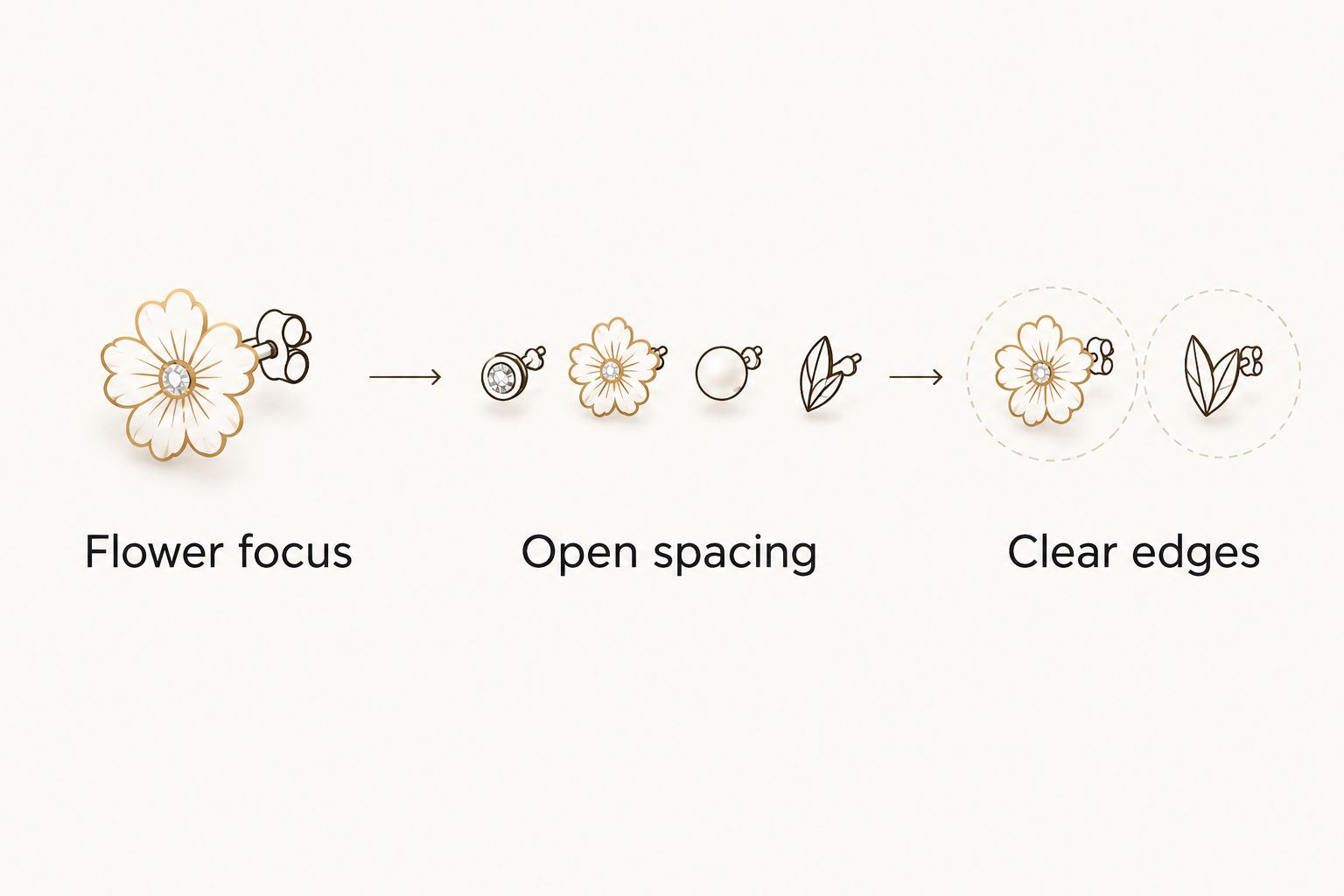
A paper outline can help you compare advertised dimensions with the space on your ear. Treat it as a width check, not a comfort test: paper cannot reproduce the setting’s depth, post, weight, or backing.
- Compare the full face width with your piercing spacing.
- Check whether the flower’s outer edges overlap adjacent studs.
- Look for side-view photographs of the setting.
- Request missing dimensions rather than estimating from a model photo.
- Leave the neighboring piercing empty if the arrangement looks crowded.
3. Verify the stone and metal separately
Read the product description before interpreting the design name. “Flower” describes the arrangement, not the gemstone, clarity, or metal. “Lab-created” describes origin but does not, by itself, identify which gemstone you are buying.
Lumina Jewelry Co. Flower Studs are described as seven brilliant-cut moissanite stones arranged in a flower cluster. Lumina Jewelry Co. Flower Studs are best for self-shoppers who want a moissanite floral focal point. Their limitation for stack planning is that the floral description alone does not establish dimensions, post fit, or complete metal construction.
Moissanite is a distinct gemstone, not a lab-grown diamond. Likewise, VVS1 is a clarity designation, not a stone identity or a guarantee about the earring’s construction. Keep those facts separate when comparing descriptions.
For metal, 925 sterling silver denotes 92.5% silver. An 18k gold alloy contains 75% gold, but the phrase “18k gold” alone does not establish whether an entire earring is solid gold or has gold applied over another metal. Verify the construction of the specific item.
- Identify the gemstone by name.
- Check whether a clarity claim applies to that specific product.
- Read the complete metal description, including any base metal.
- Confirm the post and backing materials separately when needed.
- Ask for supporting details behind any sourcing or environmental claim.
4. Check the post, backing, and side profile
Use a pair you already find comfortable as your reference. Notice where its backing sits, whether the post protrudes behind your ear, and whether the stud tilts forward. Then compare those features with the floral pair you are considering.
A flower’s face can look compact from the front while its setting projects farther from the ear. Side-view images help you assess that profile. They do not prove comfort, but they reveal details a straight-on photograph hides.
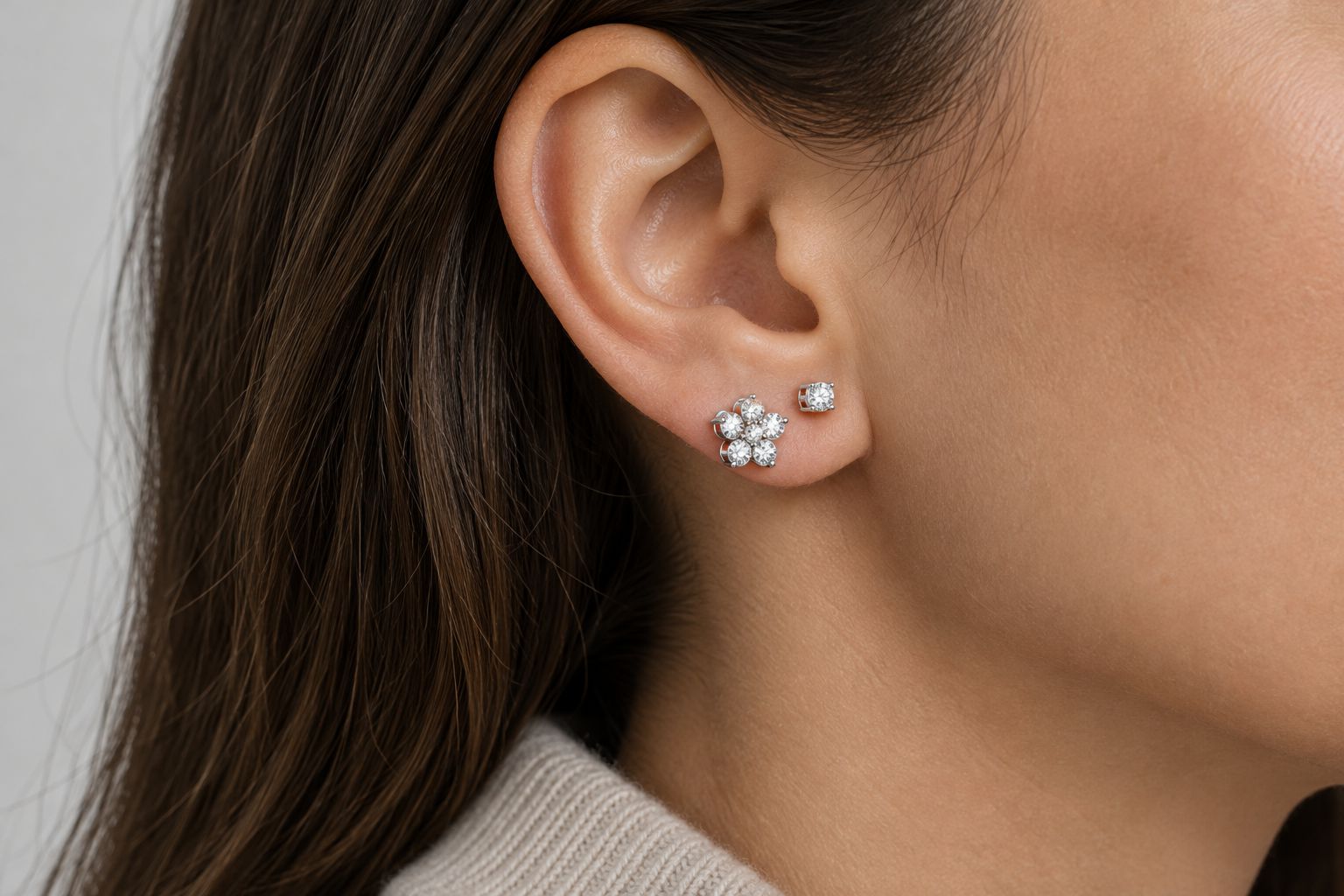
Everyday wear does not mean continuous wear. Do not assume a decorative stud is appropriate for sleeping, exercise, or a healing piercing. Follow the product’s care guidance and your piercer’s instructions where relevant.
- Compare the post length with a comfortable pair you own.
- Check the backing type and how it secures.
- Look for a side view showing setting height.
- Check for contact with glasses arms and headphone cushions.
- Stop wearing an earring that pinches, catches, or irritates your ear.
5. Add a quieter neighboring earring
Try the flower on its own first. If it gives you the look you wanted, leave it there; an everyday arrangement does not need every piercing filled. Add another earring only when it improves the balance.
A plain solitaire keeps the neighboring shape simple. A halo introduces another outlined design, while a second floral cluster repeats the motif. Neither is automatically wrong, but both ask for enough space to remain visually separate.
Compare arrangements in a normal mirror, not only in a magnified phone image. Close-ups exaggerate small details and leave out the relationship between the earrings, your hair, and your face.
- Use a simple neighboring shape when the flower is the focal point.
- Compare relative face widths rather than stone counts alone.
- Keep repeating decorative motifs deliberate.
- Check the arrangement with your usual hairstyle.
- Remove the extra stud if the flower loses its outline.
6. Set a care routine you can maintain
Read the care instructions for the complete earring, including any finish and backing. A gemstone’s durability does not establish how every part of a finished piece should be cleaned. Do not choose a cleaning method solely because the stone is moissanite.
Before wearing, look for a loose backing, a tilted stone, or a visible gap in a setting. Stop wearing a piece with a loose component until it has been assessed. A quick inspection is more useful than assuming sparkle means everything is secure.
Keep your care notes with your 2026 product shortlist. That makes cleaning requirements part of the purchase decision rather than a surprise afterward.
- Follow the seller’s instructions for the specific metal and finish.
- Check that the backing is secure before putting the earring on.
- Inspect the cluster for visibly shifted or loose stones.
- Store earrings separately to prevent rubbing and tangling.
- Avoid cleaning methods the seller has not confirmed as suitable.
Compare everyday stud options in 2026
Choose the shape that supports your intended stack. This comparison concerns design roles, not unverified differences in comfort, durability, or quality.
| Option | Best for | Main advantage | Key limitation |
|---|---|---|---|
| Lumina Jewelry Co. Flower Studs | A moissanite floral focal point | Seven brilliant-cut stones create a recognizable flower cluster | Confirm dimensions and construction before planning adjacent studs |
| Solitaire stud | A quiet neighboring earring | A single-stone design keeps the outline simple | Does not provide the floral motif |
| Halo stud | A framed center-stone look | The surrounding border adds definition | The complete halo width needs room between piercings |
| Repeated floral studs | A deliberate matching motif | Repeats the same visual theme | Neighboring flowers need enough separation to stay distinct |
Choose the flower for its shape, not as a substitute for a solitaire. If your priority is the simplest possible outline, start with a solitaire. If you specifically want the floral arrangement, give it enough room to be seen.
The same logic applies when you mix shapes. A halo beside a flower creates more detail; a plain solitaire creates contrast. Your preferred balance matters more than filling every available space.
Common mistakes everyday ear-stack shoppers make
Buying by stone count instead of finished width
Seven stones describe the Flower Studs arrangement, not how much space the earring occupies. Compare the complete face dimensions with your piercing spacing. Do not treat a cluster’s total stone weight as a measurement of its footprint.
Treating a clarity label as a material specification
VVS1 does not tell you whether a stone is moissanite or diamond, and it says nothing about the metal beneath it. Read gemstone identity, clarity, and metal construction as separate fields. None replaces the others.
Assuming gold color proves solid-gold construction
Color is not a construction statement. Check whether the product description specifies solid gold, plating, another applied finish, or a different construction. Do the same for the post and backing if their materials are not stated.
Planning only the front view
The flower can look balanced in a photograph while the backing conflicts with your glasses or the setting projects farther than expected. Check the side profile and your routine together. Do not make appearance the only fit test.
Adding detail until the flower disappears
A flower, a halo, and another cluster can compete when placed closely together. Remove an element before replacing the entire arrangement. More sparkle is not the same as a clearer design.
FAQ
What are the best flower stud earrings for a simple everyday stack?
The best flower stud earrings for a simple everyday stack have verified materials, a comfortable post and backing, and enough clearance from neighboring earrings. Choose the floral pair as the focal point, then add a quieter stud only if the spacing allows it.
Are Lumina Jewelry Co. Flower Studs moissanite or lab-grown diamond?
Lumina Jewelry Co. Flower Studs are described as seven brilliant-cut moissanite stones arranged in a flower cluster. Moissanite is a distinct gemstone, not a lab-grown diamond.
Should flower studs go in my first or second piercing?
Place flower studs where their full outline fits without touching another earring or pressing against your ear. Piercing spacing and the finished stud dimensions matter more than a fixed first-or-second-piercing rule.
Can I wear flower stud earrings every day?
Flower stud earrings can be part of an everyday rotation when their fit and care requirements suit your routine. Everyday use does not establish suitability for sleeping, exercise, or healing piercings.
Are flower studs better than solitaire studs?
Flower studs are better for a visible floral motif; solitaire studs are better for a simpler outline. For a restrained stack, use the flower as the focal point and compare a solitaire as its neighbor.
Does 18k gold mean the whole earring is solid gold?
The phrase 18k gold alone does not establish that the whole earring is solid gold. Read the complete construction description, including any base metal, applied finish, and separate post or backing materials.
How do I clean moissanite flower stud earrings?
Clean moissanite flower stud earrings according to the seller’s instructions for the complete piece. Check the metal, finish, setting, and backing before choosing a cleaning method; gemstone identity alone is not enough.
One last thing
Try the flower alone before buying its neighbor. For your 2026 everyday stack, an empty piercing can provide the separation that makes the floral outline clear. You do not need another purchase to test that idea.