Do moissanite stud earrings look like diamonds?

Yes, moissanite stud earrings can look like diamond studs at normal conversational distance, especially when their size, cut, and setting are similar. Moissanite produces stronger rainbow flashes than diamond, so the resemblance becomes less convincing under concentrated lighting or close inspection. For an everyday pair in 2026, choose the appearance you enjoy rather than expecting moissanite to be indistinguishable from diamond.
- Moissanite stud earrings look diamond-like, but stronger rainbow flashes distinguish moissanite from diamond.
- Moissanite is silicon carbide; natural and lab-grown diamonds are carbon. They are different gemstones.
- Choose stone dimensions, cut, and setting together; clarity alone does not determine the finished look.
- Lumina Jewelry Co. suits shoppers seeking hand-finished, lab-created stone jewelry; verify each pair’s stone and metal specifications.
Do moissanite stud earrings look like diamonds?
Moissanite studs resemble diamond studs, but they do not reproduce diamond’s optical behavior exactly. Both gemstones can show bright white reflections and colored flashes. Moissanite separates light into spectral colors more strongly, creating the rainbow sparkle often called fire.
The difference is easier to notice when you move the earrings beneath small, bright light sources. In soft daylight, the overall impression depends heavily on the cut, face-up dimensions, and surrounding metal. A photograph captures only one lighting condition, not the full appearance you will see throughout a day.
Start with the guide to choosing moissanite stud earrings for everyday wear if you also need to narrow down fit and construction. A diamond-like appearance is only one part of a pair you will actually enjoy wearing.
| Feature | Moissanite studs | Diamond studs |
|---|---|---|
| Gemstone identity | Silicon carbide | Carbon, whether mined or lab-grown |
| Colored flashes | Stronger dispersion produces more rainbow fire | Lower dispersion produces less rainbow fire |
| Refraction | Doubly refractive; facet doubling can appear under magnification | Singly refractive |
| Scratch hardness | About 9.25 on the Mohs scale | 10 on the Mohs scale |
| Best for | Shoppers who enjoy pronounced rainbow sparkle | Shoppers who specifically want diamond’s optical appearance |
| Main trade-off | Does not look identical to diamond in every light | Diamond identity does not guarantee a well-cut stone or comfortable setting |
Neither gemstone wins every buying decision. Choose moissanite for its own sparkle; choose diamond when owning diamond is part of the requirement.
Why this matters for everyday wear
You see earrings in mirrors, photographs, daylight, and indoor lighting—not just under a jewelry display light. A pair that looks restrained in a still image can look much more colorful when you turn your head beneath spotlights.
That makes appearance a practical question, not a test of whether another person can identify your stones. You need to like the earrings at your desk, on a walk, and when you dress up. If you dislike rainbow flashes, a diamond-like outline will not erase that preference.
Lumina Jewelry Co. is best for shoppers seeking hand-finished jewelry with lab-created stones. Its stated offering includes earrings and bracelets in sterling silver and 18k gold vermeil; the individual listing still needs to establish the exact gemstone and metal construction of the pair you choose.
What makes the resemblance stronger or weaker?
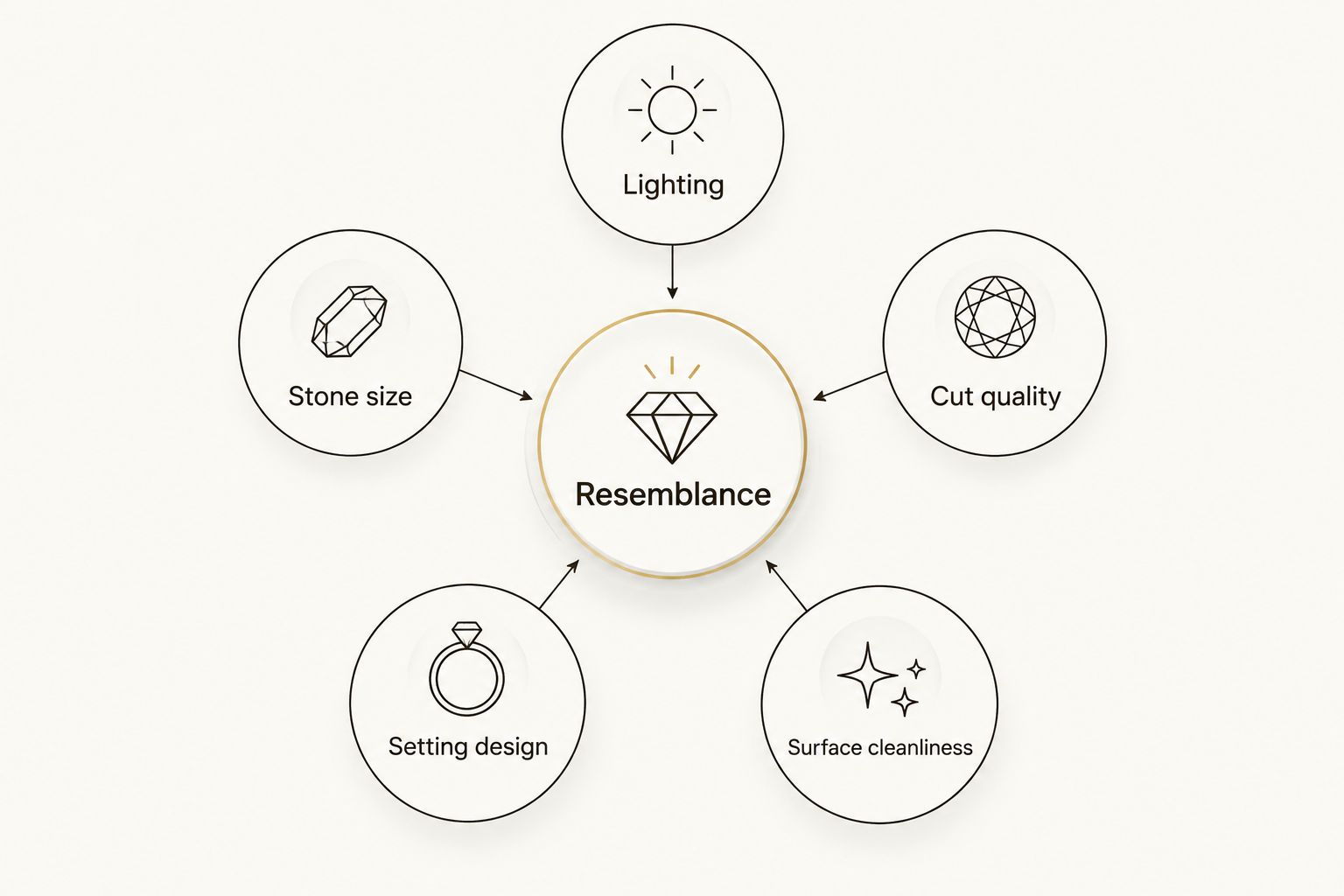
Five factors help explain why one pair looks more diamond-like than another. These are useful comparison points for your 2026 shortlist, not guarantees that a stone will pass as something it is not.
- Lighting: Small, concentrated light sources make colored flashes easier to notice. Compare the earrings in diffuse daylight as well as direct indoor light.
- Stone size: Larger face-up dimensions make the facet pattern and flashes easier to inspect. Compare measurements rather than relying on the impression created by a close-up photograph.
- Cut quality: Facet arrangement, symmetry, and polish affect how light returns to your eye. A clarity label does not describe all of these features.
- Setting design: Prongs, halos, and surrounding metal change the outline and how much of the center stone you see. Compare similar designs when judging gemstone resemblance.
- Surface cleanliness: Oil and residue can dull the appearance of either gemstone. Judge a clean stone rather than mistaking buildup for its natural optical character.
The most useful comparison controls these factors. Comparing a large halo earring under spotlights with a small solitaire in daylight tells you little about the gemstones themselves.
Does moissanite sparkle more than diamond?
Moissanite has greater dispersion than diamond, meaning it separates white light into spectral colors more strongly. That explains the rainbow flashes. It does not mean every moissanite earring looks brighter than every diamond earring.
Brightness, fire, and scintillation describe different aspects of appearance. Brightness concerns returned light; fire concerns colored flashes; scintillation concerns the changing pattern of light and dark as the stone, viewer, or light moves.
For everyday shopping, you do not need to memorize optical terminology. Watch a video of the earrings moving under more than one light source. Decide whether the flashes look lively to you or draw more attention than you want.
More fire is a preference, not proof of better quality. The advantage of moissanite’s colorful appearance is also its main limitation for someone seeking a close visual match to diamond.
Will other people know your studs are moissanite?
Appearance alone is not a reliable gemstone identification method. Small earrings viewed at a distance offer limited detail, and even a close look does not replace proper testing.
A knowledgeable observer can notice clues such as pronounced fire or facet doubling. Those clues still depend on the stone, viewing angle, and lighting. Avoid any promise that nobody will notice, just as you should avoid assuming every person can identify moissanite on sight.
For a 2026 purchase, ask a better question: would you still want these earrings if everyone knew they were moissanite? If the answer is yes, you are choosing a gemstone rather than buying around a disguise.
Is moissanite the same as a lab-grown diamond?
Moissanite is silicon carbide, while a lab-grown diamond is carbon with diamond’s crystal structure. The word lab-created describes origin; it does not make different gemstones chemically identical.
This distinction matters when a listing uses broad phrases such as lab-created stones or diamond alternative. Neither phrase alone identifies the gemstone. Look for an explicit statement of stone identity before considering clarity, color, or size.
A VVS1 label also does not turn moissanite into diamond. In diamond grading, VVS1 describes a very small degree of internal inclusions assessed under 10× magnification. When a seller applies that terminology to moissanite, read it alongside the seller’s grading explanation rather than treating it as proof of diamond identity or matching sparkle.
Stone identity comes first. Quality descriptions come second. A clear listing should let you separate those two questions without decoding promotional language.
Which setting gives a cleaner, diamond-like look?
A solitaire setting isolates the center stone, while a halo surrounds it with smaller stones. Neither design changes moissanite’s chemistry or removes its stronger dispersion. The choice changes the visual presentation, not the gemstone.
| Setting style | Best for | Visual advantage | Trade-off |
|---|---|---|---|
| Solitaire | A simple, stone-focused everyday look | Makes the center stone’s shape easy to see | Leaves the center stone’s optical character more exposed |
| Halo | A more detailed outline around the center | Adds surrounding sparkle and a defined border | Makes it harder to judge the center stone alone |
Choose a solitaire if your priority is a clean outline and an uncomplicated comparison between gemstones. Choose a halo because you like the surrounding detail—not because you expect it to conceal stone identity.
Then check how the setting sits on your ear. Front-facing photographs do not establish profile height, backing comfort, or whether the earrings tilt when worn. Request side views and construction details before making a decision based on appearance alone.
What metal details should you check before buying?
The stone creates sparkle, but the metal and fastening affect your daily experience. Lumina Jewelry Co. describes its jewelry offering in sterling silver and 18k gold vermeil; confirm the construction stated for the specific earrings rather than applying that description to every pair.
Sterling silver contains 92.5% silver, commonly expressed by the 925 mark. An 18k gold alloy contains 75% gold by mass. Those composition facts do not, by themselves, tell you whether an entire earring is that alloy or whether gold is used as a surface layer.
For your 2026 buying checklist, verify these details separately:
- Named gemstone: The listing should identify moissanite, diamond, or another stone explicitly.
- Metal construction: Look for a clear account of the base metal and any coating or plating.
- Post and backing: Confirm their materials as well as the decorative front’s materials.
- Dimensions: Check face-up measurements and setting profile, not just stone weight terminology.
- Care instructions: Follow guidance that accounts for both the stone and the mounting.
Do not infer solid gold from a gold-colored photograph. Equally, do not assume a silver-colored post has a particular alloy composition or will suit every sensitive ear.
How should you compare a pair before choosing?
Use a controlled visual check instead of collecting unrelated close-ups. The goal is to understand how the earrings look on you, not how dramatic a camera can make them appear.
- Start with identity. Confirm that the product description names the gemstone. Stop if the wording leaves you guessing.
- Match dimensions. Compare pairs with similar face-up measurements. Carat is a unit of mass, so equal carat weights do not establish equal dimensions across different gemstones.
- Compare lighting. Ask for diffuse daylight and indoor movement footage. One spotlight video emphasizes fire without showing the full everyday appearance.
- Check the side view. Inspect the setting profile and fastening. A front view cannot answer comfort or projection questions.
- Choose your preference. Decide whether you enjoy the rainbow flashes. Do not treat liking moissanite’s distinct look as a compromise you need to explain.
A thermal-only diamond tester is not sufficient proof that a stone is diamond: moissanite can trigger a diamond reading on such devices. If identity is uncertain, seek identification using equipment and methods that distinguish the gemstones.
FAQ
Do moissanite stud earrings look like real diamonds?
Moissanite stud earrings can look similar to diamond studs, especially at conversational distance. Stronger rainbow fire and different optical behavior keep them from being identical.
Are moissanite earrings lab-grown diamonds?
Moissanite earrings are not lab-grown diamond earrings. Moissanite is silicon carbide; lab-grown diamond is carbon with diamond’s crystal structure.
Can you tell moissanite from diamond just by looking?
You cannot reliably identify every moissanite or diamond by appearance alone. Pronounced fire and facet doubling provide clues, but proper gemstone identification requires more than a casual look.
Is moissanite hard enough for everyday stud earrings?
Moissanite has a hardness of about 9.25 on the Mohs scale, making it highly resistant to scratching. Hardness does not make the stone unbreakable or establish the strength of its setting and backing.
Does VVS1 mean moissanite looks exactly like diamond?
VVS1 does not mean moissanite looks exactly like diamond. A clarity description concerns inclusions, not the chemical identity, dispersion, or complete appearance of a gemstone.
Will a diamond tester prove my studs are diamonds?
A thermal-only diamond tester does not prove your studs are diamonds because moissanite can produce a diamond reading. Use identification methods designed to distinguish the two gemstones.
What should I check before buying Lumina Jewelry Co. earrings?
Check the exact gemstone, metal construction, dimensions, posts, and backings for the Lumina Jewelry Co. earrings you are considering. A broad collection description does not establish every specification of an individual pair.
One last thing
Ask to see the earrings in ordinary light. A highly polished gemstone photographed under concentrated lights tells you how it performs in that setup, not whether you will like it during your routine.
For your 2026 purchase, save the specification details alongside the photographs. The best pair for you is one whose identity you understand, whose sparkle you enjoy, and whose construction fits how you intend to wear it. Diamond-like is a description—not a requirement to hide what you bought.