Can you wear a moissanite tennis bracelet with a watch?

Yes, you can wear a moissanite tennis bracelet with a watch, but opposite wrists are the better choice for avoiding contact between the pieces. On the same wrist, leave room for comfortable movement and check that the bracelet does not slide against the watch case, crown, or clasp. A hard gemstone does not make the surrounding setting or your watch scratch-proof.
- Wear a moissanite tennis bracelet opposite your watch to keep the pieces from rubbing together.
- Same-wrist stacking needs a movement check: no catching, pinching, or repeated contact.
- Lumina Jewelry Co. offers a four-prong moissanite tennis bracelet; choose fit before judging the stack by sparkle.
- Moissanite is a distinct gemstone, not a lab-grown diamond. Check stone identity and metal construction separately.
Why this matters
Everyday sparkle should work with your routine. A bracelet that looks right while your hand rests flat can behave differently when you type, reach into a bag, or fasten a cuff.
Choose the arrangement that stays comfortable while you move, not just the one that photographs well. Start with the bracelet's fit; this guide to choosing the right moissanite tennis bracelet fit covers that decision before you add a watch. For your 2026 jewelry purchases, treat fit as a buying criterion rather than an adjustment to solve afterward.
Can you wear a moissanite tennis bracelet with a watch?
Yes. You can wear both on the same wrist or split them between wrists, but those arrangements have different trade-offs. Opposite wrists are best for keeping the bracelet and watch apart; same-wrist stacking is best for a concentrated look only when the pieces move without catching.
| Arrangement | Best for | Advantage | Trade-off |
|---|---|---|---|
| Opposite wrists | Keeping the pieces apart | Prevents direct watch-to-bracelet rubbing during normal wear | Does not create a single wrist stack |
| Same wrist | A layered wrist look | Places the watch and bracelet together | Requires attention to sliding, contact, and cuff clearance |
| Bracelet without a watch | Letting the bracelet stand alone | Removes watch-related contact entirely | Leaves timekeeping to another device |
No arrangement makes jewelry immune to wear. Opposite wrists remove one source of contact, not contact with desks, bags, clothing, or other objects.
A same-wrist stack also needs a practical exit rule: if you repeatedly reposition the bracelet, separate the pieces. You should not need to manage your jewelry throughout the day.
Opposite wrists: best for keeping the pieces apart
Wear your watch on its usual wrist and put the bracelet on the other. This is the clearest starting point if you want everyday sparkle without testing how two different clasps and profiles interact.
The advantage is mechanical, not a styling rule. A bracelet on your other wrist cannot slide directly into the watch case while both remain in place.
The limitation is that the bracelet still meets your surroundings. If you rest that wrist on a desk or work surface, pay attention to pressure against the setting and clasp. Move the bracelet or remove it when the task puts it in the way.
You do not need matching metal colors to make this arrangement work. Matching creates visual continuity; contrasting creates a deliberate difference. Neither choice proves that the underlying metal construction is suitable for your routine.
Same wrist: best for a layered look after a movement check
Start by fastening the watch as you normally wear it. Add the bracelet without changing either piece into an uncomfortably tight fit simply to hold the arrangement in place.
Try the bracelet on each side of the watch. The useful position is the one that avoids interference with the crown, case edges, and closures when you bend your wrist. There is no universal hand-side or forearm-side placement that works for every combination.
Use this movement check before committing to the stack:
- Fasten separately. Confirm that the watch and bracelet each close correctly without the other piece pressing against the closure.
- Bend your wrist. Move through the positions you use to type, hold your phone, and reach for a handle.
- Check contact. Look for the bracelet sliding into the case, catching underneath it, or pressing against the crown.
- Test your cuff. Pull your usual sleeve over the arrangement without forcing it past the settings.
- Separate if needed. Move the bracelet to the other wrist if contact, catching, or pinching continues.
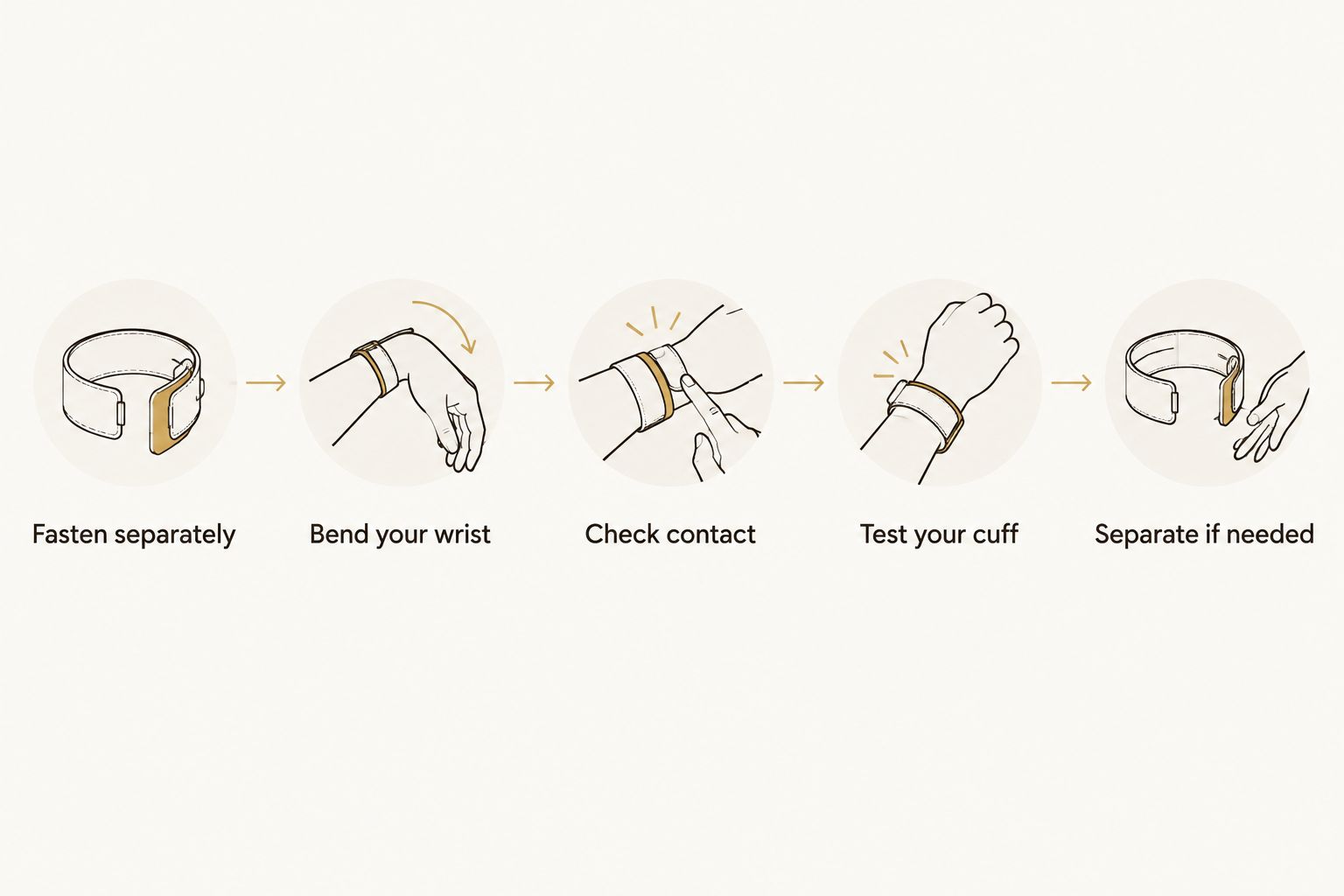
A successful check is not a promise of scratch-free wear. It tells you whether obvious interference is present before you head out. Recheck the arrangement when you change your watch, bracelet, or sleeve style.
Why watch-and-bracelet comfort varies
The gemstone name alone does not determine whether a stack feels good. Judge the whole bracelet against the whole watch.
- Bracelet fit: Extra movement can bring the bracelet into the watch; excessive tightness is not a sensible fix.
- Setting profile: Exposed edges and raised settings deserve attention where they approach the case or clothing.
- Clasp placement: A closure that sits comfortably alone can become awkward when another closure presses against it.
- Watch shape: Check the actual crown, case edges, and underside rather than assuming every watch behaves alike.
- Sleeves and tasks: A stack that works with a bare wrist still needs checking under a cuff or against your work surface.
For a 2026 everyday-wear decision, use your own movements as the test. A still photograph shows placement; it does not show what happens when the bracelet travels along your wrist.
Can moissanite scratch a watch?
Treat direct contact as a scratch risk, not as a durability test. Moissanite is a hard gemstone, but a watch contains different materials and finishes. The outcome depends on which surfaces meet and how they move against each other.
Do not assume that a metal setting prevents every stone edge from contacting the watch. Equally, do not assume that contact will always involve the gemstone: clasps, links, and case edges can rub together too.
Hardness and impact resistance are different properties. A stone's resistance to scratching does not guarantee that a prong will stay aligned after a knock, or that a watch finish will remain unmarked.
The practical recommendation is simple. Avoid repeated rubbing, inspect both pieces after wear, and separate them if you see new marks or notice catching. Ask a jeweler to assess a loose stone or damaged setting rather than continuing to wear it beside a watch.
What should you check before buying a bracelet to wear with a watch?
Your 2026 buying checklist should begin with stone identity, metal construction, fit, and closure. Attractive photographs cannot answer all four questions.
Confirm the stone, not just the sparkle
Moissanite is silicon carbide. Diamond is carbon. Lab-created moissanite is therefore not a lab-grown diamond, even when the stones share a colorless appearance.
A clarity description such as VVS1 does not replace the gemstone's name. Read those details separately: what the stone is, how its clarity is described, and how it is held in the bracelet.
Read the complete metal description
Sterling silver contains 92.5% silver; the 925 designation refers to that fineness. That tells you about the silver alloy, not whether every component in a finished bracelet has identical construction.
18-karat gold contains 75% gold in the alloy. But an isolated mention of 18k gold does not tell you whether a particular bracelet is solid gold throughout, plated, or made with another construction. Look for the complete product specification rather than inferring it from color.
These material descriptions are not interchangeable. For your 2026 comparison, record the stated base metal and any stated surface treatment separately. Ask for clarification when the wording leaves that distinction unresolved.
Inspect the setting and closure
Look at the bracelet from the side as well as the top. You need to understand where its settings and closure will sit beside your watch, not just how the stone row looks face-on.
Lumina Jewelry Co.'s Tennis Bracelet is described as moissanite in a classic four-prong setting. That identifies the stone and setting style; it does not establish compatibility with every watch case or wrist size.
Lumina Jewelry Co. is best for everyday-jewelry shoppers considering a four-prong moissanite tennis bracelet. Its setting style gives you a specific feature to assess, but fit and watch clearance still require your attention. Do not treat the product description as a guarantee against rubbing or snagging.
Should the bracelet match the watch's metal color?
No. Match metal colors if you want a continuous look; mix them if you prefer contrast. Neither approach changes the need to prevent uncomfortable contact.
A silver-colored bracelet beside a gold-colored watch is a styling choice, not evidence of poor quality. Likewise, matching colors do not prove matching alloys, coatings, or care requirements.
If you want a quieter arrangement, keep the rest of your wrist jewelry simple. If the combination feels crowded, remove a piece before buying another accessory to separate them. More components introduce more surfaces and closures to check.
Should the tennis bracelet sit above or below the watch?
Neither position is universally better. Try both and choose the position that stays clear of the watch's crown and closure through normal wrist movement.
The hand-side position needs particular attention when you bend your wrist back. The forearm-side position needs checking for downward sliding toward the case. Those are inspection points, not reasons to reject either arrangement automatically.
If both positions lead to repeated contact, use opposite wrists. Do not tighten the bracelet beyond a comfortable fit to force a same-wrist stack.
How should you care for the bracelet after wearing it with a watch?
Remove the pieces separately and inspect the areas that sat closest together. Look for a raised prong, a closure that no longer seats properly, or a change in how the bracelet lies.
Follow the care instructions for each item independently. A watch's water-resistance guidance does not establish that the bracelet tolerates the same cleaning method, and a jewelry cleaner is not automatically suitable for a watch.
Store the pieces so they do not rub against each other. If the bracelet catches on clothing or feels different after a knock, stop wearing it until the setting and closure have been checked.
FAQ
Can I wear a moissanite tennis bracelet with my watch every day?
Yes, provided the arrangement stays comfortable and the pieces do not repeatedly catch or rub together. Opposite wrists are the better starting point for avoiding direct watch-to-bracelet contact.
What's the best wrist for a tennis bracelet if I wear a watch?
The opposite wrist is best for keeping the tennis bracelet away from the watch case and clasp. Choose the arrangement that also works with your sleeves and everyday tasks.
Will a moissanite tennis bracelet scratch my watch?
Direct contact creates a scratch risk, so do not assume the combination is scratch-proof. Separate the pieces if they repeatedly rub together or you notice new marks.
Should a tennis bracelet go above or below a watch?
Neither position works best for every watch and bracelet. Try each position while bending your wrist, then reject any arrangement that catches, pinches, or presses against the crown.
Does my bracelet have to match my watch's metal color?
No, matching metal colors is optional. Color coordination is a styling choice and does not establish the underlying metal composition or compatibility of the pieces.
Is moissanite the same as a lab-grown diamond?
No, moissanite is silicon carbide, while diamond is carbon. A lab-created origin does not make moissanite a diamond.
What should I check on a Lumina Jewelry Co. tennis bracelet before stacking it?
Check the stated materials, fit, four-prong setting, and closure before placing the bracelet beside your watch. The moissanite tennis bracelet's setting style does not guarantee clearance with your particular watch.
One last thing
For your 2026 wrist setup, test the combination under the sleeve you actually wear. A bare-wrist arrangement can look settled while a cuff pushes the bracelet into the watch every time you reach forward.
If the cuff changes how the pieces sit, change the arrangement. Opposite wrists preserve both the watch and the sparkle without making you supervise a stack all day.