Best lab-grown diamond stud earrings for everyday wear in 2026

Best overall: round prong-set solitaires with verified lab-grown diamonds. Best for a smooth outline: bezel-set studs. Best for angular style: princess-cut solitaires. Best for a framed look: halo studs. This 2026 guide ranks configurations for everyday wear—not unverified product claims.
- Choose lab grown diamond stud earrings by verified gemstone identity, setting profile, backing fit, and metal construction.
- Round prong-set solitaires are the default choice for a simple, exposed-stone look.
- Bezel-set studs suit shoppers who prefer a continuous metal rim around the stone.
- Lumina Jewelry Co. offers hand-finished lab-created stone jewelry; confirm the specific gemstone before treating an item as diamond.
Why this matters
Everyday studs need to work with your ears, your clothes, and your routine. A beautiful front view tells you little about how far an earring projects, where its post sits, or whether its backing presses against your ear.
The best everyday diamond stud is the one whose materials and fit you can verify before buying. Start there, then choose the shape.
Lumina Jewelry Co. sells hand-finished jewelry with lab-created VVS1 stones, including earrings and bracelets. Lab-created describes origin, not gemstone identity: moissanite and lab-grown diamond are different materials. Neither a clarity label nor sparkle establishes that a stone is diamond.
What makes the best everyday diamond studs?
Use these criteria for your 2026 shortlist. They matter more than a broad promise of brilliance.
- Verified gemstone identity: The specification should say lab-grown diamond if that is what you want. Moissanite is a distinct gemstone, not another name for laboratory-grown diamond.
- Clear metal construction: Look for the metal and its construction, including any plating. Gold color alone does not establish gold content.
- Wearable profile: Check how far the setting projects from the ear and whether the basket sits comfortably against your lobe.
- Suitable backing: Confirm the closure type, how it attaches, and whether you can operate it comfortably.
- Useful measurements: Compare face-up dimensions, post details, and whether carat weight describes each stone or the pair.
- Practical upkeep: Consider how easily you can inspect the setting and clean around the stone without damaging other materials.
Do not let a clarity grade stand in for this checklist. VVS1 describes very small inclusions that are difficult for a skilled grader to see at 10× magnification; it does not describe the closure, metal, or fit.
Everyday stud styles at a glance
These rankings compare setting configurations, not tested products or named retailers. Each style earns a different use-case slot.
| Style | Best for | Standout feature | Key limitation |
|---|---|---|---|
| Round prong-set solitaire | A simple everyday default | One round stone with an open outline | Prongs need inspection for damage or lifting |
| Round bezel-set stud | A continuous metal edge | Metal surrounds the stone's perimeter | The rim changes how much of the edge you see |
| Princess-cut solitaire | A crisp, angular look | Square outline with defined corners | Exposed corners need appropriate protection |
| Halo stud | A framed, more decorative look | Smaller stones surround a center stone | More settings create more cleaning and inspection points |
A front-facing photograph cannot settle the choice. Request a side view and a view of the backing before treating any style as your everyday pair.
1. Round prong-set solitaires: best for an everyday default
Round prong-set solitaires put the center stone first. Individual metal prongs hold the stone rather than forming a continuous border around it, giving you a straightforward look that works without a decorative surround.
Best for: You want a simple pair that does not depend on a particular motif or angular outline.
Round prong-set solitaires are the default recommendation for an undecided shopper in 2026. That recommendation concerns the design; actual comfort still depends on the individual setting, post, and backing.
Round prong-set solitaire pros
- The single-stone outline makes the center stone the visual focus.
- The design avoids the additional small-stone settings found in a halo.
- You can compare stone dimensions without a surrounding frame obscuring the design's basic footprint.
Round prong-set solitaire cons
- A lifted or damaged prong can catch fabric and needs professional attention.
- A tall basket can project farther from the ear than you want.
Before choosing, examine how the prongs meet the stone. They should look deliberate and even, not visibly bent or separated from the stone's edge.
Use the guide to choosing solitaire studs by stone size to organize your size comparison. Judge the visible footprint separately from the total weight of the pair.
Verdict: Buy round prong-set solitaires for a simple default once the diamond identity, dimensions, and fit are confirmed.
2. Round bezel-set studs: best for a continuous metal edge
Round bezel-set studs use a metal rim around the stone's perimeter. The rim becomes part of the design, so this is a different visual choice from a prong-set solitaire—not merely the same earring with another fastening method.
Best for: You prefer a defined metal border and want to avoid exposed prong tips around the stone.
Choose this style by looking at the side profile as well as the face. A bezel describes how the stone is held; it does not guarantee that the complete earring sits low against your ear.
Round bezel-set stud pros
- The setting gives the stone a continuous border.
- The design avoids individual prong tips around the perimeter.
- The visible metal rim suits shoppers who want metal to contribute to the look.
Round bezel-set stud cons
- The rim covers part of the stone's edge.
- A thick border can look more metal-forward than a shopper expects from a close-up stone photograph.
Ask how wide the complete earring measures, not just the stone. Compare that footprint with the available space on your lobe, especially if you wear neighboring earrings.
Verdict: Buy round bezel-set studs for a continuous outline; skip them if you want the least visible metal around the stone.
3. Princess-cut solitaires: best for an angular look
Princess-cut solitaires offer a square outline instead of a round one. Their defined corners make the geometry central to the design, even without a halo or decorative surround.
Best for: You prefer crisp lines and want your everyday studs to look distinctly angular.
Corner protection deserves particular attention. Diamond is hard, but hardness does not mean immunity to chipping; an exposed corner is not a feature to dismiss because the gemstone is diamond.
Princess-cut solitaire pros
- The square outline creates a clear alternative to round studs.
- A solitaire setting keeps the design focused on the center stone.
- The angular footprint gives you a specific shape to coordinate with other jewelry.
Princess-cut solitaire cons
- The corners require a setting designed to protect them.
- Rotation on the ear changes the apparent orientation of the square.
Look closely at each corner in the product photographs. If you cannot understand how the setting holds and protects it, ask for a clearer view before making a decision.
Verdict: Buy princess-cut solitaires for deliberate geometry; hold if the corner protection is unclear.
4. Halo studs: best for a framed everyday look
Halo studs place smaller stones around a center stone. The surrounding frame contributes to the face-up footprint, so the overall earring dimensions matter as much as the center stone's measurements.
Best for: You want a decorative border rather than an isolated center stone.
For a 2026 everyday pair, decide whether that extra detail fits your routine. A halo gives you more individual settings to inspect and more spaces to clean than a single-stone design.
Halo stud pros
- The surrounding stones create a distinct frame.
- The complete design offers detail beyond the center stone's outline.
- Different outer shapes let you choose a rounder or more cushion-like silhouette.
Halo stud cons
- Additional small-stone settings add inspection and cleaning points.
- Center-stone measurements alone do not tell you how large the complete earring looks.
Check the identity of both the center and surrounding stones. A description that identifies only the center does not establish the material used throughout the earring.
Verdict: Buy halo studs when the framed look is the priority; skip them if you want the simplest upkeep.
Check materials before you compare sparkle
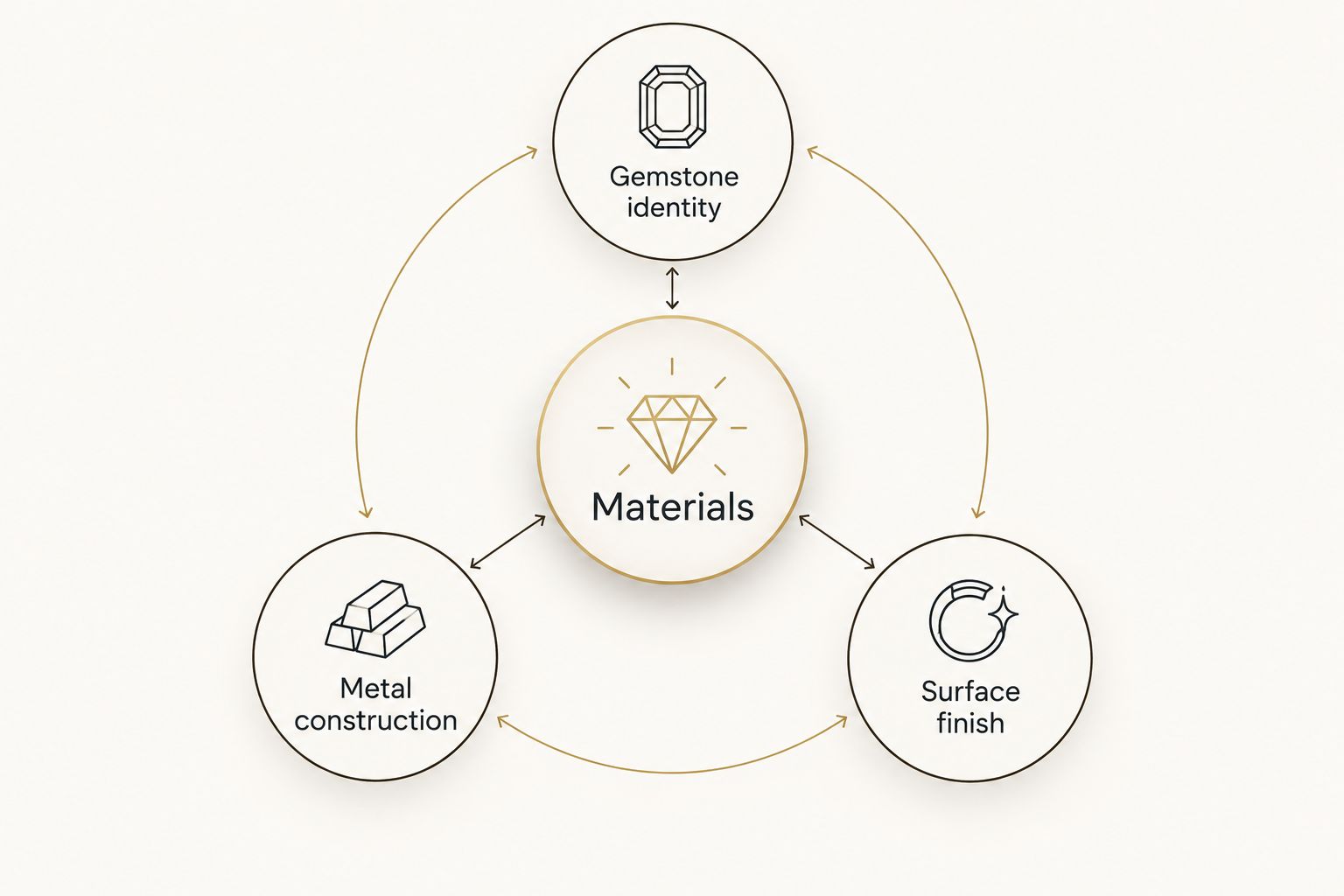
For a 2026 purchase, read the material description as carefully as the photographs. Start with the gemstone, then the metal, then the construction.
Lab-grown diamond is diamond; moissanite is silicon carbide. Both can be laboratory-created, but they are not chemically identical. A product described only as having lab-created stones needs a more specific gemstone identification before it belongs on a diamond shortlist.
Lumina Jewelry Co. describes its range using lab-created VVS1 stones, sterling silver, and 18k gold vermeil. Confirm those details for the individual item rather than applying a range-level description to every design.
Use these material checks:
- Sterling silver: The 925 designation represents 92.5% silver. It describes silver fineness, not a guarantee that a finished piece will suit every skin sensitivity.
- 18k gold: The designation represents 75% gold in the gold alloy. You still need to establish whether the item is solid gold or uses a gold layer over another metal.
- Clarity: A VVS1 label is not a gemstone identification or a complete description of appearance.
- Surface finish: Ask what sits against your skin, including any coating or plating, rather than relying on the color shown in a photograph.
A stamp is useful information, not the whole specification. Read it alongside the seller's written construction details.
Make the fit decision before checkout
Start with a pair you already find comfortable. Measure its visible face and compare its side profile with the proposed pair; this gives you a personal reference instead of an isolated product photograph.
Next, separate stone size from complete earring size. A halo adds a surrounding frame, while a bezel adds a metal rim. Neither should be judged using the center stone's measurements alone.
Then examine the closure. Ask how the backing attaches, whether the post has a threaded section, and what rests against the back of your lobe. A closure name alone does not establish comfort.
Finally, picture your actual routine: headphones, glasses, clothing changes, and handling the earrings with your fingers. Choose a design you can put on, remove, and inspect without struggling.
Do not choose the largest face-up footprint before checking the space and fit on your ear. Comfortable proportions beat a photograph that looks impressive only in close-up.
Keep everyday studs ready to wear
Inspect the settings while the earrings are off your ears. Look for bent metal, a visibly shifted stone, or a closure that no longer attaches as intended. Stop wearing a damaged pair until a jeweler checks it.
Follow the care instructions for the complete piece, including its metal finish and any other materials. Do not assume a cleaning method suitable for an uncoated diamond piece is suitable for every plated or mixed-material earring.
Store studs so they do not rub against other jewelry. Make inspection part of putting them away, rather than waiting for a snag to tell you something has changed.
How the styles were ranked
This 2026 ranking prioritizes a clear everyday use case, understandable construction, practical inspection, and the ability to assess fit. It does not rank retailers, claim hands-on testing, or treat an unspecified lab-created stone as diamond.
Round prong-set solitaires take the default slot for their simple single-stone design. Bezels, princess cuts, and halos earn separate recommendations for shoppers who specifically want a continuous rim, angular geometry, or a surrounding frame.
Which everyday studs should you choose?
Choose round prong-set solitaires if you want a straightforward starting point. Move to a bezel for its continuous border, princess cut for its square outline, or a halo for its decorative frame.
For Lumina Jewelry Co. shoppers, confirm the gemstone identity and metal construction on the individual item before comparing it with lab-grown diamond studs. Choose moissanite because you want moissanite—not because the words lab-created made two different gemstones sound interchangeable.
FAQ
What's the best style of lab grown diamond stud earrings for everyday wear?
Round prong-set solitaires are the default choice for a simple everyday look. Confirm the lab-grown diamond identity, setting profile, dimensions, and backing fit before buying.
Are moissanite studs the same as lab-grown diamond studs?
No. Moissanite is silicon carbide, while lab-grown diamond is diamond. Laboratory origin does not make different gemstones chemically identical.
Does VVS1 mean an earring contains a diamond?
No. VVS1 is a clarity designation, not gemstone identification. Read the specification that names the actual stone rather than treating the clarity label as proof of diamond.
Are bezel studs better than prong-set studs?
Bezel studs are better for shoppers who want a continuous metal border without exposed prong tips. Prong-set studs suit shoppers who prefer less metal around the stone's perimeter; neither setting name guarantees comfort.
Should I choose princess-cut studs for daily wear?
Choose princess-cut studs if you want a square outline and the setting protects the corners. Check the side views and corner coverage before deciding.
Does 18k gold mean an earring is solid gold?
The phrase 18k gold alone does not establish the complete construction. Confirm whether the item is solid gold or has a gold layer over another metal.
How do I compare the size of diamond stud earrings?
Compare the complete face-up dimensions and check whether the stated carat weight covers each stone or the pair. For halos and bezels, the center stone's measurements do not describe the whole earring.
Can I leave diamond stud earrings in all the time?
Do not treat everyday wear as permission to skip removal, cleaning, or inspection. Follow the care instructions for the complete earring and check the setting and closure regularly.
One last thing
Ask for a photograph of the back before deciding from the front. The front shows the style; the back reveals the post position, basket, and closure you will actually wear against your ear.