Best lab grown diamond stud earrings for everyday wear 2026

The best lab grown diamond stud earrings for everyday wear must identify the stones as diamonds—not just lab-created gems. For moissanite alternatives, Six-Prong Solitaire Studs are the default pick, Round Halo Studs suit a framed round look, and Princess-Cut Studs suit clean angles; none is a lab-grown diamond recommendation.
- Lab grown diamond stud earrings contain diamond; Lumina Jewelry Co.’s featured studs contain moissanite, a different gemstone.
- Six-Prong Solitaire Studs are the default moissanite alternative for shoppers who want a single-stone design.
- Round Halo Studs suit a framed round look; Princess-Cut Studs suit an angular silhouette.
- Verify stone identity, metal construction, dimensions, and earring backs before choosing everyday studs.
Why this matters
Lab-created describes origin, not gemstone identity. A lab-grown diamond is diamond. Moissanite is silicon carbide, a different material with its own optical properties. Both belong in a jewelry comparison, but they do not belong under the same product label.
For your 2026 purchase, settle that distinction before comparing sparkle or settings. Lumina Jewelry Co.’s featured stud descriptions explicitly identify moissanite. Choose these earrings because you want moissanite—not because you expect a diamond under another name.
Start with your routine, too. The guide to choosing moissanite stud earrings for everyday wear addresses the right buying question: which details suit the way you actually wear earrings?
What makes the best everyday stud earrings?
Use these criteria before looking at the shortlist. A familiar silhouette is not enough; the listing must tell you what you are buying.
- Stone identity: Look for the actual gemstone name. “Lab-created,” “brilliant,” and a clarity label do not establish that a stone is diamond.
- Metal construction: Distinguish sterling silver, gold vermeil, and solid gold. Gold color alone proves none of them.
- Setting design: Compare solitaire, halo, and angular baskets by the appearance you want, then inspect how the setting holds the stone.
- Wearable proportions: Check face dimensions, setting height, and post length rather than judging scale from an isolated product photograph.
- Back fit: Confirm the fastening type and whether it sits comfortably without squeezing the lobe.
- Care access: Consider whether you want one center stone or a design with accent settings that require more detailed cleaning.
Reject unclear material descriptions before ranking appearance. That rule applies equally to a diamond purchase and a moissanite purchase.
Everyday moissanite alternatives at a glance
This 2026 shortlist ranks moissanite designs by use case. It does not rank verified lab-grown diamond products or claim that one gemstone substitutes for another in composition.
| Item | Best for | Standout feature | Key limitation |
|---|---|---|---|
| Six-Prong Solitaire Studs | A straightforward single-stone look | Brilliant-cut moissanite in a six-prong crown basket | Not a diamond; confirm metal construction and dimensions |
| Round Halo Studs | A round center with an accent-stone border | Round-cut moissanite surrounded by pavé stones | More setting detail to clean than a solitaire |
| Princess-Cut Studs | A clean, angular silhouette | Princess-cut moissanite in a four-prong basket | Corner protection needs close inspection |
The shortlist answers three different style needs. It does not establish which pair feels lightest, sits lowest, or fits your ears best; those decisions require the selected pair’s dimensions and fastening details.
1. Six-Prong Solitaire Studs: best for a single-stone everyday look
Six-Prong Solitaire Studs hold a brilliant-cut moissanite in a six-prong crown basket. The design centers attention on one stone rather than surrounding it with a halo or cluster.
Lumina Jewelry Co.’s Six-Prong Solitaire Studs are the best moissanite alternative here for shoppers who want a straightforward single-stone look. Start with this design if your goal is one repeat-wear pair rather than a decorative motif.
Six-Prong Solitaire Studs pros
- A single center stone gives the design a clear focal point.
- The six-prong crown basket is explicitly identified in the product description.
- The solitaire format avoids the additional accent-stone settings of a halo.
Six-Prong Solitaire Studs cons
- The stone is moissanite, not lab-grown diamond.
- The supplied description does not establish the selected pair’s metal construction, dimensions, or back type.
Best for: You want a recognizable solitaire outline and prefer the center stone to do the visual work.
Before choosing, inspect a side view. Six prongs describe the setting layout; they do not tell you how far the basket projects from your ear or how the back fits behind it. Check those details separately, particularly if you wear headphones or regularly change earrings during the day.
Verdict: Buy as a moissanite alternative if you want a single-stone design; skip if diamond identity is essential.
2. Round Halo Studs: best for a framed round silhouette
Round Halo Studs place a round-cut moissanite inside a continuous halo of pavé stones. The product description identifies 925 sterling silver or 18k gold vermeil construction.
Choose this design for the border, not because a halo guarantees a particular on-ear size. The center stone and surrounding accents create the outline together, so compare the total face measurement before deciding whether the pair suits your everyday style.
Round Halo Studs pros
- A round center and continuous halo create a clearly framed shape.
- The description names the metal construction options rather than merely describing a color.
- Pavé accents add visual detail around the center moissanite.
Round Halo Studs cons
- Accent settings introduce more small areas to inspect and clean.
- Gold vermeil is not solid gold; the distinction matters when planning care.
Best for: You want a circular stud with an accent-stone border rather than a plain solitaire.
For a 2026 comparison, write down the full metal description beside the style name. “18k gold vermeil” describes different construction from “solid 18k gold.” Do not shorten both to “gold earrings” and assume they are equivalent.
Check the halo’s outer edge in close-up photographs as well. You are choosing the whole face of the earring, not just the center stone, and the surrounding settings are part of its appearance and upkeep.
Verdict: Buy for the round halo design; skip if you want the simplest setting to inspect and clean.
3. Princess-Cut Studs: best for an angular everyday silhouette
Princess-Cut Studs feature hand-set princess-cut moissanite in a four-prong basket. Their description specifies 925 sterling silver or 18k gold vermeil.
The main reason to choose this pair is shape. A princess cut gives you a square, angular outline rather than the circular face of round studs; it is a distinct style choice, not an upgrade in gemstone identity.
Princess-Cut Studs pros
- The princess-cut center creates a clean, angular silhouette.
- The four-prong basket is identified in the description.
- Both the gemstone and metal construction options are explicitly named.
Princess-Cut Studs cons
- Pointed corners deserve close inspection for setting coverage and condition.
- The angular outline is not the right choice if you prefer a rounded stud.
Best for: You want a geometric single-stone look without a halo.
Inspect all four corners before wearing the pair. Look for consistent seating and prongs that meet the stone without visibly lifting away; a product photograph is not a substitute for checking the earrings you receive.
Do not infer comfort from the square outline alone. Basket height, post fit, and the back’s position still determine how the earring sits against your ear.
Verdict: Buy for the princess-cut shape; skip if rounded edges are your priority.
Compare the featured designs
These product cards collect the three moissanite alternatives discussed above. Choose the silhouette first, then verify the selected variant’s materials, measurements, and fastening details before ordering.


Read materials before choosing sparkle
Separate the buying decision into three checks: Stone identity, Metal construction, and Fit details. Read each independently; a clear answer about one does not settle the others.
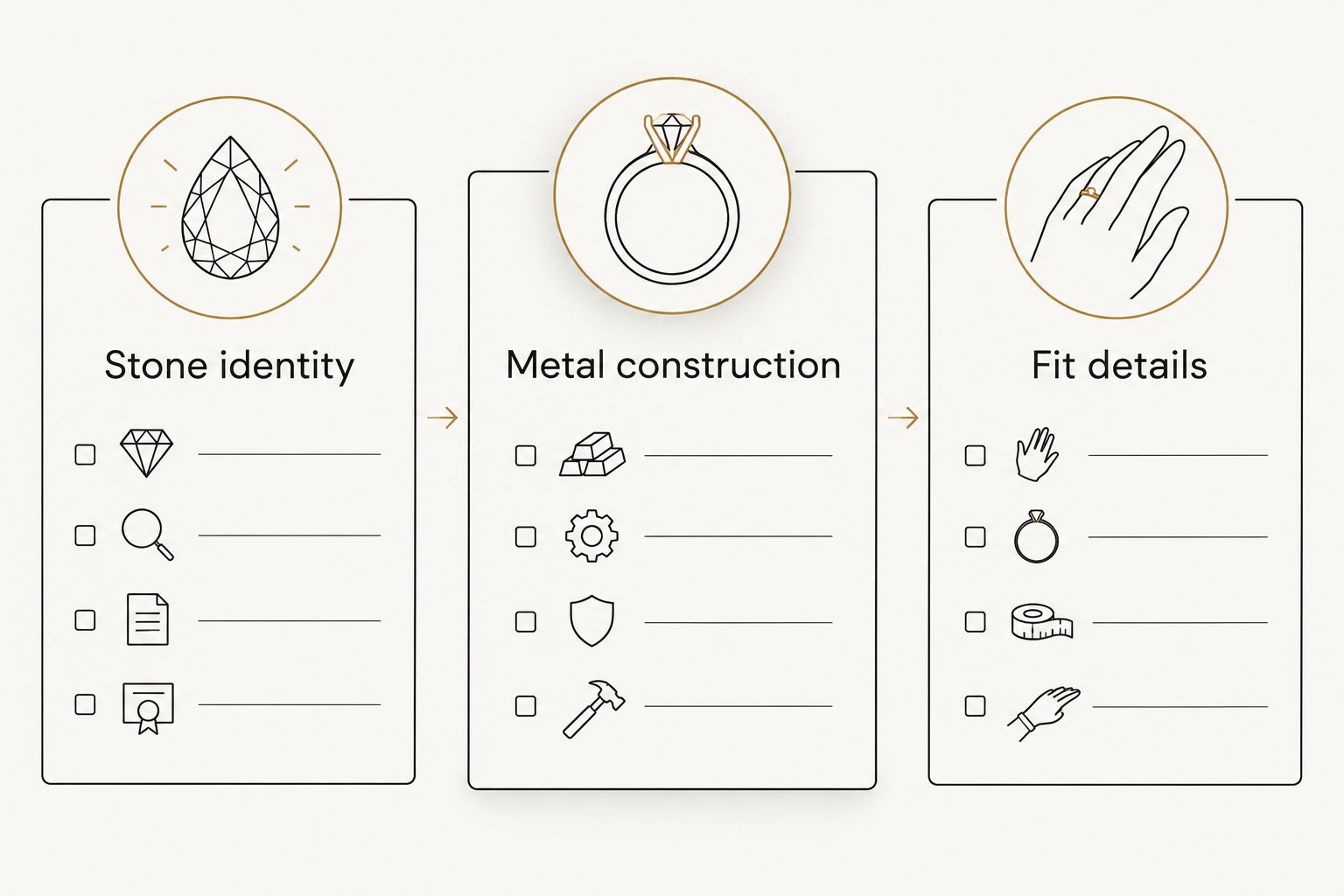
Stone identity
A lab-grown diamond has the same chemical composition and crystal structure as diamond formed underground. Moissanite is silicon carbide. The distinction remains true regardless of how either stone is cut or described in a listing.
A clarity label such as VVS1 does not identify the gemstone. Read the material name first, then consider clarity information within that context. Likewise, a tester response is not a substitute for reliable gemstone identification.
Metal construction
925 sterling silver contains 92.5% silver by mass. That mark describes an alloy standard, not a promise that every wearer will tolerate every finished earring.
Gold vermeil means gold applied over a sterling silver base, not solid gold throughout. For the Round Halo Studs and Princess-Cut Studs, retain the complete phrase “18k gold vermeil” when comparing options; the product descriptions support that construction, not a solid-gold claim.
Fit details
Check the earring face, basket profile, post, and back as separate components. A front-facing photograph tells you little about what sits behind your lobe.
For everyday use, fasten the pair without pressing the back tightly against your skin. Stop wearing earrings that cause pain or irritation, and address the cause rather than treating discomfort as something you must get used to.
A practical everyday-wear check
Before making your 2026 choice, picture an ordinary day rather than a dressed-up photograph. Consider glasses, headphones, hair, collars, and the way you put clothes on and take them off.
- Check contact points: Notice whether frames, ear cups, or clothing press against the basket or back.
- Inspect the setting: Look for lifted prongs, an unevenly seated stone, or a back that does not hold securely.
- Plan cleaning: Follow the care instructions for the complete piece, including its metal finish and accent settings.
- Choose storage: Keep earrings separated from other jewelry so settings and surfaces do not rub together.
For cleaning, prioritize access behind the center stone and around any halo. Avoid treating gemstone hardness as permission to use harsh chemicals or abrasive tools on the whole earring; the metal and construction need their own care.
Do not assume “everyday” means uninterrupted wear. Remove earrings when an activity puts pressure on them or exposes them to conditions their care instructions advise against.
How the shortlist is ranked
The ranking uses the stated gemstone, setting design, and verified metal descriptions. The default goes to the simplest visual format; the other selections serve distinct preferences for a halo or an angular center.
This is a specification-based buying guide, not a wear-test report. It does not rank the pairs by measured comfort, stone security, or durability. Lumina Jewelry Co.’s moissanite stud earrings remain alternatives to the diamond category named in the search—not evidence of a lab-grown diamond collection.
Which everyday stud earrings should you choose?
Choose Six-Prong Solitaire Studs if you want the default moissanite solitaire. Choose Round Halo Studs for a framed circular look, or Princess-Cut Studs when the square outline is the main attraction.
If your 2026 requirement is specifically lab grown diamond stud earrings, skip these moissanite alternatives. Continue with products explicitly identified as diamond and compare their documented stone details, metal construction, dimensions, and fastening type.
For a Lumina Jewelry Co. purchase, the decision is straightforward: buy the moissanite design you actually want. Do not let “lab-created” make the material decision for you.
FAQ
Are Lumina Jewelry Co. stud earrings lab-grown diamonds?
The featured Six-Prong Solitaire Studs, Round Halo Studs, and Princess-Cut Studs are described as moissanite, not lab-grown diamonds. Moissanite is a distinct gemstone.
What is the best everyday alternative to lab grown diamond stud earrings?
Six-Prong Solitaire Studs are the default moissanite alternative in this shortlist for a straightforward single-stone look. Choose them only if you want moissanite rather than diamond.
Is moissanite the same thing as lab-grown diamond?
No. Moissanite is silicon carbide, while lab-grown diamond is diamond; laboratory origin does not make the two materials identical.
Are halo studs better than solitaire studs for everyday wear?
Neither design is automatically better for everyday wear. A solitaire emphasizes one stone, while a halo adds an accent-stone border and more setting detail to inspect and clean.
Are the gold Round Halo Studs solid gold?
The supplied Round Halo Studs description identifies 18k gold vermeil, not solid gold. Read the selected variant’s complete metal description rather than relying on gold color.
Does VVS1 mean an earring contains diamond?
No. A clarity label does not establish gemstone identity; check whether the listing explicitly names diamond, moissanite, or another material.
What should I check before wearing stud earrings every day?
Check the setting, post fit, fastening, and contact with your daily accessories. Follow the care instructions for the complete earring, and stop wearing it if it causes pain or irritation.
One last thing
The back of a stud deserves as much attention as the front. A stone photograph cannot show whether the post length and fastening suit your ear, so make that check before committing to a daily pair.
Buy the material you intend to buy, then choose the shape you want to wear. That order prevents a good-looking moissanite earring from becoming the wrong purchase for someone who wanted diamond.