Best lab diamond tennis bracelets for everyday wear 2026

Best for a classic moissanite alternative: Lumina Jewelry Co.’s Tennis Bracelet. Best for pink-and-clear styling: the pink Tennis Bracelet; neither is a verified lab diamond tennis bracelet recommendation, so choose by the stated gemstone—not the sparkle alone.
- A lab diamond tennis bracelet contains laboratory-grown diamonds; moissanite is a different gemstone.
- Lumina Jewelry Co.’s Tennis Bracelet is the classic moissanite alternative, with individually set stones and four-prong settings.
- The pink Tennis Bracelet combines pink and clear stones; confirm gemstone identity before choosing it for materials.
- For everyday wear, prioritize documented metal construction, wrist fit, setting condition, and clasp operation.
Why this matters
A search for a lab diamond tennis bracelet in 2026 brings you to a material decision before a style decision. Laboratory-grown diamond and laboratory-created moissanite are not interchangeable names. Diamond is carbon; moissanite is silicon carbide.
Both belong in a jewelry comparison, but not under the same gemstone label. Buy moissanite because you want moissanite—not because a diamond-like appearance sounds like proof of diamond identity.
This guide separates the two bracelet options by their documented designs, then explains what to check before choosing an everyday piece. If laboratory-grown diamond is nonnegotiable, neither ranked option below satisfies that requirement on its stated specifications.
What makes the best everyday tennis bracelet?
Use these criteria for your 2026 shortlist. A bracelet should earn its place through clear materials and practical construction, not a photograph alone.
- Gemstone identity: Look for the actual stone name. Lab-created describes origin; it does not identify the gemstone.
- Metal construction: Separate sterling silver, solid gold, gold vermeil, and other plated construction. Gold color does not settle the question.
- Wrist fit: Compare the bracelet’s stated length with your wrist measurement and preferred movement.
- Setting condition: Inspect the prongs and links. A setting description does not replace checking the finished bracelet.
- Clasp operation: Confirm how the closure fastens, releases, and stays engaged during ordinary wrist movement.
- Daily practicality: Consider cuffs, keyboard work, watches, and the amount of maintenance you will actually do.
Everyday bracelet options at a glance
These are design-based alternatives, not a ranking of verified laboratory-grown diamond bracelets. The classic option has a stated moissanite identity; the pink option has a stated color arrangement without a specific gemstone identity in its description.
| Ranked option | Best for | Documented feature | Key limitation |
|---|---|---|---|
| Tennis Bracelet | A classic moissanite line | Individually set brilliant moissanite in four-prong settings | Moissanite is not laboratory-grown diamond |
| Pink tennis bracelet | Pink-and-clear everyday styling | Pink and clear round stones in a continuous prong-set line | The description does not identify the gemstone species |
Lumina Jewelry Co.’s Tennis Bracelet is best for shoppers seeking a classic moissanite tennis bracelet rather than a lab diamond tennis bracelet. That distinction is the buying verdict, not a footnote.
1. Tennis Bracelet: best for a classic moissanite alternative
The Tennis Bracelet uses brilliant moissanite in a classic four-prong setting, with each stone individually set. It gives you the repeated-stone format associated with a tennis bracelet while naming the gemstone directly.
Choose this design when a continuous line of moissanite is the look you want. Do not choose it to meet a laboratory-grown diamond requirement: the stone identity is different, regardless of how similar the jewelry looks at a glance.
Tennis Bracelet pros
- The description explicitly identifies the stones as moissanite.
- Individually set stones create the classic tennis-bracelet arrangement.
- Four prongs describe the setting structure clearly.
- The repeated design gives you a straightforward starting point for comparing stone size and wrist coverage.
Tennis Bracelet cons
- It is not a lab diamond tennis bracelet.
- Four-prong construction does not establish the clasp type or prove the fit will suit your wrist.
- The setting description alone does not establish the exact metal construction of every selectable version.
Best for: You want a classic moissanite bracelet for your everyday rotation and will check the selected version’s metal, length, and closure before ordering.
For your 2026 purchase, keep the gemstone decision separate from the fit decision. Knowing that the bracelet contains moissanite answers what the stones are; it does not answer how the bracelet will sit beside your wrist bone or under a sleeve.
Verdict: Buy for a classic moissanite look once the selected materials and fit meet your requirements; skip if you require laboratory-grown diamonds.
2. Pink Tennis Bracelet: best for pink-and-clear styling
The pink Tennis Bracelet combines pink and clear round stones in a continuous line of prong-set sparkle. Its distinguishing feature is the color combination, rather than a different bracelet category.
Choose this option because you want pink in your daily jewelry. Keep the gemstone decision open until you have an explicit material description; pink color and a tennis-bracelet shape do not identify what the stones are.
Pink Tennis Bracelet pros
- Pink and clear stones create a defined color contrast.
- Round stones keep the design within a familiar tennis-bracelet format.
- The description identifies a continuous prong-set arrangement.
Pink Tennis Bracelet cons
- The description does not specify the gemstone species.
- The color combination is less neutral than an all-clear stone arrangement.
- The design description does not establish metal construction, clasp design, or fit.
Best for: You want a pink-and-clear bracelet and are prepared to confirm the materials before deciding.
Do not read pink as a gemstone claim. A colored stone can belong to different gemstone categories, and appearance alone cannot establish which category applies to this bracelet.
Verdict: Hold until gemstone identity, metal construction, and sizing are confirmed; choose it for the pink-and-clear design, not an assumed diamond composition.
Compare the two designs
The classic bracelet is the direct choice when your requirement is explicitly moissanite. The pink bracelet is a style-led option that needs a material check before purchase. These cards show the products discussed above, not certified diamond alternatives.


Read the materials before judging the sparkle
For any lab diamond tennis bracelet you compare in 2026, keep the stone, metal, and setting descriptions separate. Each answers a different question. A clear answer in one category does not fill a gap in another.
- Stone identity: Laboratory-grown diamond and moissanite are different materials. Clarity terminology does not replace the gemstone name.
- Metal construction: Sterling silver contains 92.5% silver. An 18k gold alloy contains 18 parts gold out of 24, but the phrase alone does not establish whether a bracelet is solid gold or has a gold surface layer.
- Setting details: Prongs describe how a stone is held. They do not identify the stone or the metal.
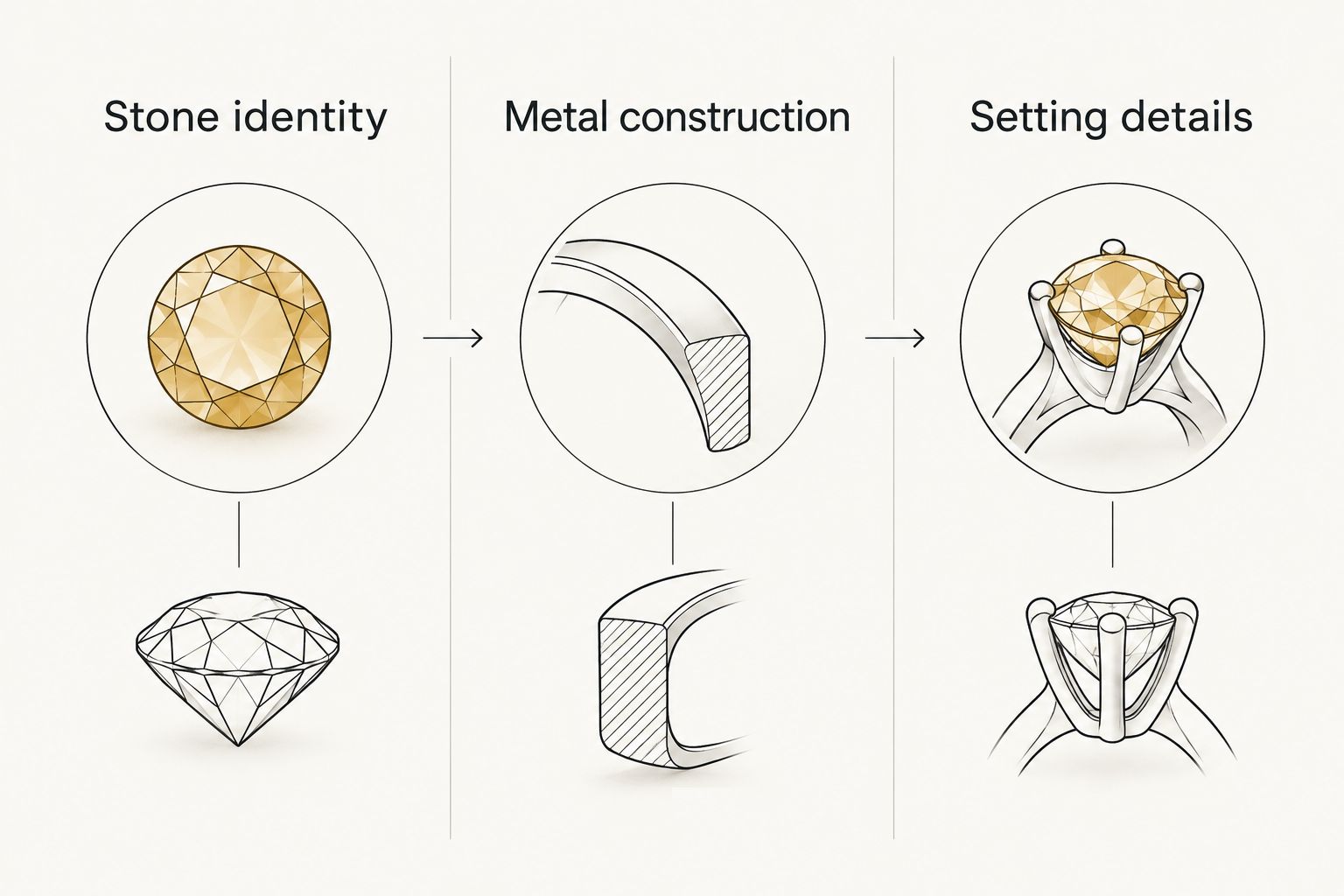
Lumina Jewelry Co. describes its broader collection using lab-created VVS1 stones, sterling silver, and 18k gold. Apply a product-specific standard anyway: collection language does not establish the construction of the bracelet version you select.
The same discipline applies to ethical claims. A laboratory-created stone description identifies origin, but it does not document every labor practice or environmental impact across a finished piece. Ask for specific supporting information when those factors drive your purchase.
Check everyday fit before committing
A good-looking bracelet still needs to work on your wrist. Measure with a flexible tape where you intend to wear it, then compare that measurement with the bracelet’s stated length and sizing instructions.
Do not turn a wrist measurement directly into an order without considering movement. You need room for the bracelet to articulate without having it travel farther along your hand than you want.
Use this sequence when trying on a bracelet:
- Check the resting position. Let your arm hang naturally and see where the bracelet settles.
- Move your wrist. Bend your wrist and make a fist without forcing the bracelet against your skin.
- Check your routine. Try the movements you use at a keyboard and with your usual sleeves.
- Inspect the closure. Fasten and release the clasp according to its instructions, then confirm that it engages fully.
Wear a watch during the try-on if that is your normal routine. Check whether the pieces contact each other; do not assume that two pieces fitting separately means they work together.
Choose the fit you can live with, not the tightest fit you can fasten. If the clasp is difficult to operate or the bracelet catches on a cuff, resolve that before making it your everyday piece.
Inspect the settings and plan the care
For a four-prong bracelet, look at the stone seats and prong positions under good light. You are checking for visible inconsistencies, lifted metal, or a stone that appears displaced—not trying to certify the workmanship yourself.
If you notice movement, a sharp catch, or a damaged link, stop wearing the bracelet and ask a qualified jeweler to inspect it. Do not bend prongs back with household tools. A small adjustment made without the right tools can create a different problem.
For care, follow the instructions for the complete bracelet, including its metal finish and any surface treatment. Gemstone durability alone does not establish whether a cleaning method is appropriate for the entire piece.
Remove the bracelet for tasks that expose it to impact, snagging, or cleaning chemicals. Store it separately so other jewelry does not rub against its settings. Everyday wear should mean regular enjoyment, not leaving the bracelet on through every activity.
How these options were ranked
The ranking prioritizes explicit gemstone identity, documented setting design, and a distinct use case. It does not claim a wear-test result, a laboratory assessment, or a comparison against currently verified competing diamond bracelets.
The classic Tennis Bracelet ranks first because its moissanite identity and four-prong construction are stated. The pink Tennis Bracelet takes the color-focused slot because its pink-and-clear arrangement is stated, while its gemstone identity still needs confirmation.
Which tennis bracelet should you choose?
Choose Lumina Jewelry Co.’s Tennis Bracelet if your goal is a classic moissanite line. It is the clearest match among these options for a shopper who has already chosen moissanite.
Choose the pink design only after its materials meet your requirements. If you want a lab diamond tennis bracelet in 2026, keep that requirement intact: look for a bracelet explicitly identified as containing laboratory-grown diamonds, with clear metal and sizing details.
Do not compromise on the material by accident. Changing your preference is a decision; confusing two gemstones is not.
FAQ
Is a moissanite tennis bracelet the same as a lab diamond tennis bracelet?
No. A moissanite tennis bracelet contains moissanite, while a lab diamond tennis bracelet contains laboratory-grown diamonds. Moissanite is silicon carbide; diamond is carbon.
Which Lumina Jewelry Co. bracelet is best for a classic everyday look?
The Tennis Bracelet is the best match here for a classic moissanite line. Its description specifies brilliant moissanite, individually set stones, and four-prong settings; confirm the selected metal, length, and closure before ordering.
Does VVS1 mean a bracelet contains diamonds?
No. VVS1 is clarity terminology, not a gemstone identity. Look for an explicit statement naming diamond or moissanite rather than treating a clarity label as proof of composition.
Are the pink Tennis Bracelet stones laboratory-grown diamonds?
The pink Tennis Bracelet description does not identify its stones as laboratory-grown diamonds. It describes pink and clear round stones in a prong-set line, so confirm gemstone identity before purchasing.
Does 18k gold always mean a solid gold bracelet?
No. The phrase 18k gold alone does not establish the construction of the whole bracelet. Check whether the specific piece is solid gold, gold vermeil, or another plated construction, including the base metal where applicable.
How should an everyday tennis bracelet fit?
An everyday tennis bracelet should allow comfortable wrist movement without traveling farther along your hand than you want. Compare your wrist measurement with the stated bracelet length, then check the fit with your usual sleeves and watch.
Can I wear a tennis bracelet all day and sleep in it?
Everyday wear does not mean every activity is suitable. Remove the bracelet for snagging, impact, or chemical exposure, and follow its care instructions rather than assuming that sleeping, showering, or exercise is appropriate.
One last thing
A tester result is not a complete gemstone identification. Some diamond testers measure thermal conductivity, and moissanite can trigger those devices. A demonstration alone does not turn moissanite into diamond.
For your 2026 purchase, save the exact gemstone description, metal construction, selected length, and care instructions alongside your order details. Those records are more useful than remembering that a bracelet looked bright on a screen.