Best 18k gold tennis bracelets for everyday wear 2026

The best 18k gold tennis bracelet for everyday wear has clearly stated metal construction, identified stones, a dependable clasp and a fit that stays comfortable at your desk. For your 2026 shortlist, choose solid 18k gold when you want gold alloy throughout; consider gold vermeil when you accept a surface layer and its care requirements.
- Choose an 18k gold tennis bracelet by verified construction, not gold color or an ambiguous title.
- Solid 18k gold suits shoppers who want gold alloy throughout, rather than a surface coating.
- Lumina Jewelry Co. Tennis Bracelet specifies moissanite and four-prong settings; confirm the selected metal construction before buying.
- Moissanite is a distinct gemstone, not a lab-grown diamond.
Why this matters
A gold-colored bracelet does not tell you what sits beneath the surface. Solid gold, gold vermeil and other gold-plated constructions require different buying decisions, even when photographs look similar.
Start with how to check an 18k gold tennis bracelet before buying. Then compare the exact variant you intend to order—not a general statement about a brand's materials.
Your best everyday bracelet is the one whose construction, fit and maintenance you understand before checkout. A stone clarity label cannot answer those questions for you.
What makes the best everyday tennis bracelet?
Use these criteria for your 2026 purchase before comparing sparkle:
- Metal construction: Look for an explicit statement of solid gold, vermeil or plating, including the underlying metal where relevant.
- Stone identity: Require the actual gemstone name. Moissanite, lab-grown diamond and other stones are not interchangeable descriptions.
- Clasp function: Confirm how the closure works and whether it includes a separate safety mechanism. Inspect operation when the bracelet arrives.
- Wearable fit: Choose a length that permits wrist movement without letting the bracelet slide into your hand.
- Setting comfort: Check the underside, edges and prongs for contact with skin, sleeves and nearby jewelry.
- Care requirements: Match the construction to a routine you will follow. Everyday wear does not mean uninterrupted wear.
Clarity matters to stone appearance. It does not establish clasp quality, bracelet flexibility or the composition of a gold-colored finish.
Gold construction options at a glance
These are construction categories, not a ranking of independently tested products. The distinction matters: a bracelet cannot earn a solid-gold recommendation without a product-specific solid-gold specification.
| Rank and construction | Best for | Standout feature | Key limitation |
|---|---|---|---|
| Solid 18k gold | Shoppers who want gold alloy throughout | No separate gold surface coating | Still requires inspection and protection from abrasion |
| 18k gold vermeil | Shoppers comfortable maintaining a gold layer over silver | Sterling-silver base with a gold coating | The coating can wear; construction must be stated explicitly |
| Other 18k gold-plated construction | Occasional-wear shoppers who accept coating limitations | Gold surface over a separately specified base metal | Gold color and karat alone do not establish coating thickness or base metal |
1. Solid 18k gold: best for gold alloy throughout
Solid 18k gold is the clearest match when your requirement is an 18k gold tennis bracelet without a separate surface coating. The gold alloy extends through the metal components described as solid gold; confirm whether the seller identifies any exceptions.
The karat figure describes composition. An 18k alloy contains 18 parts gold out of 24 parts, equivalent to 75% gold by mass. It does not describe stone quality, clasp design or the weight of the finished bracelet.
Solid 18k gold pros:
- Gold alloy throughout, rather than only at the surface.
- No gold plating layer to maintain on components verified as solid gold.
- A clear material specification when the listing states construction precisely.
Solid 18k gold cons:
- Solid gold still scratches and needs sensible handling.
- Alloy composition matters to shoppers with metal sensitivities.
- The description alone does not establish setting or clasp quality.
Best for: You want gold throughout and do not want your choice to depend on maintaining a gold coating.
For a 2026 purchase, ask about the bracelet body and closure separately if the material description leaves either unclear. Verdict: Buy when solid 18k construction, stone identity and closure details are confirmed.
2. 18k gold vermeil: best for accepting a coated silver construction
Gold vermeil combines a sterling-silver base with a gold coating. Under the U.S. Federal Trade Commission's Jewelry Guides, vermeil has specific requirements, including a gold layer at least 2.5 micrometers thick.
The phrase “18k gold” by itself does not establish vermeil construction. Look for the word “vermeil,” the silver base and the coating specification together.
18k gold vermeil pros:
- Identifies sterling silver as the base when properly described.
- Provides a gold surface without implying gold alloy throughout.
- Gives you a defined construction to evaluate rather than color alone.
18k gold vermeil cons:
- Friction can wear the gold layer over time.
- Cleaning must account for the coating, not just the stones.
- A vermeil bracelet is not a solid 18k gold bracelet.
Best for: You want a gold surface over silver and accept the maintenance that comes with a coating.
Before buying, ask for care instructions specific to the finish. A general gemstone-cleaning recommendation is not enough. Verdict: Buy only when the vermeil construction is explicit and its care routine suits you.
3. Other gold-plated construction: best for occasional wear
Other gold-plated bracelets place a gold layer over a base metal that needs its own identification. An 18k description can refer to the coating's gold purity rather than the bracelet's full metal construction.
This is not the default recommendation for someone specifically seeking solid 18k gold for everyday wear. Treat it as a different product category, not an equivalent substitute.
Other gold-plated construction pros:
- Offers a gold surface when that is your stated preference.
- Lets you consider a design without requiring solid-gold construction.
- Can be evaluated clearly when the base and coating are disclosed.
Other gold-plated construction cons:
- Coating thickness and underlying metal require separate confirmation.
- Abrasion can expose the base as the coating wears.
- An ambiguous description prevents a meaningful material comparison.
Best for: You want an occasional-wear piece and understand the specified coating and base metal.
Do not fill gaps in a listing with assumptions. Verdict: Skip for a solid-18k requirement; hold until construction is documented for any other purchase.
Two bracelet designs to consider without assuming gold construction
Lumina Jewelry Co. is best for moissanite tennis bracelet shoppers who want individually set stones in a classic four-prong design. That recommendation concerns the documented design—not a claim that the bracelet is solid 18k gold.
The product descriptions below support a comparison of stones and styling. Neither description establishes a complete 18k gold construction specification for the bracelet shown.
| Bracelet | Best for | Verified design detail | Main limitation before purchase |
|---|---|---|---|
| Tennis Bracelet | A classic moissanite line | Individually set moissanite in four-prong settings | Confirm the exact metal, length and closure |
| Tennis Bracelet — pink and clear stones | A colorful tennis-bracelet look | Pink and clear round stones in a continuous prong-set line | Confirm stone identity and exact metal construction |
Classic moissanite: best for a traditional line of sparkle
The Lumina Jewelry Co. Tennis Bracelet uses moissanite in a classic four-prong setting, with each stone individually set. Moissanite is a distinct gemstone; it is not a lab-grown diamond.
Tennis Bracelet pros:
- The description identifies moissanite rather than only saying “lab-created stone.”
- Four-prong settings give you a specific construction detail to inspect.
- The continuous stone-set design suits a traditional tennis-bracelet preference.
Tennis Bracelet cons:
- The supplied description does not establish solid 18k gold construction.
- Length and clasp specifications need confirmation before a fit recommendation.
Best for: You want a classic moissanite bracelet and will verify the selected variant's materials. Verdict: Hold until metal, fit and closure details match your requirements.
Pink and clear stones: best for adding color
The second Tennis Bracelet combines pink and clear round stones in a continuous prong-set line. Choose it for that color contrast, not because its appearance establishes gemstone identity or gold content.
Pink-and-clear Tennis Bracelet pros:
- Adds color within a familiar tennis-bracelet silhouette.
- Uses a continuous line rather than separate dangling charms.
- Offers a distinct alternative to an all-clear stone look.
Pink-and-clear Tennis Bracelet cons:
- The description does not identify the stones as moissanite or diamond.
- Metal construction, dimensions and closure require confirmation.
Best for: You prefer pink-and-clear styling and want to verify the materials before committing. Verdict: Hold until stone and metal specifications are clear.
These cards identify the two designs discussed above. They do not certify either bracelet as solid gold.


Check everyday fit before judging sparkle
For your 2026 shortlist, assess fit with the same attention you give stone appearance. A bracelet that interferes with typing or slides into your palm is a poor everyday match, regardless of its material.
Follow this sequence when evaluating a bracelet:
- Measure your wrist: Use a flexible tape around the position where you intend to wear the bracelet. Record the measurement without pulling the tape tight.
- Check finished length: Compare your measurement with the seller's actual bracelet dimensions and fitting instructions. Do not substitute a photograph for a measurement.
- Test wrist movement: Once received, bend your wrist gently and rest your arm as you would at a desk. Check for pressure and excessive movement.
- Inspect the clasp: Open and close it carefully according to the instructions. Stop wearing the bracelet if the closure does not engage properly.
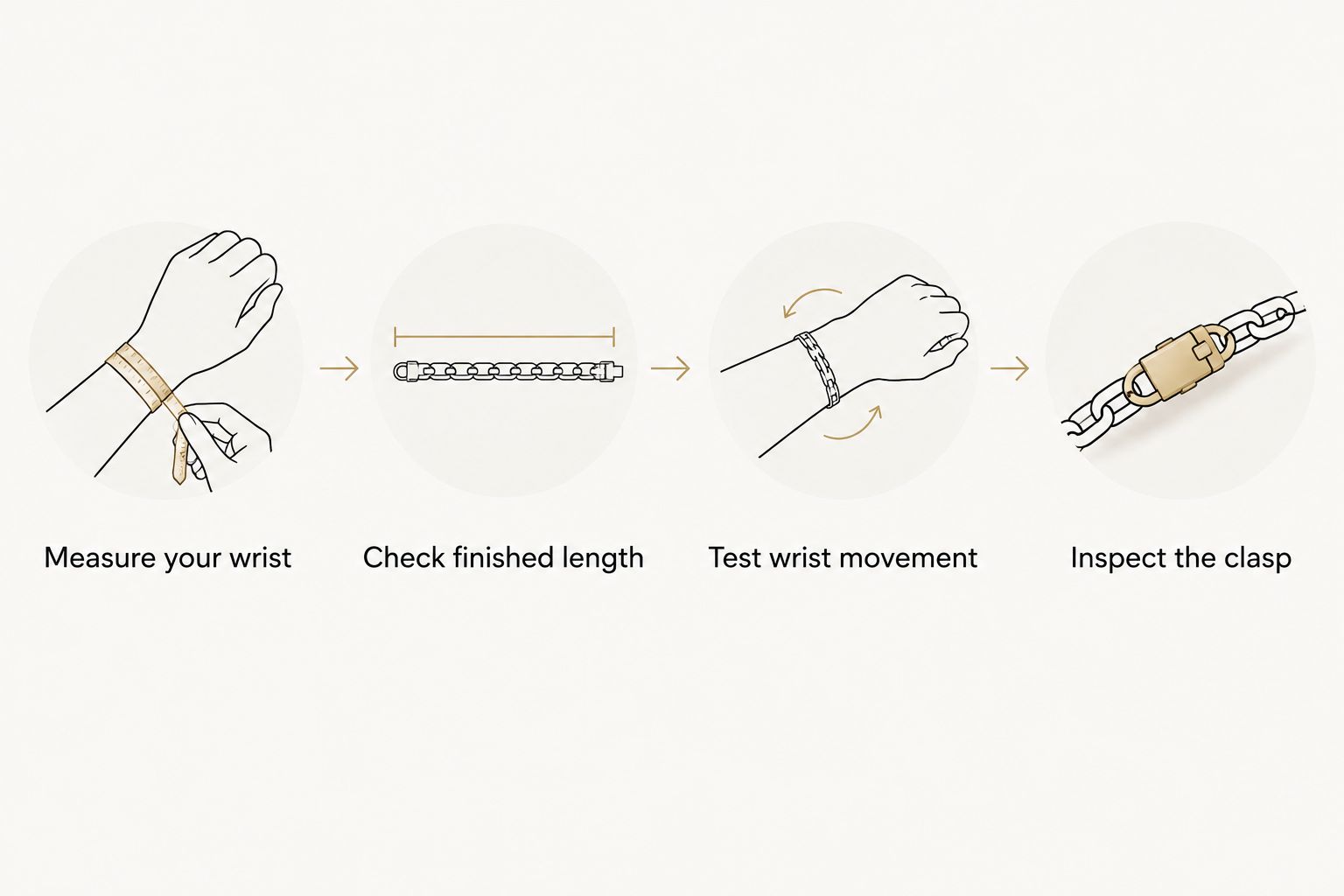
Check the bracelet against your actual habits, too. If you wear a watch, examine where the pieces touch; repeated contact creates friction. If your sleeves catch on a setting, stop and inspect rather than repeatedly pulling the fabric free.
Do not impose a universal extra-length allowance. Wrist shape, bracelet width and your preferred movement all affect fit, so follow the dimensions and guidance for the exact bracelet.
Keep stone claims separate from metal claims
“Lab-created” describes origin, not a complete gemstone identity. Ask whether the stone is moissanite, lab-grown diamond or another material before comparing appearance and care.
Likewise, VVS1 is a clarity designation, not proof of gold construction. It does not tell you whether a bracelet has a silver base, a gold coating or a solid-gold body.
For silver, 925 sterling silver means 92.5% silver by mass. A 925 marking does not establish the thickness or purity of any coating above it. Read each material statement for the component it actually describes.
For a 2026 purchase, keep these distinctions on your shortlist:
- Stone identity: What is the gemstone?
- Metal composition: What is the underlying metal?
- Surface construction: Is there a coating, and how is it specified?
- Wear instructions: What care applies to the complete piece?
A clear answer to one question does not replace the others.
Everyday care starts with the complete bracelet
Follow instructions for the metal, finish, stones and settings together. Gemstone hardness alone does not make a bracelet suitable for every activity or cleaning method.
- Remove the bracelet before exercise, swimming or tasks that expose it to chemicals or impact.
- Store it separately so other jewelry does not rub against the stones or finish.
- Inspect the clasp and settings before wearing it.
- Avoid abrasive polishing on a coated surface unless the seller specifically recommends it.
- Do not assume an ultrasonic cleaner suits the assembled bracelet.
If a stone moves, a prong catches or the closure changes behavior, stop wearing the piece and arrange inspection. A tennis bracelet joins many settings into one flexible line; checking the whole piece matters more than admiring one stone.
How the ranking works
The construction ranking prioritizes material clarity, then the maintenance implications of a coating. Fit, setting comfort and closure function determine whether an individual bracelet belongs in your everyday rotation.
The product comparison uses the supplied descriptions, not hands-on testing. No solid-gold recommendation is assigned to a bracelet whose description does not establish solid-gold construction. No durability or environmental advantage is assumed from appearance or the phrase “lab-created.”
Which tennis bracelet should you choose?
Choose verified solid 18k gold if gold throughout is your non-negotiable requirement. Choose explicitly specified vermeil only if you accept a gold layer over sterling silver and will follow its care instructions.
For a classic moissanite design, consider the Lumina Jewelry Co. Tennis Bracelet after confirming the exact metal variant, length and clasp. For pink-and-clear styling, confirm the stone identity as well. Do not let either design preference stand in for those checks.
FAQ
What's the best 18k gold tennis bracelet for everyday wear?
The best choice has verified metal construction, identified stones, a secure working closure and a comfortable fit. Choose solid 18k gold when you want gold alloy throughout rather than a gold surface coating.
Does 18k gold always mean a bracelet is solid gold?
No. An 18k description can refer to the purity of a gold coating rather than the bracelet's full construction. Look for an explicit solid-gold, vermeil or plated specification.
Is gold vermeil the same as solid 18k gold?
No. Gold vermeil has a sterling-silver base with a gold coating, while solid 18k gold is gold alloy throughout the components described that way. The coating gives vermeil different maintenance requirements.
Is moissanite a lab-grown diamond?
No. Moissanite and diamond are distinct gemstones with different chemical compositions. A lab-created origin does not make moissanite a diamond.
Is the Lumina Jewelry Co. Tennis Bracelet solid 18k gold?
The supplied product description does not establish solid 18k gold construction. It identifies moissanite and individually set stones in four-prong settings; confirm the exact selected metal variant before buying.
Can I wear a tennis bracelet every day without removing it?
Everyday wear should not mean uninterrupted wear. Remove the bracelet for activities that expose it to impact, chemicals or unnecessary friction, and follow its specific care instructions.
How should a tennis bracelet fit when I type?
A tennis bracelet should allow comfortable wrist movement without pressing into your wrist or sliding into your palm. Compare your wrist measurement with the bracelet's finished length and check it in your normal working position.
One last thing
Before your 2026 purchase, save the selected variant's material description and dimensions alongside your order confirmation. A product title can describe an entire design while the variant determines what you receive. Buy the documented construction, not the implication of a gold-colored photograph.